


DPP legislator Cho Jung-tai (卓榮泰) yesterday lashed out at new bills he says are guilty of the outdated idolization of political figures.
The central bank is to issue new NT$100 bills in July. Bills with the new face values of NT$200 and NT$2000 will be released in January and July 2002 respectively.
Sun Yat-sen, the Chinese revolutionary leader, will be portrayed on the new NT$100 bills as on the current NT$100 bill. The new NT$200 bills will feature the figure of Chiang Kai-shek (蔣介石), the KMT dictator and former ROC president.
Cho blasted the idea of using political figures on bills saying it was against the evolution of society.
"In today's modern world, we should not encourage political totems, which originate from feudal times," he said.
Cho said it is "tolerable" to see Sun on bills because "he is the only father of China." But he said that choosing Chiang's portrait for the new bill was unreasonable.
"Do we have to have all the presidents printed on our bills in the future? The decision [to have Chiang portrayed on the new bill] is solely to fulfil the requests of certain political powers," Chou said.
Cho said new bills are to be used for roughly two decades, "therefore, we should make use of the opportunity and abandon the outdated political concerns of authoritarianism."
The lawmaker said he has received complaints from a number of people, including staff of the central bank, about the new bills.
Other bills to be issued are designed to depict Taiwan's achievements in technology, education and conservation.
Wu Shaw-chii (
He said the adoption of both modern images of the country and also of portraits of political figures is "a compromise."
The central bank said the printing of the new bills has started and cannot be suspended as Cho suggested.
Cho also said it was inappropriate to issue the new NT$2000 bill, will become the highest value bill in circulation, because it may trigger inflation.
Cho claimed that the government's promotion of e-commerce would reduce the need for high-value bills, while holders of such bills would suffer greater losses in the event of a robbery.
Wu, however, said issuing the NT$2000 bills was a move to meet users' needs as well as being a global trend. "Currently, more NT$1000 bills are issued by far than all the other bills combined.
He also listed high-value bills of other countries to show consumer needs for higher-value bills. "US$100 is equivalent to over NT$3000; 500 French francs is over NT$2000; 1000 deutsche marks is about NT$15,000," he said.
"Taiwan's highest-value bill is only higher than that of Korea."
He said that only a small number of NT$2000 bills will be issued initially and will not cause inflation.
Certain revised bills issued last year featured subtle but significant changes and the modifications will be applied to other new bills.
Meanwhile the central bank -- the Central Bank of China (CBC) -- has replaced the Bank of Taiwan as the currency-issuing bank in order to make the New Taiwan Dollar the "national" currency.
The CBC had, since its establishment, issued bills for China. Taiwan suffered from serious inflation after the Nationalist withdrawal from the mainland in 1949. Therefore, the Nationalist government declared in the "Temporary provisions effective during the period of national mobilization for suppression of the communist rebellion" (
But when the provisions were made ineffective in 1991, the ROC lacked a legal national currency until last year, when the CBC replaced the Bank of Taiwan in issuing New Taiwan Dollar bills. In other words, the New Taiwan Dollar was upgraded to become the ROC currency.
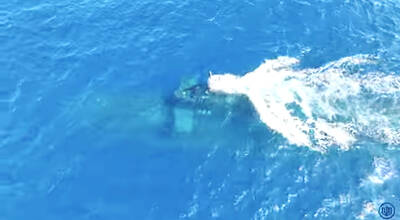
CSBC Corp, Taiwan (台灣國際造船) yesterday released the first video documenting the submerged sea trials of Taiwan’s indigenous defense submarine prototype, the Hai Kun (海鯤), or Narwhal, showing underwater navigation and the launch of countermeasures. The footage shows the vessel’s first dive, steering and control system tests, and the raising and lowering of the periscope and antenna masts. It offered a rare look at the progress in the submarine’s sea acceptance tests. The Hai Kun carried out its first shallow-water diving trial late last month and has since completed four submerged tests, CSBC said. The newly released video compiles images recorded from Jan. 29 to
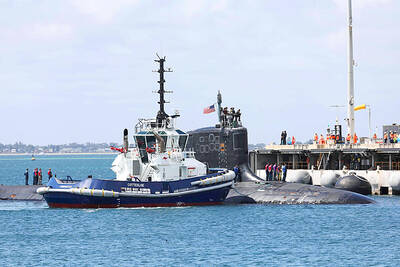
DETERRENCE EFFORTS: Washington and partners hope demonstrations of force would convince Beijing that military action against Taiwan would carry high costs The US is considering using HMAS Stirling in Western Australia as a forward base to strengthen its naval posture in a potential conflict with China, particularly over Taiwan, the Wall Street Journal reported on Saturday. As part of its Indo-Pacific strategy, Washington plans to deploy up to four nuclear-powered submarines at Stirling starting in 2027, providing a base near potential hot spots such as Taiwan and the South China Sea. The move also aims to enhance military integration with Pacific allies under the Australia-UK-US trilateral security partnership, the report said. Currently, US submarines operate from Guam, but the island could
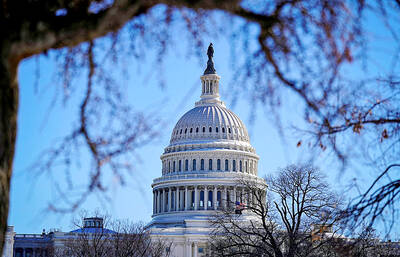
RESTRAINTS: Should China’s actions pose any threat to Taiwan’s security, economic or social systems, China would be excluded from major financial institutions, the bill says The US House of Representatives on Monday passed the PROTECT Taiwan Act, which states that Washington would exclude China from participating in major global financial organizations if its actions directly threaten Taiwan’s security. The bill, proposed by Republican Representative Frank Lucas, passed with 395 votes in favor and two against. It stipulates that if China’s actions pose any threat to Taiwan’s security, economic or social systems, the US would, “to the maximum extent practicable,” exclude Beijing from international financial institutions, including the G20, the Bank for International Settlements and the Financial Stability Board. The bill makes it clear that China must be prepared

Taiwanese trade negotiators told Washington that Taipei would not relocate 40 percent of its semiconductor production to the US, and that its most advanced technologies would remain in the nation, Vice Premier Cheng Li-chiun (鄭麗君) said on Sunday. “I told the US side very clearly — that’s impossible,” Cheng, who led the negotiation team, said in an interview that aired on Sunday night on Chinese Television System. Cheng was referring to remarks last month by US Secretary of Commerce Howard Lutnick, in which he said his goal was to bring 40 percent of Taiwan’s chip supply chain to the US Taiwan’s almost


 RSS
RSS