


The chairman of the Council of Agriculture, Chen Hsi-huang (陳希煌), yesterday announced a six-year plan to reduce the total number of betel nut trees on the island and put an end to the soil erosion caused by hillside planting.
"We have to do something because the planting of trees on mountain slopes is having a severely damaging effect on the environment. This was particularly evident after the 921 earthquake last year," Chen said during questioning at a Legislative Yuan Economic and Energy Committee meeting yesterday.
Betel nuts trees also consume large amounts of water. It is estimated that betel nut trees islandwide consume six billion tonnes of water each year.
Chen said the council's plan is to ban the planting of betel trees on mountainsides with a gradient of more than 30 degrees.
According to the council's latest survey, just over 19 percent of the 57,000 hectares of betel nut plantations are located on hillsides with slopes greater than 30 degrees, he said.
Chen said that they would help betel nut farmers switch to other occupations if the regulations forced them out of business.
As for farmers who plant betel nut trees in mountainous areas not covered by the new regulations, Chen said that officials would urge the farmers to plant some other kinds of trees.
Agricultural officials said that farmers who cooperated with the government's program would receive a subsidy for 20 years out of a pool of NT$530,000.
Legislators, however, said that this sum was only a drop in the ocean compared to the huge financial incentive behind the betel nut industry.
DPP legislator Ker Chien-ming (
"But this is not simply a health issue," Ker said. "We have to look at the issue from several angles. There are cultural, economic and agricultural aspects to the betel nut industry," he said, adding that two million consumers could not be ignored.
"How can you fight against a cash crop that generated an annual revenue of nearly NT$100 billion?" asked Ker.
He said that in all likelihood, the council's plan to crackdown on mountainside planting was an empty promise.
Chen admitted that the council faced a daunting task challenging betel nut growers -- considering that the seasonal price for a single betel nut can the same as the price of a dozen eggs.
Ironically, the high-profit industry is not limited to individual growers. The Taiwan Forestry Bureau (
DPP legislator Lin Feng-hsi (
Some legislators blamed the environmental problem on the council and its poor use of the funds it has available.
"Developing mountainous areas for tourism has done nothing to protect the environment," said KMT legislator Kao Yang-sheng (

A signaling system malfunction disrupted high-speed rail (HSR) services beginning at 8am today, with trains temporarily reduced to three northbound and three southbound trains per hour as authorities conduct inspections. The malfunction occurred on a section of track in Miaoli County during pre-operation checks early this morning, forcing northbound and southbound trains to use a single track, the HSR operator said. The regular schedule has been replaced with three hourly trains offering only nonreserved seating in each direction, stopping at every station, it said, adding that business class cars would still have reserved seating. Departures from terminal stations are scheduled at the top

Taiwan is still in the process of assessing the possibility of recruiting workers from Eswatini, the Ministry of Foreign Affairs said yesterday, adding that its goal is to help Eswatini upgrade its vocational training centers. If there are plans to recruit workers from Eswatini, safeguarding national security, protecting public health and ensuring the employment rights of Taiwanese would be prerequisites, Department of West Asian and African Affairs Director-General Yen Chia-liang (顏嘉良) told a news conference. Key considerations would also include filling labor shortages in specific industries, and fostering bilateral professional and technical exchanges, he said. Yen was asked about the progress of labor

VERBOSE VESSELS: A CGA cutter and a China Coast Guard exchanged verbal barbs for more than a day in Taiwanese-controlled waters before the Chinese vessel left The Taiwanese and Chinese coast guards had a standoff near the strategically located Pratas Islands (Dongsha Islands, 東沙群島) in the north of the South China Sea, the Coast Guard Administration (CGA) said yesterday. The two sides engaged in intense radio exchanges over sovereignty claims during the 33-hour standoff. China Coast Guard vessel 3501 eventually left the restricted waters, 26.6 nautical miles (49.2km) west of the Pratas Islands, at 5pm yesterday, the CGA said. Lying approximately between southern Taiwan and Hong Kong, the Taiwan-controlled Pratas are seen by some security experts as vulnerable to Chinese attack due to their distance — more than
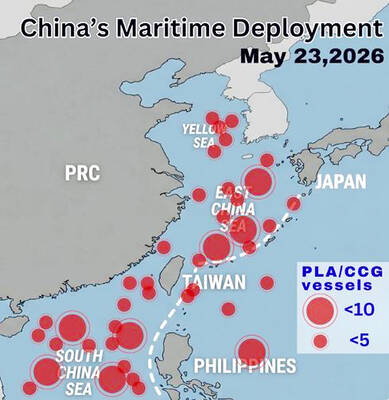
WARNING: China should stop engaging in actions that undermine regional peace and stability, as it would only build resentment among people across the Strait, the CGA said China has deployed more than 100 navy, coast guard and other vessels in waters from the Yellow Sea to the South China Sea and the western Pacific since US President Donald Trump and Chinese President Xi Jinping (習近平) met in Beijing, National Security Council Secretary-General Joseph Wu (吳釗燮) said yesterday. “In this part of the world, #China is the one & only PROBLEM wrecking the #StatusQuo & threatening regional peace & stability,” Wu wrote on X. In a separate post, he said Beijing was coercing Taiwan’s maritime domain, calling it illegal and provocative, after the Coast Guard Administration (CGA) expelled a


 RSS
RSS