


Taipei City Mayor Ma Ying-jeou (
However, it was a gesture that upset some city councilors even more.
"I apologize to the city's residents for causing council meeting delays," Ma said.
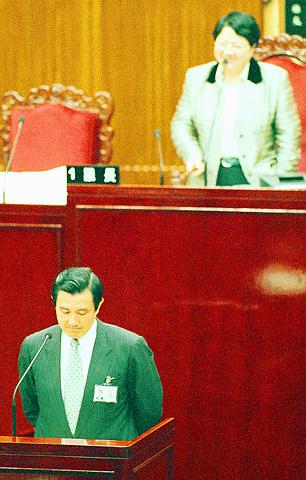
PHOTO: LIN CHENG-KUNG, LIBERTY TIMES
Following a demand reached by consensus over the weekend by council members, Ma yesterday was asked at a council meeting to apologize and give a thorough explanation for his absence from an April 12 meeting.
They demanded he make the apology before delivering a report detailing, among other things, his handling of recent protests outside the KMT's headquarters.
KMT supporters gathered outside the building on March 18, almost as soon as the election result showed the KMT's defeat, demanding that Lee Teng-hui (李登輝) step down as party chairman.
Ma appeared at the scene and sang patriotic songs with the crowd during the demonstration, which, according to the law, should not have been allowed to continue.
He was also due yesterday to discuss the city's new garbage collection fee program and policy toward high school entrance examinations after their abolishment.
Ma explained that his absence on April 12 was necessary to complete his report, so that it would "meet the high expectations of the council."
He also requested that in the future, if such reports were not urgently needed, the council should allow more time for their preparation.
Even so, many councilors said they were still "dissatisfied" with the explanation and questioned the sincerity of his apology.
The disagreement between the mayor and the council began on April 11, when it notified Ma to present a report the following morning.
Ma failed to show up at the April 12 council meeting, but reportedly phoned to say he would be able to make it later in the afternoon. His written report on the protest incident was not delivered to the council until the following evening.
Ma's absence, in addition to what councilors said was a marked similarity between Ma's report and the police report police issued on April 6, led to fierce criticism in the council.
Eventually, Ma's spokesman. King Pu-tsung (金浦聰), was forced to hold a press conference on April 12 in an attempt to clear things up.
King said Ma made two phone calls to the council speaker, Wu Pi-chu (
King's remarks prompted Wu to accuse the city government of "lying" and "framing" her, claiming Ma had not contacted her at all.
As for why his report so closely resembled that of the police, Ma blamed city staff for being "careless about the packaging of the report," adding it had in fact been edited four times by him personally, extending it to 31 pages from the original 27.
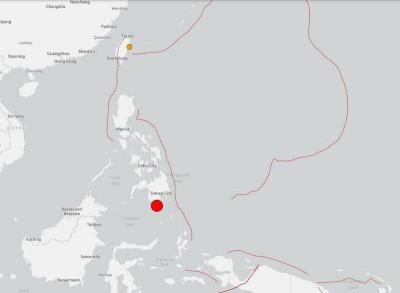
A magnitude 7.8 earthquake struck off the southern coast of Mindanao in the Philippines at 7:38am today, prompting the US Tsunami Warning System to issue an alert for neighboring countries, including Taiwan. The system issued a purple alert indicating a "tsunami threat." The potential threat zone includes Taiwan, the Philippines, Papua New Guinea, Yap and Palau. Philippine authorities were assessing the damage from the quake, with the office of civil defense seeking to verifying initial reports that 15 people had been killed and 129 injured in the region, mostly from falling debris. Arlene Hollero, disaster chief of Maasim town in the Philippines' Sarangani Province,
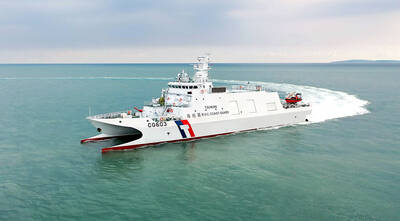
‘GRAY ZONE’ PRESSURE: Beijing’s activities are intended to create the deceitful impression that China has jurisdiction over the area around Taiwan, the CGA said Taiwan’s rights over its territorial waters and exclusive economic zone must not be violated by any country, the Mainland Affairs Council said yesterday, adding that it will not accept any unprovoked actions. The council issued the remarks in response to the China Coast Guard conducting maritime enforcement drills near eastern Taiwan and claiming to fully exercise China’s maritime administrative law enforcement authority. The Coast Guard Administration (CGA) has been closely monitoring the situation and is taking concrete steps to defend the nation’s sovereignty and secure its waters, the council said. China has no sovereign rights over the waters off eastern
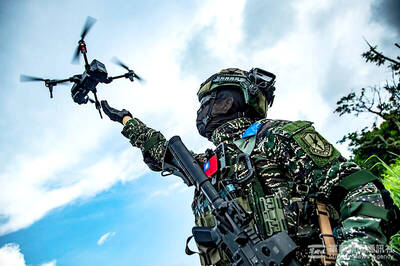
RESILIENCE: Taiwan plays a key role in semiconductors, energy, information infrastructure and advanced manufacturing, AIT Director Raymond Greene said Taiwan’s continued investment in deterrence and resilience remains vital, especially in uncrewed systems and other emerging technologies, American Institute in Taiwan (AIT) Director Raymond Greene said yesterday. Greene made the remarks at the annual National Strategic Summit on Supply Chain Resilience held by the Research Institute for Democracy, Society and Emerging Technology (DSET), a government-backed think tank. As Taiwan last year became the US’ fourth-largest trading partner and supply chain security is becoming more important, cooperation in emerging technologies continues to deepen between the two countries, he said. The US is committed to accelerating innovation, building key infrastructure, strengthening cooperation

RIGHT DIRECTION: Taiwan’s efforts to prevent forced labor include a proposal to ‘fully prohibit’ employers from withholding workers’ documents, an official said Taiwan is to establish a mechanism to restrict imports of goods linked to forced labor, the Executive Yuan said yesterday, after the US proposed imposing additional tariffs on Taiwanese goods over labor concerns. “The Ministry of Labor and the Ministry of Economic Affairs are to establish an interministerial review procedure,” Executive Yuan spokesperson Michelle Lee (李慧芝) said at a news briefing in Taipei. “The government is to use the Foreign Trade Act [貿易法] as the legal basis to restrict imports of goods produced with forced labor” and bring its supply chain governance more in line with international standards on human rights, resilience


 RSS
RSS