


Education Minister Kirby Yung (
To attain this goal, the most urgent need is to incorporate pre-schools into the formal educational system, Yung told a group of private kindergarten managers from around the island.
"It is our hope to achieve a 100-percent enrollment rate," Yung said.
Official statistics show that 520,000 children aged between four and six years old -- about 80 percent of children in this age bracket -- attend kindergartens or nurseries.
However, there are wide local differences. While the enrollment rate in Liangchiang County is already 100 percent, the percentage in some densely populated localities still remains low. For example, the enrollment rate is only 49.2 percent in Taipei County and 35 percent in Taichung County.
Yung said his ministry will work out a timetable with local governments concerned to have a sufficient number of kindergartens set up. He said the ministry will also help subsidize the cost.
Under a preliminary plan, Yung said, kindergartens will be permitted to be set up on the premises of all government-funded schools. The kindergartens will be run by the private sector.
"This can decrease the costs for private kindergartens and reduce the tuition fees," Yung said.
Also, the ministry will subsidize existing private kindergartens to help them upgrade their teaching quality, Yung added.
Of the children attending kindergartens, 70 percent are in private kindergartens. Of those going to nurseries, 55 percent are in private nurseries, statistics show.
Parents sending their children to private kindergartens usually need to spend between NT$70,000 and NT$100,000 per year, which is at least triple the average cost per pupil at public kindergartens. The ministry has announced it will issue education vouchers worth NT$10,000 per year per person for children between five and six years old who are studying in private kindergartens or nurseries, starting September this year.
Yung said the government hopes to offer pre-school education free of charge or at least have the tuition fees reduced.
"Free of charge doesn't necessarily mean compulsory," Yung said. "Furthermore, since some parents may prefer educating their children at home, we doubt the necessity of making pre-school compulsory," he added.
In another effort that is also related to the quality of private kindergartens, the ministry is working on plans to set up a benefit system for kindergarten teachers and to help unlicensed teachers obtain qualifications, Yung said.
Meanwhile, the ministry will encourage local governments to experiment on the so-called "nursery schools," which are for children up to eight years old.
According to the ministry's plan, nursery schools will offer pre-school courses and courses of the first two years of elementary school.
Michael Tseng (
"It is a major change for children to go from kindergartens to elementary schools. While the teaching in kindergartens involve a lot of playing, children are taught to obey rules in elementary schools," said Tseng, who was executive secretary of the ad hoc Educational Reform Evaluation Committee set up by the Executive Yuan from 1994 and 1996.
Tseng said the idea of nursery schools has already been tested in foreign countries such as the United States.
Tseng explained that the existence of nursery schools will offer children two alternatives: to enter an elementary school immediately after pre-school or stay in nursery schools until they become more mature and can better adjust to elementary school life.
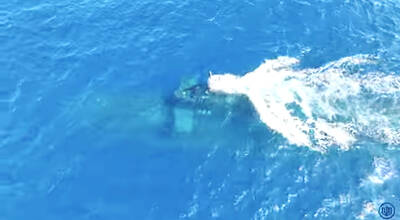
CSBC Corp, Taiwan (台灣國際造船) yesterday released the first video documenting the submerged sea trials of Taiwan’s indigenous defense submarine prototype, the Hai Kun (海鯤), or Narwhal, showing underwater navigation and the launch of countermeasures. The footage shows the vessel’s first dive, steering and control system tests, and the raising and lowering of the periscope and antenna masts. It offered a rare look at the progress in the submarine’s sea acceptance tests. The Hai Kun carried out its first shallow-water diving trial late last month and has since completed four submerged tests, CSBC said. The newly released video compiles images recorded from Jan. 29 to
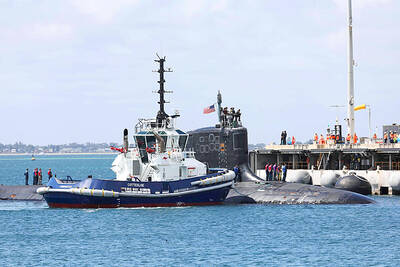
DETERRENCE EFFORTS: Washington and partners hope demonstrations of force would convince Beijing that military action against Taiwan would carry high costs The US is considering using HMAS Stirling in Western Australia as a forward base to strengthen its naval posture in a potential conflict with China, particularly over Taiwan, the Wall Street Journal reported on Saturday. As part of its Indo-Pacific strategy, Washington plans to deploy up to four nuclear-powered submarines at Stirling starting in 2027, providing a base near potential hot spots such as Taiwan and the South China Sea. The move also aims to enhance military integration with Pacific allies under the Australia-UK-US trilateral security partnership, the report said. Currently, US submarines operate from Guam, but the island could

RESTRAINTS: Should China’s actions pose any threat to Taiwan’s security, economic or social systems, China would be excluded from major financial institutions, the bill says The US House of Representatives on Monday passed the PROTECT Taiwan Act, which states that Washington would exclude China from participating in major global financial organizations if its actions directly threaten Taiwan’s security. The bill, proposed by Republican Representative Frank Lucas, passed with 395 votes in favor and two against. It stipulates that if China’s actions pose any threat to Taiwan’s security, economic or social systems, the US would, “to the maximum extent practicable,” exclude Beijing from international financial institutions, including the G20, the Bank for International Settlements and the Financial Stability Board. The bill makes it clear that China must be prepared

Taiwanese trade negotiators told Washington that Taipei would not relocate 40 percent of its semiconductor production to the US, and that its most advanced technologies would remain in the nation, Vice Premier Cheng Li-chiun (鄭麗君) said on Sunday. “I told the US side very clearly — that’s impossible,” Cheng, who led the negotiation team, said in an interview that aired on Sunday night on Chinese Television System. Cheng was referring to remarks last month by US Secretary of Commerce Howard Lutnick, in which he said his goal was to bring 40 percent of Taiwan’s chip supply chain to the US Taiwan’s almost


 RSS
RSS