


A potential row between the New Party and its presidential candidate, Li Ao (李敖), which could have taken the party out of the presidential race, appeared to be averted yesterday after the party announced that legislator Elmer Fung (馮滬祥) would be Li's running mate.
"Our presidential ticket has been officially decided, and we are now launching our challenge," announced Lee Ching-hua (
The decision ended speculation that Li -- who is not a New Party member himself -- might quit the campaign over what he had said was the party's reluctance to cooperate with him over the issue.
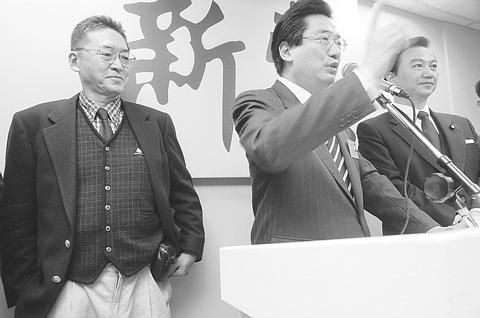
PHOTO: CHEN CHENG-CHANG, TAIPEI TIMES
Li, who has refused to join the New Party despite representing the party in the campaign, initially had three favored choices -- Lee, former DPP spokeswoman Sisy Chen (
While Lee and Chang turned down the offer, the choice of Chen met with strong opposition within the party due to her ideological differences.
After Lee said the New Party might be forced to quit the presidential campaign, Fung offered to be Li's running mate.
Li agreed to accept Fung if the party recommended him officially.
Yesterday, Lee admitted that Fung was in fact on a list of 14 people whom he had proposed to Li as candidates, but that Fung had not been shortlisted.
Li did not explain why he had not considered Fung initially, though he apparently is aware of the controversy surrounding him.
"Fung is a very handsome and knowledgeable man, but he is also much misunderstood -- being suspected of having too close a relationship with the People's Republic of China," Li said.
Fung, who leads a private group promoting unification between Taiwan and China, has made frequent visits to Beijing and has met with senior Communist officials.
Fung explained that the fact he has kept close contact with Beijing does not mean he is "pro-Chinese communists" or supports "hasty unification."
"The Cold War is over and confrontation should be replaced with negotiation," Fung said. Fung, who was a National Assembly deputy before being elected a legislator, worked as secretary to the late President Chiang Ching-kuo (
Fung allegedly played a part in the KMT-sponsored suppression of academic freedom at National Taiwan University in 1973, now known as the "philosophy department incident."
In 1985, Fung also sued a magazine headed by Chen Shui-bian (
Chen was sentenced to one year in jail, and ordered to pay Fung NT$2 million. The verdict, which appeared to mix elements of a criminal trial with civil responsibility, was allegedly the result of political interference.

‘UNFRIENDLY’: Changing the nationality listing of Taiwanese residents to ‘China’ goes against EU foreign policy as well as democratic and human rights principles, MOFA said Taiwan yesterday called on Denmark to correct its designation of the nationality of Taiwanese residents as “China” or face retaliatory measures. The Danish government in 2024 changed the nationality of Taiwanese citizens on their residence permits from “Taiwan” to “China.” The decision goes against EU foreign policy and contravenes democratic and human rights principles, Ministry of Foreign Affairs (MOFA) spokesman Hsiao Kuang-wei (蕭光偉) said. Denmark should present a solution acceptable to Taiwan as soon as possible and correct the erroneous designation to preserve the longstanding friendship between the two nations, Hsiao said. The issue could damage Denmark’s image and business reputation in Taiwan,

KEY INDUSTRY: The vice premier discussed a plan to create a non-red drone supply chain by next year, which has been allocated a budget of more than NT$7.2 billion The government has budgeted NT$44.2 billion (US$1.38 billion) to cultivate Taiwan’s uncrewed aerial vehicle (UAV) industry over the next five years, which would make the nation a major player in the industry’s democratic supply chain in the Asia-Pacific region, Premier Cho Jung-tai (卓榮泰) said yesterday. Cho made the remarks during a visit to the facilities of Cub Elecparts Inc (為升電裝). Democratic Progressive Party (DPP) Legislator Chen Su-yueh (陳素月) and Chinese Nationalist Party (KMT) Legislator Hsieh Yi-fong (謝依鳳) also participated in the trip. Cub Elecparts has transitioned from the automotive industry to the defense industry, which is the top priority among the nation’s
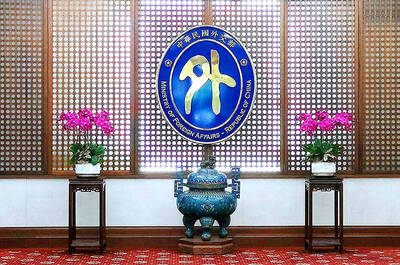
SOUTH KOREA DISPUTE: If Seoul continues to ignore its request, Taiwan would change South Korea’s designation on its arrival cards, the foreign ministry said If South Korea does not reply appropriately to a request to correct Taiwan’s name on its e-Arrival card system before March 31, the government would take corresponding measures to change how South Korea is labeled on the online Taiwan Arrival Card system, the Ministry of Foreign Affairs said yesterday. South Korea’s e-Arrival card system lists Taiwan as “China (Taiwan)” in the “point of departure” and “next destination” fields. Taipei has asked Seoul to change the wording. Since March 1, South Koreans who hold government-issued Alien Resident Certificates (ARC) have been identified as from “South Korea” rather than the “Republic of Korea,” the
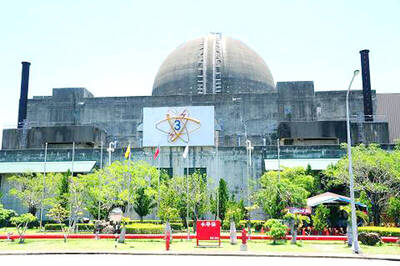
SUFFICIENT: The president said Taiwan has enough oil for next month, with reserves covering more than 100 days and natural gas enough for 12 to 14 days A restart plan for the Guosheng Nuclear Power Plant in New Taipei City’s Wanli District (萬里) and the Ma-anshan Nuclear Power Plant in Pingtung County’s Hengchun Township (恆春) would be submitted to the Nuclear Safety Commission by the end of the month, President William Lai (賴清德) said yesterday, reversing the government’s policy to abolish nuclear energy. On May 17 last year, Taiwan shut down its last nuclear reactor and became the first non-nuclear nation in East Asia, fulfilling the Democratic Progressive Party (DPP) government’s pledge of a “nuclear-free homeland.” Even without nuclear power, Taiwan can maintain a stable electricity supply until 2032,


 RSS
RSS