


A Taiwanese company has provoked an angry response because of an advertising campaign using large subway billboards featuring a cartoon figure of a smiling Adolf Hitler. The advertisements are for German-made electric space heaters.
Israeli and German culture and trade officials in Taipei said yesterday they were appalled by the ad.
The maker of the space heaters, DBK, based in the southwest German city of Kandel, said it would order an immediate halt to the campaign.
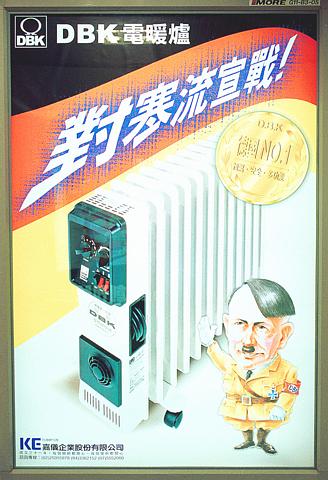
The ad shows Hitler in a khaki uniform and black jackboots, his right arm raised high in a Nazi salute. Above him is a slogan that says "Declare war on the cold front!"
There are no swastikas in the ad, but the Hitler figure wears a red arm band on his left arm with a white circle bearing the German manufacturer's name.
Shen Yu-shan (
"We decided to use Hitler because as soon as you see him, you think of Germany. It leaves a deep impression," said Shen, who works in the company's planning and design department.
Shen said the company had not been worried that the public would have a negative reaction to an ad that features a man who oversaw the killing of millions of Jews during World War II.
"Most people in Taiwan are not that sensitive about Hitler," she said.
Shen could not say whether the German firm had been informed about the contents of the ad.
"As always, we do our promotion planning independently and we report what we have done to DBK afterwards," she said in a press statement.
At DBK headquarters in Kandel, executive director Hans-Hermann Alfers said the company had first heard about the ad on Friday.
Alfers said the company's managers were not immediately sure who was behind the ad, but they will order an immediate stop to the campaign.
Uri Gutman of the Israel Economic and Cultural Office in Taipei said the advertisement was "unbelievable."
He feared using Hitler's image in such ads would make Nazi atrocities during World War II seem less real.
"It supports the denial of the Holocaust," said Gutman, referring to fringe theories that the Nazis did not kill Jews.
German officials in Taiwan also objected to the ad.
"We are not happy about this, this is not an appropriate way to make an advertisement," said Dr Hilmar Kaht, director general of the German Trade Office in Taipei , yesterday.
Kaht said while the intention of the ad is to tell consumers that the space heater is a German product, which he does not object to, he added that: "They should not use any political advertisement, especially not from Nazi times ... It creates a negative image of Germany and legitimizes the crimes of the Nazi regime by playing it down."
"Such an ad would be forbidden in Germany," Kaht said.
Patricia Kortmann of the German Cultural Center in Taipei was dismayed by the ad and doubted a German firm would approve it.
"It sounds too absurd to me that a German company would agree to such an advertising strategy," Kortmann said.
Johannes Goeth of the German Trade Office in Taipei also doubted that the manufacturer knew about the ad beforehand. He said the trade office faxed DBK a letter two weeks ago telling it about the ad but had yet to receive a reply.
Both Kortmann and Goeth said the advertisement didn't surprise them because they often encounter Taiwanese who admire Hitler and lack a deep understanding of European history.
"Taxi drivers will often tell me Hitler was a great man, very strong," Goeth said.

‘NO SECURITY RISK’: The Railway Bureau reassured the public that the technicians’ activities were limited to technical guidance and did not involve sensitive systems The Railway Bureau yesterday said it had invited eight Chinese technicians to assist with an airport MRT construction project. The bureau issued the confirmation after an Internet user said Chinese nationals had entered the construction zone of Taiwan Taoyuan International Airport’s Terminal 3 project. They asked why “individuals from an enemy state” were allowed access to such a major national infrastructure project, which raised serious concerns over Taiwan’s industrial safety, sensitive systems and information security. The bureau’s Northern Region Engineering Branch Office said subcontractor Taiwan Handle Industrial Co (台灣手把工業) of the Taoyuan airport MRT’s “Contract No. CU05 Project A14 Station Civil, MEP &

A US uncrewed surface vessel (USV) encountered multiple Chinese warships during an autonomous transit of the Taiwan Strait, US defense company Seasats said in a statement on Wednesday. Seasats announced that a Lightfish USV had completed the first autonomous transit of the Taiwan Strait. Over five days, the USV traversed the entire length of the Strait while constantly monitoring surface vessel traffic, the company said. The Lightfish encountered multiple Chinese warships, one of which was a Chinese People’s Liberation Army Navy (PLAN) Type 056 corvette, it said. The Chinese vessels were operating “well within Taiwan’s exclusive economic zone without transmitting their identity via the

Taiwan is still in the process of assessing the possibility of recruiting workers from Eswatini, the Ministry of Foreign Affairs said yesterday, adding that its goal is to help Eswatini upgrade its vocational training centers. If there are plans to recruit workers from Eswatini, safeguarding national security, protecting public health and ensuring the employment rights of Taiwanese would be prerequisites, Department of West Asian and African Affairs Director-General Yen Chia-liang (顏嘉良) told a news conference. Key considerations would also include filling labor shortages in specific industries, and fostering bilateral professional and technical exchanges, he said. Yen was asked about the progress of labor
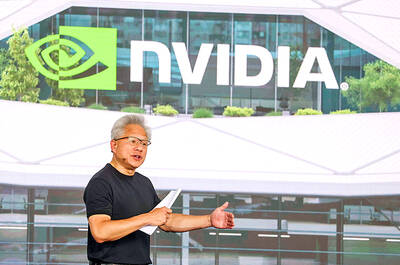
‘BOOMING’: ’ The number of partners we have here is incredible. You can see from their stock prices. They’re doing so well, they’re so happy,’ Jensen Huang said Nvidia Corp’s spending in Taiwan has ballooned to about US$150 billion a year, 10 times the US$10 billion to US$15 billion the company spent five years ago, Nvidia chief executive officer Jensen Huang (黃仁勳) said yesterday, suggesting Taiwan’s strategic importance in the global artificial intelligence (AI) supply chain. “Taiwan is the epicenter of the AI revolution. This is where the chips come, packaging comes. This is where the systems are made. This is where AI supercomputers were created,” Huang said at a meeting for the company’s employees in Beitou-Shilin Technology Park (北投士林科技園區) in Taipei, the planned site of Nvidia’s Taipei headquarters. “Taiwan


 RSS
RSS