


A man surnamed Huang, wearing just thin clothing, arranged to meet up with some friends on Kaohsiung’s Cishan to forage for mushrooms. However, after his friends failed to turn up, Huang became lost in the unfamiliar terrain. Stranded on the mountain for seven days, Huang had to rely on just a cigarette lighter for making fires and drank water from streams to stay alive. During the ordeal, Huang was petrified when he chanced upon two Formosan black bears accompanied by a cub. Eventually, Huang was able to find his way off the mountain to safety by following a stream. Search and rescue workers pronounced Huang’s lucky escape a “miracle.”
However, despite Huang’s good fortune in escaping with his life intact, following questioning, police have charged Huang for violating the Forestry Act. Huang stated he climbed the mountain to forage for mushrooms and no forbidden articles were found in his possession.
While following a stream, Huang noticed there were two Formosan black bears and a cub drinking water from the stream on the opposite bank. Huang was immediately concerned he would be attacked but the bears, which Huang believes may have mistaken him for a hunter, after a while retreated into the forest and disappeared.
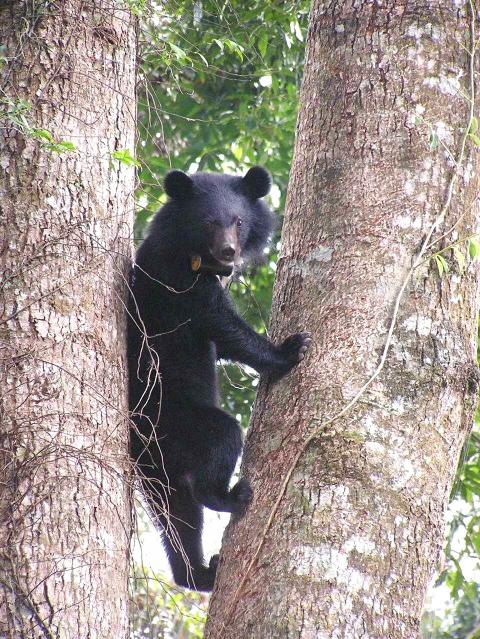
Photo courtesy of Yushan National Park headquarters
照片:玉山國家公園管理處提供
According to the director of National Pingtung University of Science and Technology’s Institute of Wildlife Conservation Hwang Mei-hsiu, Formosan black bears will not normally attack a human if unprovoked and says members of the public should not feel unduly concerned if they come across a Formosan black bear. When a female bear is accompanied by a cub, Hwang says she will be even more cautious and unless her cub’s safety is threatened during an extreme situation, she will normally take the first opportunity to remove her cub from danger. As for Huang’s situation, separated by the stream, Hwang says he did not need to worry.
(LIBERTY TIMES, TRANSLATED BY EDWARD JONES)
僅著單薄衣物的高雄市旗山黃姓男子,和友人相約上山採牛樟菇,卻在山上被友人「放鳥」,因不熟悉地形迷蹤七天,僅靠著打火機生火取暖及喝溪水求生,期間一度撞見兩隻台灣黑熊帶著幼熊,驚嚇不已,最後自行沿著溪流走出山區脫困,搜救人員直呼是「奇蹟」。
黃男幸運活著下山,不過他和警方對談時,說出是要上山採牛樟菇,雖然警方沒有在他身上發現違法或禁採物品,但仍將他依違反森林法罪嫌函送法辦。
沿溪而走時,他發現河對岸有兩隻台灣黑熊帶著幼熊到溪邊喝水,一度擔心黑熊會過河攻擊他,但黑熊可能以為他是獵人,不一會兒自行逃進山林內消失。
國立屏東科技大學野生動物保育研究所所長黃美秀表示,一般來說,台灣黑熊不會主動攻擊人,民眾若遇到不要太緊張。母熊在帶著小熊的情況下,會更加謹慎小心,除非遇到緊急情況讓小熊安全受到威脅,否則母熊通常會在第一時間馬上把小熊帶離。和黑熊之間隔著河的這種情況,可以不必擔心。
(自由時報)

The US-Israeli war with Iran, which began on Feb. 28, has killed thousands of people, destabilized the Middle East and rocked global energy markets by effectively closing the strait. WHAT IS THE STRAIT OF HORMUZ? Lying between Oman and Iran and linking the Gulf north of it with the Gulf of Oman to the south and the Arabian Sea beyond, the strait is 33km wide at its narrowest point, with a shipping lane just 3km wide in either direction. Perhaps the world’s most important energy shipping channel, the waterway is about 167km long. Following through on an old threat, Tehran effectively closed the strait

Have you ever found yourself desperately feeding coins into a claw machine just because you’ve already spent so much trying to win that stuffed animal? Or maybe you’ve continued watching a boring movie simply because you already paid for the ticket? If so, you’ve experienced the “sunk cost fallacy.” A sunk cost refers to time, money or effort that has already been spent and cannot be recovered. This psychological trap is surprisingly common. You might keep playing a video game you no longer enjoy because you’ve invested countless hours in building your character, or maintain a toxic friendship because you’ve known

A: Which TV drama series have been global hits so far this year? B: The US drama “Stranger Things 5,” South Korean drama “Can This Love Be Translated?” and Chinese megahit “Pursuit of Jade” are all popular lately. A: Isn’t “Pursuit of Jade” the costume idol drama about the romance between a charming marquis and a pig-slaughterer? Actor Zhang Linghe and actress Tian Xiwei are both so attractive. B: Plus, Netflix’s Korean-Japanese gay romance drama “Soul Mate” — starring Korea’s Ok Taec-yeon and Japan’s Hayato Isomura — is set to premiere in May. A: These hit international dramas

1. 他甚至還自認為是個了不起的領導人。 ˇ He even went so far as to think himself a great leader. ˇ He even went so far as to think of himself as a great leader. χ He even went so far as to think himself as a great leader. 註:認為某人或某事為何等樣人或何等樣事,可用 think+受詞+受詞補語,或 think of ... as ...,正句第一句比第二句普遍些。用了 of,後面用 as;沒有 of,就不可以用 as。又如: I thought him quite a joke. I thought of him as quite a joke. 2. 你不應該打擾他休息。 ˇ You should not intrude upon him during his time off. χ You should not intrude him during his time off. 註:intrude 作「闖進」、「打擾」、「侵入」解時,是不及物動詞,後面跟 upon。 3. 男孩正在玩陀螺。 ˇ The boy is playing with his top. χ


 RSS
RSS