


Green Party Taiwan Taoyuan City Councilor Xavier Wang has posted a picture of a dirty pillow on Facebook, saying that it was a military pillow shot by a friend of his when he was serving his short-term reserve training duty at the Armor Training Command And Armor School in Hsinchu County’s Hukou Township. The picture has provoked heated discussions among netizens. Having just offered help in a case involving Jian Chih-lung, a rookie soldier in a military police training center in Taoyuan who was infected with Leptospirosis and died as a result of sepsis, Wang asked, “How can rookie soldiers avoid getting sick in an environments of this sanitary standard? What’s the matter with the military?”
A netizen commented that, “when I did my military service in the past it was this filthy.” Others said that, “Items for the short-term reserve training are kept for years in a warehouse” and that “Filthy is normal. If they give you brand new stuff, then something really is wrong.” Someone else asked, “Do you expect to be welcome as if you were at a five star hotel? You are here to fulfill your military duty, not to take a vacation.” However, one also said, “Pathetic. So many people take it for granted and think that it is normal for soldiers to use filthy and defective things.” They think the public should stop regarding abnormalities as the normal state of affairs and stop taking unreasonable things for granted if they want the military to make improvements.
(Liberty Times, translated by Ethan Zhan)
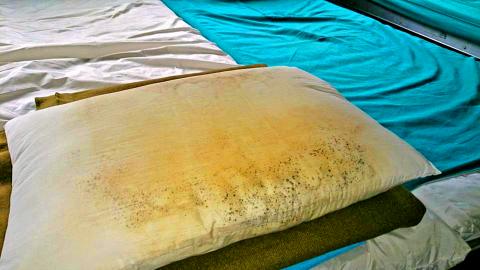
Photo from Xavier Wang’s Facebook profile
照片取材自王浩宇臉書
綠黨桃園市議員王浩宇在臉書貼出一張髒枕頭的照片,指出是朋友到新竹湖口裝甲兵學校教召時所拍下的國軍枕頭,引起網友熱議。才剛協助處理桃園市憲兵訓練中心新兵簡志龍感染「細鉤端螺旋體病」導致敗血症不治的案例,他感慨質疑:「如此衛生環境,新兵怎麼可能不生病?國軍,你怎麼了?」
有網友留言「以前當兵都這樣髒髒臭臭的」,「教召的物品都是長年放在倉庫的」, 「有髒兮兮這正常的,全新的給你才有鬼」,「不然要像住五星級飯店歡迎住宿嗎?進來當兵不是進來度假的」。不過也有網友認為「好慘,大家都把軍人使用髒東西、爛東西視為理所當然和正常。」他們認為不應該把不正常視為正常,也不該把不合理視為理所當然,才能夠慢慢地改進讓軍隊更好。
Photo: Chien Jung-fong, Taipei Times
照片:自由時報記者簡榮豐攝
(自由時報記者李容萍)

You might think knitting is only for grandmas, but surprisingly, many young people are embracing so-called “grandma hobbies.” On social media platforms, activities such as home cooking, embroidery and gardening are becoming popular among teenagers and young adults who are drawn to their relaxing and creative nature. “Grandma hobbies” typically refer to activities that are slow-paced, handmade and nostalgic. Common examples include knitting scarves, baking cookies, sewing clothes and growing plants. These hobbies were once part of everyday life for many women in previous generations, but today they provide an escape from the fast-paced digital world. The appeal

A: Isn’t the 2026 Coachella Valley Music and Arts Festival — a massive music event held every April — about to open in California? B: Yeah the festival is set to take place over two weekends, from April 10 to 12 and 17 to 19, US time. A: I heard this year’s main stage headliners include Sabrina Carpenter, Justin Bieber, Karol G and EDM DJ Anyma. B: The K-pop army is also making an appearance, with legendary group BigBang, SHINee member Taemin and girl group Katseye debuting for the first time. A: Isn’t Coachella also live-streamed on its YouTube

A: Several Japanese and South Korean acts, such as BigBang, are participating in this year’s Coachella Music Festival. Have any Mando-pop singers ever performed at Coachella? B: Yup, K-pop group GOT7’s Hong Kong member Jackson Wang, and Taiwanese band Sunset Rollercoaster, which primarily performs in English, attended the festival before. A: It’s a pity that we didn’t fly to Coachella. But in fact, Taipei has also gradually become an Asian music hub in recent years. B: That’s true. K-pop sensation Twice just held three concerts at the Taipei Dome, followed by Hong Kong singer G.E.M., who is going

Concertgoers know the rush all too well — the moment the first notes play, your heart races, and nothing else seems to matter. For many, the excitement doesn’t end when the lights come back on. Some fans try to relive the performance by listening to the same songs for days afterward. __1__ A few days after an amazing show, they begin to feel unexpectedly low. Psychologists have coined a term for this phenomenon: “post-concert depression,” or “PCD.” PCD is primarily related to hormone levels. When you’re at a concert, the excitement causes your brain to release feel-good chemicals like


 RSS
RSS