


“Umbrella boy” Wang Chun-sheng and “cauliflower girl” Yen Ching-yu are two talented youths from the Changhua branch of the Taiwan Fund for Children and Families. They studied diligently and have made a success of life in their own ways.
Yen’s father was a farmer whose livelihood depended on cauliflowers. When Yen was in senior high school, her father got cancer, so she often had to get up early in the morning to help carry cauliflowers on the farm. After her father passed away, her mother worked in a hardware store so that she could raise three children on her own. Yen was the oldest child, and she was and the best tutor her younger brother and sister could have. Yen’s family and friends advised her to go to Taiwan Police College so that she could help lighten the financial burden on her family. Fortunately, her aunt supported her dream of going to university, otherwise she could not have done so. Now she has passed the entrance examination to study in the Department of Computer Science at National Tsinghua University.
After graduating from the Department of Business Administration at Fujen Catholic University, Wang helped his friend, an umbrella maker, to set up a counter in a department store. Wang says that when he was in college he got seriously ill from doing a part-time job, and this led him to realize that he had to find the value and meaning of his life to avoid getting lost in the material world of money. He used to receive support from the fund, and now that he is able, he wants to be a volunteer to give something back to society.
(Liberty Times, Translated By Ethan Zhan)
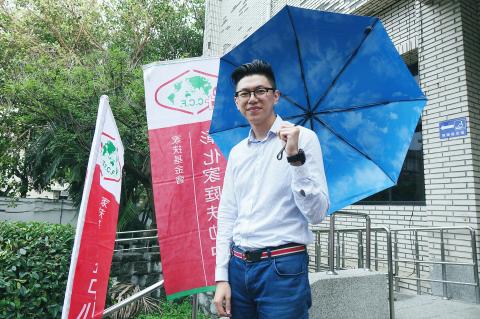
Photo: Liu Hsiao-hsin, Liberty Times
照片:自由時報記者劉曉欣
「雨傘男孩」王俊升與「花椰菜女孩」顏慶妤,兩位彰化家扶中心的家扶兒好棒棒,靠著努力求學,走出自己一片天。
顏慶妤的父親務農,以種植花椰菜為生,然而顏慶妤高中時,父親罹癌,因此她一清早就要到田裡搬忙搬花椰菜。父親過世後,母親在五金行工作,獨立將三個孩子拉拔長大。慶妤是老大,也是弟弟妹妹的最佳小老師。本來親友都建議她去念警專減輕家計,還好有阿姨支持她的大學夢,才得以上大學。如今她已考取清大資工研究所。
王俊升在輔大企管系畢業後,就協助自製雨傘的朋友在百貨公司設櫃。王俊升說,他曾在大學期間為了打工而生場大病,因此發現:必須找到自己生命的價值與定位,才不會迷失在物質金錢的世界。以前受惠於家扶,如今有能力,他要當志工回饋社會。
(自由時報記者劉曉欣)

Photo: Liu Hsiao-hsin, Liberty Times
照片:自由時報記者劉曉欣
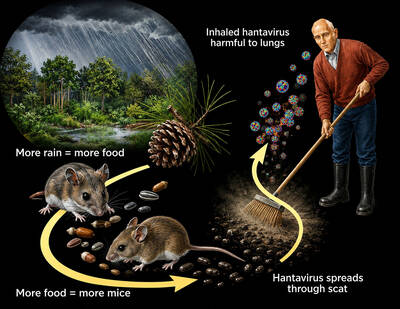
An outbreak aboard a cruise ship of a rare rodent-borne illness called hantavirus has left three passengers dead and sickened others, but global health officials say the risk to the general public remains low because the germ does not easily spread between people. “This is not the next COVID, but it is a serious infectious disease,” said Maria Van Kerkhove, director of epidemic and pandemic preparedness at the World Health Organization (WHO). “Most people will never be exposed to this.” The virus usually spreads when people inhale contaminated residue of rodent droppings. Hantaviruses have been around for centuries and are thought to

Have you ever wondered how people navigate the world when they can’t see a map? For individuals with visual impairments, conventional maps are nearly impossible to use. This is where tactile maps come in — essential tools that allow people to “see” the world through touch. A tactile map is specially designed with raised lines, textures, and symbols to represent geographical features such as roads, rivers, and buildings. Users explore it with their fingertips. However, these maps are not exclusively for people with visual disabilities. They serve as valuable multisensory learning tools that enhance spatial understanding for everyone, making

A: In early May, there were concerts by Icyball, Chyi Yu, Korea’s EXO and Japan’s Anisama, but I missed them all. What a shame. B: That’s OK. There are shows coming up by various artists, including Power Station, Accusefive, Japanese singer Mika Nakashima, Chinese-Icelandic jazzer Laufey, and even Singaporean diva Stefanie Sun. A: After a 12-year hiatus, Stefanie is finally returning to Taipei again. B: In late May, there will be more shows by Crowd Lu, WeiBird, Korea’s Donghae, 2AM, EXID, and Thailand’s BUS. A: The Thai boyband is so popular. It looks like “T-pop” is catching up with J-pop

對話 Dialogue 清清:這個週末就是母親節了,你們打算怎麼過? Qīngqing: Zhè ge zhōumò jiù shì mǔqīn jié le, nǐmen dǎsuàn zěnme guò? 華華:有啊,我們家通常會去餐廳吃飯,不過很難訂位。 Huáhua: Yǒu a, wǒmen jiā tōngcháng huì qù cāntīng chīfàn, búguò hěn nán dìngwèi. 清清:而且那天的餐廳都比較貴。 Qīngqing: Érqiě nà tiān de cāntīng dōu bǐjiào guì. 華華:所以也有人選擇在家吃,比較輕鬆。 Huáhua: Suǒyǐ yě yǒu rén xuǎnzé zài jiā chī, bǐjiào qīngsōng. 清清:聽起來不錯,在家也可以慢慢聊天。 Qīngqing: Tīng qǐlái búcuò, zài jiā yě kěyǐ màn man liáotiān. 華華:對啊,而且不用趕時間,氣氛也比較自在。 Huáhua: Duì a, érqiě bù yòng gǎn shíjiān, qìfēn yě bǐjiào zìzài. 清清:那你們會送禮物嗎? Qīngqing: Nà nǐmen huì sòng lǐwù ma? 華華:會,不過每次都不知道要送什麼。 Huáhua: Huì, búguò měi cì dōu bù zhīdào yào sòng shénme. 清清:我媽都說「不用買」,可是收到還是很開心。 Qīngqing: Wǒ mā dōu shuō “bú yòng mǎi”, kěshì shōudào háishì hěn kāixīn. 華華:真的,我覺得陪她一起吃飯、聊天最重要。 Huáhua: Zhēn de, wǒ juéde péi tā


 RSS
RSS