


Apart from performing proper tasks, what else are office workers preoccupied with on the job? A survey conducted by the online job board yes123 found that chatting, using the Internet and Facebook are office workers’ three main ways of relaxing at work, with 54.4 percent saying that it helps reduce work-related stress.
The survey found that the majority of office workers spend on average six hours per day performing work-related tasks (24.9 percent), followed by people who spend seven hours (21.9 percent), or more than two-thirds of their time at the office. When answering multiple-choice questions, it was discovered that the rest of their time is spent chatting with coworkers (66.4 percent), surfing the Internet (43.2 percent) or using Facebook (42.3 percent).
Although it may be a form of escapism, most office workers (54.4 percent) think that such distractions are helpful ways to relieve work-related stress, while some (9.7 percent) believe that it helps them work more efficiently, and is a necessary distraction (7.3 percent). In comparison, only 5.2 percent believe that surfing the Internet is lazy and irresponsible behavior, while 4.5 percent said it is a failure to perform their proper duties and 3 percent feel pangs of conscience when they engage in such activities.
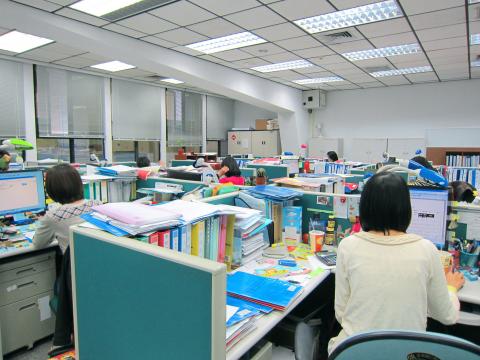
Photo: Chu Yu-ling, Taipei Times
照片:自由時報記者朱有鈴
As for exactly how much time office workers spend on Facebook, Internet auctions or chatting at work, the survey found that more than half spend 1.5 hours on average surfing the Internet every day. Around 59 percent of the respondents said that they spend half an hour on Facebook every day, while 21 percent said they spend an hour on the social networking site. Among the respondents, 64 percent said they usually spend around half an hour every day on Internet auctions or group buying sites. Around 57 percent said that they spend approximately half an hour every day using chatting software.
(Liberty Times, Translated by Kyle Jeffcoat)
上班族除了忙公事外,還忙些什麼?yes123求職網調查發現,聊天、上網、上臉書,是上班族的「紓壓三寶」,百分之五十四點四的上班族認為,上班三寶對於緩解工作壓力很有幫助。
調查發現,上班族平均每天花六小時處理公事的比率最高(百分之二十四點九),其次是七小時(百分之二十一點九),每天約花超過三分之二的時間忙公務,其他時間在可複選的狀況下分別是和同事聊天(百分之六十六點四)、上網(百分之四十三點二)、上臉書(百分之四十二點三)。
雖然心有旁騖,但過半(百分之五十四點四)上班族認為有助於舒緩工作壓力,還有人認為可提高工作效率(百分之九點七)、是必要的分心(百分之七點三);相對之下,認為上班時上網摸魚不負責任的有百分之五點二、有虧職守僅百分之四點五、良心不安的更只有百分之三。
究竟,上班族上臉書、網拍、上網聊天的時間有多高?調查顯示,逾五成上班族約花一點五小時神遊網路;五成九的上班族表示,在臉書上逗留的時間為半小時,兩成一逗留時間為一小時;至於看網拍或者團購,六成四控制在半小時內;五成七表示約花半小時使用通訊軟體。
(自由時報記者楊久瑩)


A: Isn’t the 2026 Coachella Valley Music and Arts Festival — a massive music event held every April — about to open in California? B: Yeah the festival is set to take place over two weekends, from April 10 to 12 and 17 to 19, US time. A: I heard this year’s main stage headliners include Sabrina Carpenter, Justin Bieber, Karol G and EDM DJ Anyma. B: The K-pop army is also making an appearance, with legendary group BigBang, SHINee member Taemin and girl group Katseye debuting for the first time. A: Isn’t Coachella also live-streamed on its YouTube

★ Bilingual Story is a fictionalized account. 雙語故事部分內容純屬虛構。 Lucas was already on the ground before he fully understood what was happening. “Hurry! Kneel down!” someone shouted. The asphalt was warm against his knees. Around him, dozens of people lay flat in the narrow street outside Jenn Lann Temple in Dajia. Some pressed their hands together in prayer. Others closed their eyes. Lucas had only come to look at the temple. An hour earlier he had stepped into the noisy courtyard out of curiosity. Inside the main hall, people held incense sticks, bowed three times,

You might think knitting is only for grandmas, but surprisingly, many young people are embracing so-called “grandma hobbies.” On social media platforms, activities such as home cooking, embroidery and gardening are becoming popular among teenagers and young adults who are drawn to their relaxing and creative nature. “Grandma hobbies” typically refer to activities that are slow-paced, handmade and nostalgic. Common examples include knitting scarves, baking cookies, sewing clothes and growing plants. These hobbies were once part of everyday life for many women in previous generations, but today they provide an escape from the fast-paced digital world. The appeal

對話 Dialogue 清清:我連假回老家掃墓,帶了一些草仔粿回來,你要不要吃吃看? Qīngqīng: Wǒ liánjià huí lǎojiā sǎomù, dài le yìxiē “tsháu-á-kué” huílái, nǐ yào bú yào chī chī kàn? 華華:哇!看起來就很好吃。這是你們家自己做的嗎? Huáhua: Wa! Kàn qǐlái jiù hěn hǎochī. Zhè shì nǐmen jiā zìjǐ zuò de ma? 清清:對啊,是我阿姨親手做的。每年清明節她都會做。 Qīngqīng: Duì a, shì wǒ āyí qīnshǒu zuò de. Měinián Qīngmíng jié tā dōu huì zuò. 華華:你阿姨手藝真好!看起來好像外面賣的。 Huáhua: Nǐ āyí shǒuyì zhēn hǎo! Kàn qǐlái hǎoxiàng wàimiàn mài de. 清清:口味有鹹的,也有甜的。 Qīngqīng: Kǒuwèi yǒu xián de, yě yǒu tián de. 華華:聞起來好香!裡面包什麼? Huáhua: Wén qǐlái hǎo xiāng! Lǐmiàn bāo shénme? 清清:鹹的是蘿蔔絲的,甜的有紅豆口味和綠豆口味的。你想要哪種? Qīngqīng: Xián de shì luóbo sī de, tián de yǒu hóngdòu kǒuwèi hàn lǜdòu kǒuwèi de. Nǐ xiǎng yào nǎ zhǒng? 華華:我不挑食,哪種都可以,你幫我選吧。謝謝你跟我分享! Huáhua: Wǒ bù tiāoshí, nǎ


 RSS
RSS