


All you need to do to save the rainforest, improve your diet, better your health, cut global carbon emissions and slash your food budget is eat bugs.
Mealworm quiche, grasshopper springrolls and cuisine made from other creepy crawlies is the answer to the global food crisis, shrinking land and water resources and climate-changing carbon emissions, Dutch scientist Arnold van Huis says.
The professor at Wageningen University in the Netherlands said insects have more protein than cattle per bite, cost less to raise, consume less water and don’t have much of a carbon footprint.

PHOTO: REUTERS 照片:路透
“Meat consumption is expected to double from 2000 to 2050. We are already using 70 percent of our agricultural land for livestock and we cannot afford to spare more,” he said.
“Children don’t have a problem with eating insects, but adults with developed eating habits do, and only tasting and experience can make them change their minds,” Van Huis said.
“The problem is psychological.”
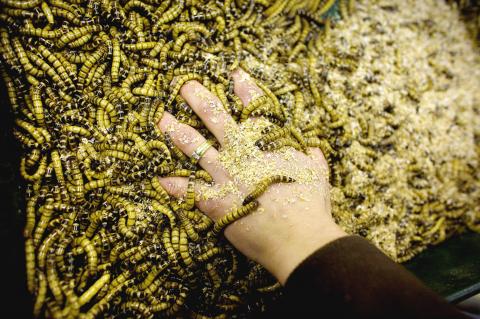
PHOTO: REUTERS 照片:路透
Van Huis has organized lectures, food tastings, and cookery classes with a master chef who demonstrates how to prepare a range of recipes using worms and grasshoppers, all bred — or raised — at a Dutch insect farm for consumption.
“It is good food, of high nutritional value, and very healthy for elderly people,” said Margot Callis. Though she cannot eat insects herself because she is allergic to them.
(REUTERS)
若要拯救雨林、改善飲食、促進健康、減少二氧化碳排放與降低伙食預算,只要吃蟲就能達成。

PHOTO: REUTERS 照片:路透
荷蘭科學家阿諾‧范豪斯說,吃粉蝨乳蛋餅、蚱蜢春捲與其他以爬蟲為食材做成的菜餚,就能解決全球食物危機、腹地與水資源減少與導致氣候變化的溫室氣體排放等問題。
這位荷蘭瓦罕寧恩大學的教授說每口昆蟲蛋白質含量比牛多、飼養成本與用水量比牛少,同時沒有什麼碳足跡。
他說︰「肉類的消耗量預計從二零零零年至二零五零年倍增,我們已使用百分之七十的農地畜牧,無法騰出更多的土地了。」
范豪斯說,「兒童沒有吃昆蟲的問題,但成人已養成一定的飲食習慣,只能靠淺嚐或體驗來改變他們。」
他說,「這是心理障礙。」
范豪斯開課演講、辦試吃會與烹飪班,並有廚師示範如何將蟲與蟋蟀等入菜,而所有昆蟲都來自荷蘭食用昆蟲飼養場。
為了吸引更多人改吃蟲,他與瓦罕寧恩大學的科學團隊找上當地的烹飪學校合作,發表食譜與料理書籍。
雖然瑪戈‧卡里斯因對昆蟲過敏而無緣親自品嚐,但她說,「這是很好的食物、富含營養,適合高齡者食用。」
(路透╱翻譯:林亞蒂)

In 2023, an 80-year-old woman in Taipei suffocated her paralyzed son after over five decades of caring for him. Turning herself in immediately, she confessed that worsening health and anxiety about who would care for him after her death had driven her to act. The court, acknowledging her difficult situation, sentenced her to two-and-a-half years in prison while recommending a presidential pardon. This rare judicial recommendation drew a complicated social response. Supporters argue that the mother’s half-century of caregiving renders her deserving of compassion instead of incarceration, believing that allowing her to live her final years in dignity and

★ Bilingual Story is a fictionalized account. 雙語故事部分內容純屬虛構。 The mango looked perfect. It sat on the fruit stand like a small sunset, red on one side and gold on the other. “I’ll take this one,” said Daniel. The fruit seller shook her head. “Not that one.” Daniel was surprised. “Why not? It looks beautiful.” “Yes,” she said, “but beautiful is not always ready.” She picked up another mango and held it near his nose. “First, smell here.” Daniel smelled the top of the mango. It was sweet and warm. “Good mangoes have a smell,” she said. “Next, feel the weight.”

Put the Cart Before the Horse 本末倒置 Iris: I think I’m in love. Carl: What? Iris: We just have so much in common. We like all of the same things. Carl: Yes, but you’ve only chatted with him online. Iris: It doesn’t matter. I know we’ll end up getting married. Carl: I’m afraid you’re putting the cart before the horse. You should at least meet him first. Iris: OK, OK. I’ll do that. 艾瑞絲: 我想我戀愛了。 卡 爾: 什麼? 艾瑞絲: 我們就是有那麼多的共通點。我們喜歡的東西都一樣。 卡 爾: 是沒錯,不過妳和他只在網路上聊過天而已。 艾瑞絲: 那不重要。我知道我們最後一定會步入禮堂。 卡 爾: 妳恐怕是本末倒置了吧。妳至少應該先跟他見個面。 艾瑞絲: 好啦,好啦。我會的啦。 A tough cookie 強悍的人∕堅強的人 Tracy: I heard you went out with Iris last night. Justin: Yeah. We

A: Over 130,000 college graduates are about to enter the workforce upon graduation. B: According to a survey, the top 10 most desired careers among Taiwanese are: independent content creator, civil servant, information engineer, financial professional, medical worker, content planner, flight attendant, news anchor, designer and fitness trainer. A: What are the “dream jobs” for young Gen Zers? B: The top three for men are YouTuber, pro gamer and engineer. For women, they are writer, social media editor and YouTuber. A: Every profession has its champion. Just look at Taiwanese fire dancer Yang Li-wei — who was on fire


 RSS
RSS