


Can you tell what that small, black thing is? It isn't dirt, and it isn't a stick. It's a worm.
Most worms live in the ground. They dig down into dirt to make their homes. This worm also digs deep to make its home, but this worm digs into snow, not dirt. It's called an ice worm.
The ice worm in this picture was found underneath 3.6m of snow. Can you imagine trying to live in a place that cold? Scientists want to know how the ice worm can live in such cold temperatures.
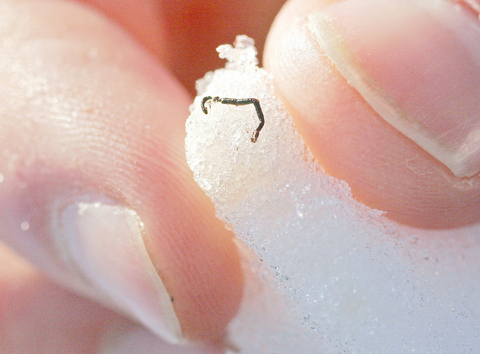
PHOTO : AP
They think that if the ice worm can live without a lot of heat or light, maybe there could be living things on distant planets that are much colder than Earth. (Taipei Times)
你看得出來那個小小黑黑的東西是什麼嗎?不是泥巴,也不是一根樹枝,它是一隻蟲。
大部份的蟲住在地底下,它們鑽進土裡築巢,這隻蟲也得鑽出自己的巢,不過這隻蟲是鑽進雪地裡而不是泥土裡,它叫做冰蟲。
照片裡的這隻冰蟲是在雪地下三點六公尺被發現的。你能想像住在這麼冷的地方嗎?科學家想知道為什麼冰蟲能在這麼冷的溫度存活。
他們認為,如果冰蟲可以在欠缺光和熱的環境存活,也許在比地球冷的遙遠星球上也會有生物存在。

In 2023, an 80-year-old woman in Taipei suffocated her paralyzed son after over five decades of caring for him. Turning herself in immediately, she confessed that worsening health and anxiety about who would care for him after her death had driven her to act. The court, acknowledging her difficult situation, sentenced her to two-and-a-half years in prison while recommending a presidential pardon. This rare judicial recommendation drew a complicated social response. Supporters argue that the mother’s half-century of caregiving renders her deserving of compassion instead of incarceration, believing that allowing her to live her final years in dignity and

A: Over 130,000 college graduates are about to enter the workforce upon graduation. B: According to a survey, the top 10 most desired careers among Taiwanese are: independent content creator, civil servant, information engineer, financial professional, medical worker, content planner, flight attendant, news anchor, designer and fitness trainer. A: What are the “dream jobs” for young Gen Zers? B: The top three for men are YouTuber, pro gamer and engineer. For women, they are writer, social media editor and YouTuber. A: Every profession has its champion. Just look at Taiwanese fire dancer Yang Li-wei — who was on fire

A: While AI is reshaping the world, “Money Talks News” revealed seven career fields that are “AI-proof.” First is the healthcare field, like nursing jobs, personal care aides, and social work specialists. B: This type of job is indeed in high demand. So what’s next? A: Up next are skill-based positions, like electricians, mechanics, and construction workers. Then there’s the field of education, like teachers, tutors, and education specialists. Fourth is the mental health field, like jobs in counseling, therapy, and social work. B: I didn’t expect teaching to be safe from AI. What else is

India has launched one of the world’s largest social policy experiments by transferring cash directly to housewives in recognition of their unpaid domestic labor. Across 12 states, an estimated 118 million adult women regularly receive 1,000 to 2,500 rupees (NT$348 to NT$871), equal to about 5% to 12% of household income. Surveys show Indian women devote nearly five hours per day to household tasks — over 7.6 times men’s contribution. This imbalance is a major factor in India’s low female labor force participation. Though modest in amount, the transfers symbolically acknowledge the hidden labor supporting families and society.


 RSS
RSS