


Opposition lawmakers yesterday blocked a bill authorizing a special defense budget of NT$1.25 trillion (US$39.8 billion) from being placed on the agenda for Friday’s Legislative Yuan plenary session as they urged President William Lai (賴清德) to appear before the legislature and answer questions about the proposed budget first.
Lai on Wednesday last week announced the NT$1.25 trillion supplementary budget to underscore the nation’s determination to defend itself, saying that China’s goal is to “prepare for the military unification with Taiwan by 2027.”
The Executive Yuan on Thursday last week passed the draft act for the NT$1.25 trillion in government spending for major weapons purchases over eight years, from next year to 2033.

Photo: Tu Chien-jung, Taipei Times
During a meeting of the legislature’s Procedure Committee yesterday, the Chinese Nationalist Party (KMT) proposed postponing consideration of the bill, a move that was supported by the Taiwan People’s Party (TPP).
KMT caucus whip Fu Kun-chi (傅?萁) said the KMT caucus fully supports national defense and military procurement to protect the nation, and defend free and democratic Taiwan, but the Ministry of National Defense had not explicitly stated that the Chinese Communist Party would have the capability to take Taiwan by force by 2027 in any of its defense budgets across the past three fiscal years, including this fiscal year.
Lai had neither briefed the legislature nor informed the public, but made the announcement through an op-ed in an international newspaper, Fu said.
The government has not stated what equipment or platforms are being purchased before attempting to ram a draft defense budget through the Procedure Committee, he said, adding that this was akin to demanding a blank check while the public remains in the dark.
The president must appear before the legislature to clarify the defense budget to the public before a decision can be made, he said.
TPP Chairman Huang Kuo-chang (黃國昌) said that the public absolutely supports measures to increase the nation’s self-defense capabilities, but with budgets running to more than NT$1 trillion and the lackluster results of defense procurements, Lai must provide guarantees that the special budget would translate into a direct increase in Taiwan’s combat readiness.
The Democratic Progressive Party’s (DPP) efforts to legitimize its demands to boost the defense budget, while smearing the opposition’s right to oversight, as well as allowing the president to “threaten” the public with the imminent subjugation of the country, are the greatest dangers facing Taiwan, he added.
Huang agreed that the president should appear before the legislature and the TPP wished to ask the president many questions, as it had received only two A4 pages of information on the proposed budget.
Meanwhile, DPP lawmakers went to the committee meeting armed with protest placards.
DPP caucus secretary-general Chen Pei-yu (陳培瑜) said the opposition parties must make known to the public why they are blocking the special defense budget.
The president has made it very clear that his appearance at the legislature is open for discussion as long as the process is in line with standing regulations and procedures, Chen said, but the opposition parties were unwilling to discuss the issue in detail.
DPP Legislator Fan Yun (范雲) said the opposition’s demands were an excuse to hide behind their true intention to oppose the defense budget.
DPP spokesman Justin Wu (吳崢) said that Lai was willing to brief the legislature, but the opposition’s insistence that each legislator be allowed to question the president is unconstitutional.
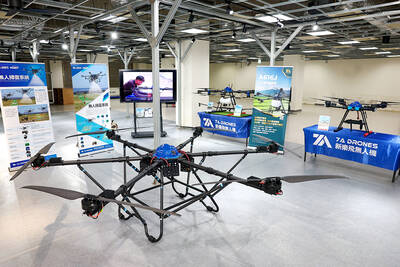
DRONE CENTRAL: Taiwan aims to become Asia’s democratic hub for drones, with most exports focused on high-quality military-grade models, an official said Taiwan’s drone industry is expected to expand significantly by 2030, producing 100,000 units per month and exporting half of them, the Ministry of Economic Affairs said yesterday. Current drone production capacity is about 15,000 units per month, but the industry can quickly scale up as demand increases, Industrial Development Administration Director-General Chiou Chyou-huey (邱求慧) told a news conference in Taipei. Taiwan’s drone output grew 2.5-fold last year to NT$12.9 billion (US$408.3 million) under a government program to develop the uncrewed vehicle sector, he said. The Executive Yuan in October last year approved plans to invest NT$44.2 billion into domestic production of uncrewed aerial
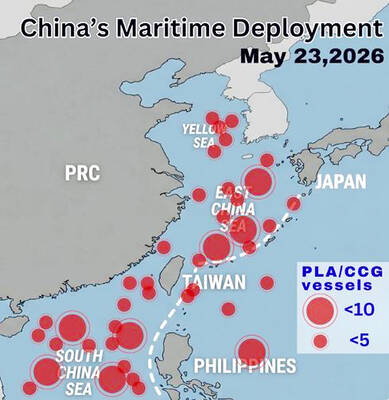
WARNING: China should stop engaging in actions that undermine regional peace and stability, as it would only build resentment among people across the Strait, the CGA said China has deployed more than 100 navy, coast guard and other vessels in waters from the Yellow Sea to the South China Sea and the western Pacific since US President Donald Trump and Chinese President Xi Jinping (習近平) met in Beijing, National Security Council Secretary-General Joseph Wu (吳釗燮) said yesterday. “In this part of the world, #China is the one & only PROBLEM wrecking the #StatusQuo & threatening regional peace & stability,” Wu wrote on X. In a separate post, he said Beijing was coercing Taiwan’s maritime domain, calling it illegal and provocative, after the Coast Guard Administration (CGA) expelled a

VERBOSE VESSELS: A CGA cutter and a China Coast Guard exchanged verbal barbs for more than a day in Taiwanese-controlled waters before the Chinese vessel left The Taiwanese and Chinese coast guards had a standoff near the strategically located Pratas Islands (Dongsha Islands, 東沙群島) in the north of the South China Sea, the Coast Guard Administration (CGA) said yesterday. The two sides engaged in intense radio exchanges over sovereignty claims during the 33-hour standoff. China Coast Guard vessel 3501 eventually left the restricted waters, 26.6 nautical miles (49.2km) west of the Pratas Islands, at 5pm yesterday, the CGA said. Lying approximately between southern Taiwan and Hong Kong, the Taiwan-controlled Pratas are seen by some security experts as vulnerable to Chinese attack due to their distance — more than
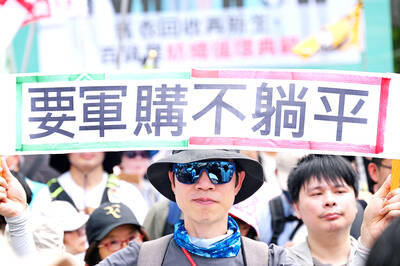
More than 8,000 people took part in a rally in Taipei yesterday to express support for more defense spending, after the opposition slashed the Cabinet’s proposed NT$1.25 trillion (US$39.6 billion) special defense budget and capped it at NT$780 billion. The demonstrators urged the Cabinet to propose another bill. Taiwan Economic Democracy Union convener Lai Chung-chiang (賴中強) said the main problem of the passed budget plan is the removal of funding for critical items, not just that the total amount is smaller. Critical budget items included purchasing or developing uncrewed vehicles, Strong Bow (強弓) missile systems, additional ammunition, artificial intelligence-powered combat systems and Taiwan-US


 RSS
RSS