


The US is to deliver High Mobility Artillery Rocket Systems (HIMARS) to Taiwan a year ahead of schedule, in 2026, with the delivery being expedited in response to rising military tensions across the Strait, the Ministry of National Defense said.
Taiwan agreed to buy 29 HIMARS worth NT$32.5 billion (US$1.06 billion), including an initial order of 11 systems and an additional 18 to replace 40 M109A6 self-propelled howitzers, Lee Shih-Chiang (李世強), director of the ministry’s Department of Strategic Planning, told lawmakers on Thursday.
The first 11 systems are on sechedule, to be delivered next year or in 2025, while the additional 18 are to arrive in 2026, ahead of the planned 2027 or 2028 delivery, Lee said.
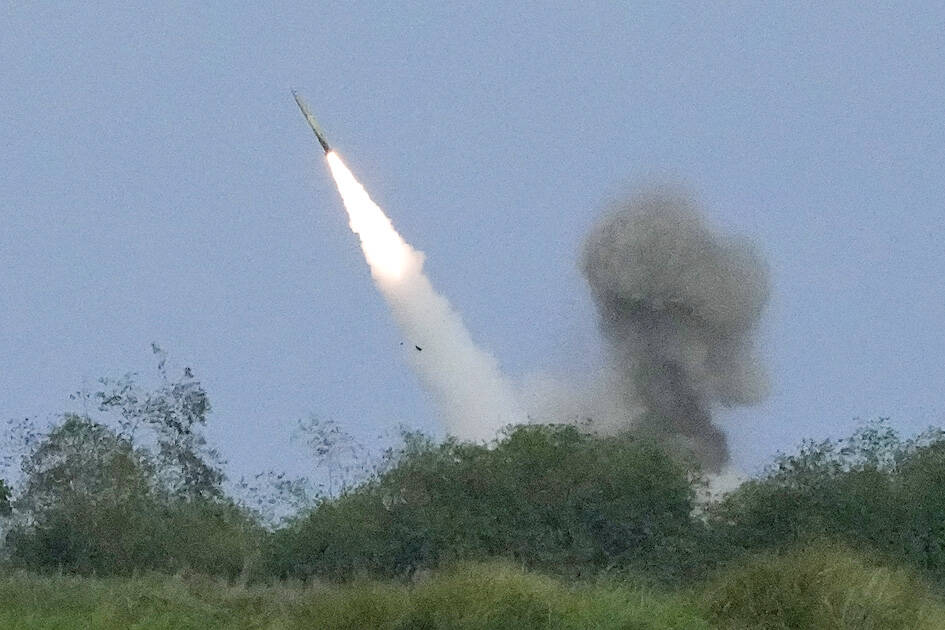
Photo: AP
The army’s procurement of rocket artillery systems and ammunition additionally includes 84 Army Tactical Missile Systems (ATACMs) with a nominal range of 300km and 864 Guided Multiple Launch Rocket Systems (GMLRS), with a nominal effective range of 42km, he said.
Separately, retired admiral Huang Shu-kuang (黃曙光), convener of the Presidential Office’s indigenous submarine task force, said yesterday that the nation is on track to put the first indigenous submarine to sea in September.
He made the remark at a National Taiwan Ocean University event discussing the nation’s shipbuilding programs.
Submarines are crucial for Taiwanese security, as the nation’s geostrategic position on the first island chain is better suited for a defensive posture based on submarine warfare than strength-on-strength surface action, Huang said.
The nation’s security strategy should involve improving the capability of the armed forces and banding with other democratic nations to form a defensive alliance in the Indo-Pacific region, he said.
Taiwan began efforts to obtain submarines under former president Lee Teng-hui’s (李登輝) administration, but the first attempts were unsuccessful due to diplomatic constraints, Huang said.
The indigenous defense submarine program was proposed near the end of former president Ma Ying-jeou’s (馬英九) term and continued by President Tsai Ing-wen (蔡英文), he said.
Precision strike missiles, submarines, undersea vessels, missile-firing boats, and mines and minelayers must be developed to defend the maritime logistical lifelines the nation depends on for gas and strategic resources, Huang said.
The university is at the forefront of the nation’s bid to develop AI-based autonomous uncrewed undersea vessels, and a prototype has successfully completed an one-hour undersea voyage, university president Cheng Ying-yao (鄭英耀) said.

SILENCING CRITICS: In addition to blocking Taiwan, China aimed to prevent rights activists from speaking out against authoritarian states, a Cabinet department said The Ministry of Foreign Affairs (MOFA) yesterday condemned transnational repression by Beijing after RightsCon, a major digital human rights conference scheduled to be held in Zambia this week, was abruptly canceled due to Chinese pressure over Taiwanese participation. This year’s RightsCon, the world’s largest conference discussing issues “at the intersection of human rights and technology,” was scheduled to take place from tomorrow to Friday in Lusaka, and expected to draw 2,600 in-person attendees from 150 countries, along with 1,100 online participants. However, organizers were forced to cancel the event due to behind-the-scenes pressure from China, the ministry said, expressing its “strongest condemnation”
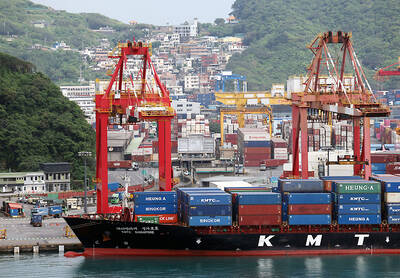
Taiwan’s economy grew far faster than expected in the first quarter, as booming demand for artificial intelligence (AI) applications drove a surge in exports, spilling over into investment and consumption, the Directorate-General of Budget, Accounting and Statistics (DGBAS) said yesterday. GDP growth was 13.69 percent year-on-year during the January-to-March period, beating the DGBAS’ February forecast by 2.23 percentage points and marking the most robust growth in nearly four decades, DGBAS senior official Chiang Hsin-yi (江心怡) told a news conference in Taipei. The result was powered by exports, which remain the backbone of Taiwan’s economy, Chiang said. Outbound shipments jumped 51.12 percent year-on-year to
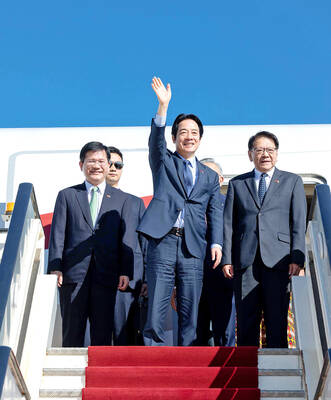
DELAYED BUT DETERMINED: The president’s visit highlights Taiwan’s right to international engagement amid regional pressure from China President Willaim Lai (賴清德) yesterday arrived in Eswatini, more than a week after his planned visit to Taiwan’s sole African ally was suspended because of revoked overflight permits. “The visit, originally scheduled for April 22, was postponed due to unforeseen external factors,” Lai wrote on social media. “After several days of careful arrangements by our diplomatic and national security teams, we successfully arrived today.” Lai said he looked forward to further deepening Taiwan-Eswatini relations through closer cooperation in the economy, agriculture, culture and education, as well as advancing the nation’s international partnerships. The president was initially scheduled to arrive in time to celebrate
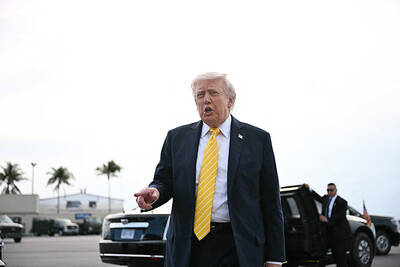
Iran’s Islamic Revolutionary Guard Corp (IRGC) yesterday said the US faced a choice between an “impossible” military operation or a “bad deal” with Tehran, after US President Donald Trump disparaged Iran’s latest peace proposal. Negotiations between the two countries have been deadlocked since a ceasefire came into effect on April 8, with only one round of direct peace talks held so far. Iran’s Tasnim and Fars news agencies reported that Tehran had submitted a 14-point proposal to mediator Pakistan, but Trump was quick to cast doubt on it. “I will soon be reviewing the plan that Iran has just sent to us, but


 RSS
RSS