


At least 10 people were killed in the collapse of a hotel used as a coronavirus quarantine facility in Quanzhou in China’s Fujian Province, authorities said yesterday.
Rescuers pulled 48 people from the rubble, of whom 38 are still alive, the Chinese Ministry of Emergency Management said on social media.
Most of the rescued were taken to hospitals for treatment, some with serious injuries, officials said.
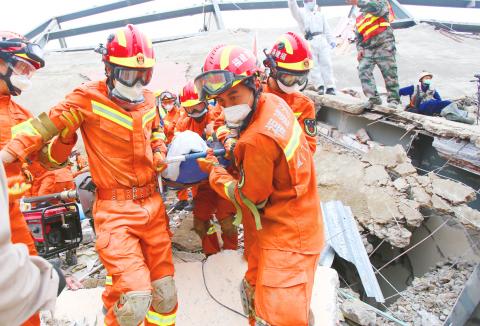
Photo: EPA-EFE
The building in the coastal city had been repurposed to house people who recently had contact with patients confirmed with COVID-19, the state-run People’s Daily reported.
The city has recorded 47 cases of the virus.
Video posted online by the ministry’s firefighting department showed rescuers helping children don surgical masks before pulling them from the wreckage of the six-story Xinjia hotel.
A 12-year-old boy told rescuers that his mother was still buried in the rubble.
“She was next to me just now,” he said in the video.
His mother was rescued alive hours later, the ministry said.
Another video released by the ministry showed rescuers squirting water from a bottle into the mouth of a trapped man.
Rescuers were also seen spraying disinfectant on each other between shifts.
Nine people escaped on their own, the ministry said.
Footage published by local media appears to show the hotel collapsing in seconds, with the building’s facade crumbling to the ground, exposing the structure’s steel frame.
Two retail spaces on the first floor had been undergoing renovation since before the Lunar New Year holiday, and construction workers called the hotel’s owner minutes before the collapse to report a deformed pillar, officials said.
Built in 2013, the building was converted to a 66-room hotel that opened in June 2018, Quanzhou authorities said.
The owner has been summoned by police while investigators work to determine whether the renovation or an original structural issue was at fault, the ministry said.
Fifty-eight people who had recently been in regions hard hit by COVID-19 were being quarantined in the hotel, but all had tested negative for the virus, the Quanzhou Evening News reported yesterday.
Additional reporting by AP

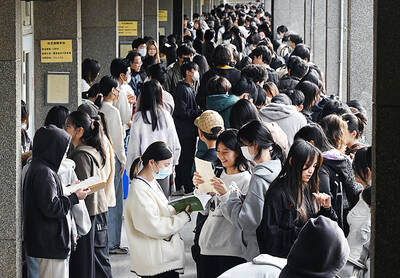
A global survey showed that 60 percent of Taiwanese had attained higher education, second only to Canada, the Ministry of the Interior said. Taiwan easily surpassed the global average of 43 percent and ranked ahead of major economies, including Japan, South Korea and the US, data from the Organisation for Economic Co-operation and Development (OECD) for 2024 showed. Taiwan has a high literacy rate, data released by the ministry showed. As of the end of last year, Taiwan had 20.617 million people aged 15 or older, accounting for 88.5 percent of the total population, with a literacy rate of 99.4 percent, the data

NEW LOW: The council in 2024 based predictions on a pessimistic estimate for the nation’s total fertility rate of 0.84, but last year that rate was 0.69, 17 percent lower An expected National Development Council (NDC) report expects the nation’s population to drop below 12 million by 2065, with the old-age dependency ratio to top 100 percent sooner than 2070, sources said yesterday. The council is slated to release its latest population projections in August, using an ultra-low fertility model, the sources said. The previous report projected that Taiwan’s population would fall to 14.37 million by 2070, but based on a new estimate of the total fertility rate (TFR) — the average number of children born to a woman over her lifetime — the population is expected to reach 12 million by
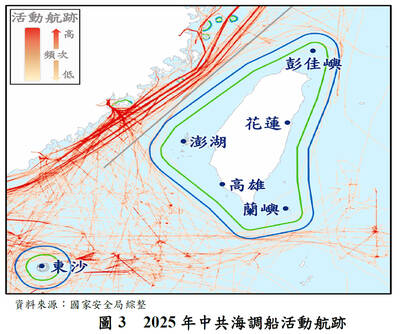
INTENSIFYING THREATS: Beijing’s tactics include massive attacks on the government service network, aircraft and naval vessel incursions and damaging undersea cables China is prepared to interfere in November’s nine-in-one local elections by launching massive attacks on the Taiwanese government’s service network (GSN), a report published by the National Security Bureau showed. The report was submitted to the Legislative Yuan ahead of the bureau’s scheduled briefing at the Foreign Affairs and National Defense Committee tomorrow. The national security team has identified about 13,000 suspicious Internet accounts and 860,000 disputed messages, the bureau said of China’s cognitive warfare against Taiwan. The disputed messages focus on major foreign affairs, national defense and economic issues, which were produced using generative artificial intelligence (AI) and distributed through Chinese

COUNTERING HOSTILITY: The draft bill would require the US to increase diplomatic pressure on China and would impose sanctions on those who sabotage undersea cable networks US lawmakers on Thursday introduced a bipartisan bill to bolster the resilience of Taiwan’s submarine cables to counter China’s hostile activities. The proposal, titled the critical undersea infrastructure resilience initiative act, was cosponsored by Republican representatives Mike Lawler and Greg Stanton, and Democratic Representative Dave Min. US Senators John Curtis and Jacky Rosen also introduced a companion bill in the US Senate, which has passed markup at the chamber’s Committee on Foreign Relations. The House’s version of the bill would prioritize the deployment of sensors to detect disruptions or potential sabotage in real-time and enhance early warning capabilities through global intelligence sharing frameworks,


 RSS
RSS