


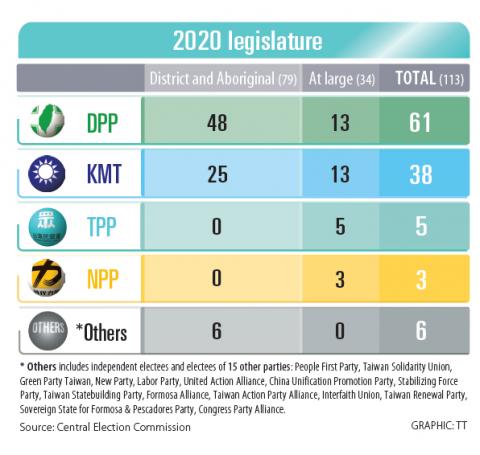
The Democratic Progressive Party (DPP) yesterday retained its legislative majority, garnering 61 of the 113 seats, while the Chinese Nationalist Party (KMT) won 38 seats.
The Taiwan People’s Party, led by Taipei Mayor Ko Wen-je (柯文哲), snatched five seats after gaining 11.2 percent of the party vote, while the New Power Party (NPP) won three seats with 7.8 percent of the party vote.
Despite the backing of Hon Hai Precision Industry Co founder Terry Gou (郭台銘), the People First Party (PFP) failed to pass the 5 percent threshold of party votes and is to lose its representation at the Legislative Yuan.
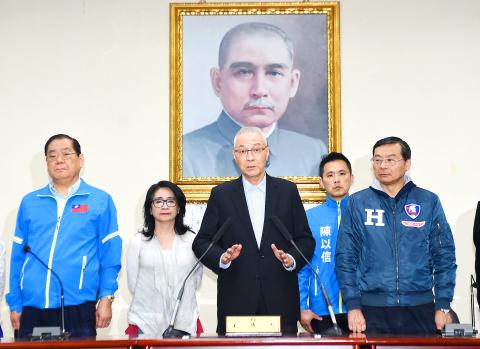
Photo: Fang Pin-chao, Taipei Times
In Taipei’s third electoral district (Zhongshan-Northern Songshan), DPP challenger Enoch Wu (吳怡農), who won 99,539 votes, failed to upset KMT Legislator Chiang Wan-an (蔣萬安), who had 112,784 votes.
On the campaign trail, Wu had launched a movement to boycott KMT legislator-at-large nominee Wu Sz-huai (吳斯懷), who is No. 4 on the KMT’s legislator-at-large list and stands to take a seat in the legislature.
Following hours of tug-of-war in Taipei’s fourth electoral district (Nangang-Neihu), DPP Taipei City Councilor Kao Chia-yu (高嘉瑜) obtained 125,138 votes, narrowly beating KMT Legislator Lee Yen-hsiu (李彥秀), who had 118,432.
Former KMT legislator Lin Yu-fang (林郁方) failed to reclaim his seat in Taipei’s fifth electoral district (Zhongzheng-Wanhua), losing again to independent Legislator Freddy Lim (林昶佐), who ousted Lin four years ago as an NPP legislative candidate.
Meanwhile, several incumbent legislators representing Taoyuan were ousted. KMT legislators Apollo Chen (陳學聖) and John Wu (吳志揚) failed to defend their seats, losing to independent legislative candidate Chao Chen-yu (趙正宇) and DPP legislative candidate Huang Shih-chieh (黃世杰) respectively.
KMT Taoyuan City Councilor Wan Mei-ling (萬美玲) defeated incumbent DPP Legislator Cheng Pao-ching (鄭寶清).
In Taichung, independent Legislator Hung Tzu-yung (洪慈庸), who had 90,213 votes, lost to former KMT legislator Yang Chiung-ying (楊瓊瓔), who had 91,182 votes, by a razor-thin margin following a drawn-out count.
After initially saying that she would request a recount, Hung said that she accepted the outcome.
In the 2016 legislative election, Hung garnered 93,451 votes, defeating Yang, who was seeking re-election, by 15,117 votes.
Taiwan Statebuilding Party legislative candidate Wonda Chen (陳柏惟), a dark horse candidate, beat KMT Legislator Yen Kuan-heng (顏寬恆), son of former Non-partisan Solidarity Union legislator Yen Ching-piao (顏清標), who is chairman of Dajia Jenn Lann Temple (大甲鎮瀾宮).
Former Yunlin County commissioner Su Chih-fen (蘇治芬) of the DPP edged out her KMT rival, Chang Chia-chun (張嘉郡), daughter of former Yunlin County commissioner Chang Jung-wei (張榮味), an influential figure in the county.
The DPP had a complete sweep in Kaohsiung, where all eight of its candidates — Chiu Yi-ying (邱議瑩), Chiu Chih-wei (邱志偉), Liu Shih-fang (劉世芳), Lin Tai-hua (林岱樺), Hsu Chih-chieh (許智傑), Lee Kuen-tse (李昆澤), Chao Tien-lin (趙天麟) and Lai Jui-lung (賴瑞隆) — were elected.
DPP Tainan chapter director Huang Hsien-chu (黃先柱) said that the party’s victories were thanks to an improved political atmosphere.
The Hong Kong pro-democracy protests — and the Chinese-leaning legislator-at-large candidates nominated by the KMT — deepened unease regarding China, Huang Hsien-chu said.
The election results were also thanks to the DPP’s unity, while the KMT remained divided, he said.
In the 2016 legislative elections, the DPP gained 68 seats (60 percent), while the KMT won 35 (31 percent), the NPP five and the PFP three.
Additional reporting by Tsai Wen-chu

A signaling system malfunction disrupted high-speed rail (HSR) services beginning at 8am today, with trains temporarily reduced to three northbound and three southbound trains per hour as authorities conduct inspections. The malfunction occurred on a section of track in Miaoli County during pre-operation checks early this morning, forcing northbound and southbound trains to use a single track, the HSR operator said. The regular schedule has been replaced with three hourly trains offering only nonreserved seating in each direction, stopping at every station, it said, adding that business class cars would still have reserved seating. Departures from terminal stations are scheduled at the top

Taiwan is still in the process of assessing the possibility of recruiting workers from Eswatini, the Ministry of Foreign Affairs said yesterday, adding that its goal is to help Eswatini upgrade its vocational training centers. If there are plans to recruit workers from Eswatini, safeguarding national security, protecting public health and ensuring the employment rights of Taiwanese would be prerequisites, Department of West Asian and African Affairs Director-General Yen Chia-liang (顏嘉良) told a news conference. Key considerations would also include filling labor shortages in specific industries, and fostering bilateral professional and technical exchanges, he said. Yen was asked about the progress of labor

A US uncrewed surface vessel (USV) encountered multiple Chinese warships during an autonomous transit of the Taiwan Strait, US defense company Seasats said in a statement on Wednesday. Seasats announced that a Lightfish USV had completed the first autonomous transit of the Taiwan Strait. Over five days, the USV traversed the entire length of the Strait while constantly monitoring surface vessel traffic, the company said. The Lightfish encountered multiple Chinese warships, one of which was a Chinese People’s Liberation Army Navy (PLAN) Type 056 corvette, it said. The Chinese vessels were operating “well within Taiwan’s exclusive economic zone without transmitting their identity via the

VERBOSE VESSELS: A CGA cutter and a China Coast Guard exchanged verbal barbs for more than a day in Taiwanese-controlled waters before the Chinese vessel left The Taiwanese and Chinese coast guards had a standoff near the strategically located Pratas Islands (Dongsha Islands, 東沙群島) in the north of the South China Sea, the Coast Guard Administration (CGA) said yesterday. The two sides engaged in intense radio exchanges over sovereignty claims during the 33-hour standoff. China Coast Guard vessel 3501 eventually left the restricted waters, 26.6 nautical miles (49.2km) west of the Pratas Islands, at 5pm yesterday, the CGA said. Lying approximately between southern Taiwan and Hong Kong, the Taiwan-controlled Pratas are seen by some security experts as vulnerable to Chinese attack due to their distance — more than


 RSS
RSS