


The Taichung City Government has revoked the operating permits for two units at the Taichung Power Plant, Taichung Mayor Lu Shiow-yen (盧秀燕) announced yesterday morning, saying that the plant had exceeded its annual allowance of raw coal.
Inspections last month and earlier this month found that the plant had surpassed the city’s annual limit of 11.04 million tonnes of raw coal, Lu said, adding that a third inspection on Monday found that no improvements had been made.
“The limit is in place to protect the health of Taichung residents, to safeguard the city’s air quality,” she said.

Photo: Tsai Shu-yuan, Taipei Times
The plant was fined NT$3 million (US$99,328) after an inspection on Nov. 3 by the city’s Environmental Protection Bureau, and then an additional NT$6 million after an inspection on Dec. 13, when the city gave the plant 10 days in which to make improvements.
Following the second inspection, the plant said it had not exceeded the legal limit, because a 2017 permit from the city gave it a maximum of 16 million tonnes of coal per year.
However, a lower utilization limit was introduced in January 2016, Lu said yesterday, adding that the plant had been breaking the law by exceeding the limit each year over the past four years.
“Administrative responsibility means setting an example, but more importantly, it means protecting the public’s health and improving the environment,” Lu said.
The Taichung plant is the nation’s largest power plant, meaning that the municipality has for decades been responsible for more than its fair share of power generation costs, which is unreasonable, she said.
Yesterday, the Executive Yuan said that revoking the plant’s permits — the first time that a local government has done so — was “regrettable.”
Power generation should not be used as a political bargaining chip, it said, adding that the government aims to stabilize power generation.
The city government unilaterally amended documents to shorten the deadline for reducing air pollution and demonstrated a misunderstanding of administrative procedure, Executive Yuan spokeswoman Kolas Yotaka said.
“Mayor Lu has said numerous times since taking office that air quality in the city has improved, but is now using public health as a pretext for canceling the permits,” she said.
“This is a contradiction — it’s incomprehensible,” Kolas said.
The central government places personal property and safety first, and has always stood by its intention to reform power generation, she added.
“There are a multitude of reasons for pollution in the central part of the nation, but the government has made improvements to the air quality there,” Kolas said. “Confusing the facts ahead of the elections is unnecessary.”
The central and local governments must cooperate on reducing pollution and generating power, she said.

CROSS-STRAIT COLLABORATION: The new KMT chairwoman expressed interest in meeting the Chinese president from the start, but she’ll have to pay to get in Beijing allegedly agreed to let Chinese Nationalist Party (KMT) Chairwoman Cheng Li-wun (鄭麗文) meet with Chinese President Xi Jinping (習近平) around the Lunar New Year holiday next year on three conditions, including that the KMT block Taiwan’s arms purchases, a source said yesterday. Cheng has expressed interest in meeting Xi since she won the KMT’s chairmanship election in October. A source, speaking on condition of anonymity, said a consensus on a meeting was allegedly reached after two KMT vice chairmen visited China’s Taiwan Affairs Office Director Song Tao (宋濤) in China last month. Beijing allegedly gave the KMT three conditions it had to

STAYING ALERT: China this week deployed its largest maritime show of force to date in the region, prompting concern in Taipei and Tokyo, which Beijing has brushed off Deterring conflict over Taiwan is a priority, the White House said in its National Security Strategy published yesterday, which also called on Japan and South Korea to increase their defense spending to help protect the first island chain. Taiwan is strategically positioned between Northeast and Southeast Asia, and provides direct access to the second island chain, with one-third of global shipping passing through the South China Sea, the report said. Given the implications for the US economy, along with Taiwan’s dominance in semiconductors, “deterring a conflict over Taiwan, ideally by preserving military overmatch, is a priority,” it said. However, the strategy also reiterated

‘BALANCE OF POWER’: Hegseth said that the US did not want to ‘strangle’ China, but to ensure that none of Washington’s allies would be vulnerable to military aggression Washington has no intention of changing the “status quo” in the Taiwan Strait, US Secretary of Defense Pete Hegseth said on Saturday, adding that one of the US military’s main priorities is to deter China “through strength, not through confrontation.” Speaking at the annual Reagan National Defense Forum in Simi Valley, California, Hegseth outlined the US Department of Defense’s priorities under US President Donald Trump. “First, defending the US homeland and our hemisphere. Second, deterring China through strength, not confrontation. Third, increased burden sharing for us, allies and partners. And fourth, supercharging the US defense industrial base,” he said. US-China relations under
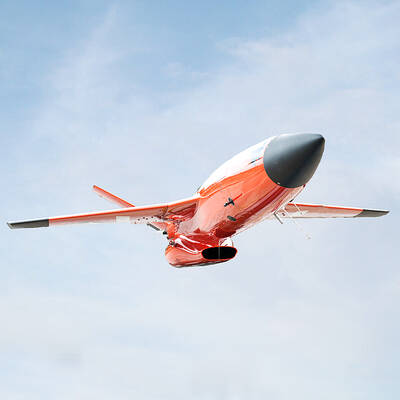
The Chien Feng IV (勁蜂, Mighty Hornet) loitering munition is on track to enter flight tests next month in connection with potential adoption by Taiwanese and US armed forces, a government source said yesterday. The kamikaze drone, which boasts a range of 1,000km, debuted at the Taipei Aerospace and Defense Technology Exhibition in September, the official said on condition of anonymity. The Chungshan Institute of Science and Technology and US-based Kratos Defense jointly developed the platform by leveraging the engine and airframe of the latter’s MQM-178 Firejet target drone, they said. The uncrewed aerial vehicle is designed to utilize an artificial intelligence computer


 RSS
RSS