

Police in Taoyuan said they have raided an illegal gambling ring that took bets on the result of next month’s presidential election, and detained four people for questioning.
Seized material suggests that the ring had total money flow of NT$250 million (US$8.3 million), they said.
A 53-year-old man surnamed Chen (陳), who is suspected of masterminding the ring, remained in police custody, they added.
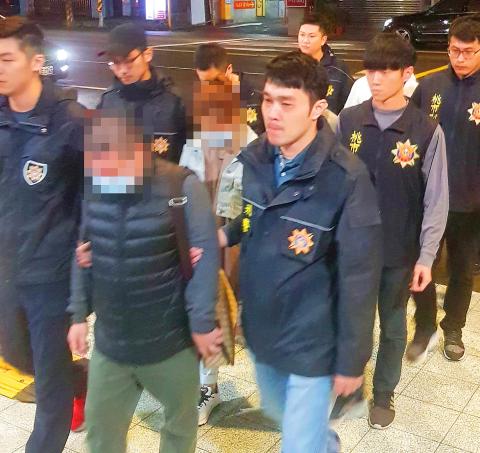
Photo: Lee Jung-ping, Taipei Times
Chen had three employees and offered odds for people to bet on the number of votes President Tsai Ing-wen (蔡英文) and Kaohsiung Mayor Han Kuo-yu (韓國瑜) would get in the Jan. 11 elections, police said.
Tsai is seeking re-election, while Han is the Chinese Nationalist Party’s (KMT) candidate.
“The raid was carried out at a location in Taoyuan’s Guanyin District (觀音) on Friday, in which computers, mobile phones, fax machines, ledgers, receipts and NT$20,000 in cash were seized,” Taoyuan Police Department Jhongli Police Station Chief Liu Yin-kong (劉印宮) said.
The suspects face charges of conducting illegal gambling activities under the Criminal Code, and breaches of the Civil Servants Election and Recall Act (公職人員選舉罷免法), Liu said.
Underground betting on election results is known to have affected election results in one-on-one races, Liu said.
Operators can entice people to bet on a certain candidate by offering favorable odds, which can skew the odds toward a higher payout, and is therefore considered a form of illegal vote-buying, Liu added.
In Chen’s case, people placed bets by telephone, fax or the Line messaging app, and each bet was set at NT$50,000, Liu said, adding that bidders used code words to bet on Tsai or Han.
Law enforcement agencies nationwide have been instructed to crack down on illegal betting on the election results and cut off such operations’ money flow, Liu added.
The authorities have promised to clean up such activities and prevent underground criminal syndicates from interfering in the election’s outcome, Liu said.
Separately, the Criminal Investigation Bureau last week said that from Dec. 10 to 13, it raided 24 illegal operations allowing people to bet on the election’s outcome, and arrested 30 people.
The arrests were part of an investigation into 694 cases of all forms of gambling nationwide.
Bureau officials said they seized NT$36.88 million during the raids.
Cases of illegal gambling on election outcomes are prosecuted under Article 104 of the act, which stipulates a punishment of up to five years in prison for “anyone who disseminates rumors or spreads falsehoods by text, picture, audio tape, video tape, speech or any other method” that results in a candidate losing or winning an election.
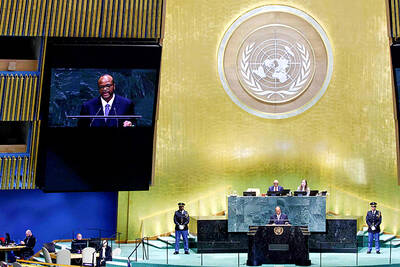
UNITY: Lai thanked the nations who spoke up for Taiwan, saying that democracies must stand together to face global authoritarian expansion Taiwan yesterday thanked eight European and Indo-Pacific countries for opposing unilateral changes to the “status quo” in the Taiwan Strait in a joint statement earlier this week, as well as three of Taiwan’s allies for speaking up for the nation’s participation in the UN at the body’s General Assembly in New York. Minister of Foreign Affairs Lin Chia-lung (林佳龍) welcomed the support and expressed his appreciation for the countries’ stance, the Ministry of Foreign Affairs said in a statement. Foreign ministers and senior representatives of Australia, France, Germany, Japan, New Zealand, Poland, South Korea and the UK issued a statement on Tuesday
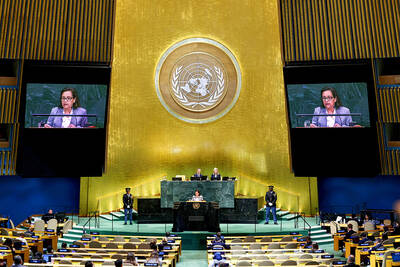
PLEA: How the UN addresses Taiwan’s security issue would be a test of its strength and relevance, Marshall Islands President Hilda Heine told the UN General Assembly Only Taiwan’s elected government can represent the people of Taiwan, Marshall Islands President Hilda Heine said on Friday at the UN General Assembly, calling for the nation’s inclusion in the UN. Taiwan and its 23 million people are a reality, and only its democratically elected government can represent it, Heine said when addressing the 81st session of the UN General Assembly General Debate. Appropriate ways must be found for Taiwan’s substantive participation in UN meetings if the UN is to be truly inclusive and effective in years to come, she said. UN member states would experience pressure to accept a
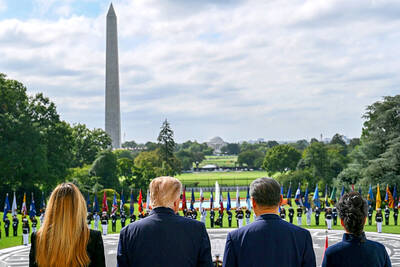
FACTS DISTORTION: The MAC rejected Xi’s remarks that the US and ‘China’ fought side-by-side during WWII, saying the ROC was Washington’s true ally during the war Taiwan yesterday denounced Chinese President Xi Jinping’s (習近平) comments to US President Donald Trump on the nation’s future, after Xi appeared to push Trump for a subtle change in stance that could erode US support for Taiwan. Xi told Trump in Washington on Thursday that he hoped the US would adhere to the “correct position” of opposing Taiwanese independence, according to a Chinese readout of the talks. That would be a tougher version of Washington’s long-standing formulation that it does not “support” independence. There was no immediate White House readout of the exchange. Xi’s remarks represent “the consistent Chinese approach of distorting facts
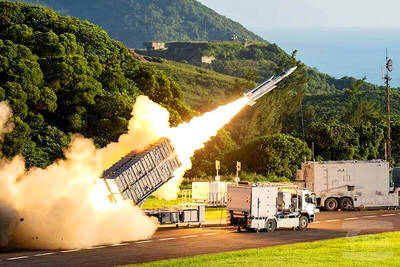
RESILIENCE: Keeping the defense industry’s assembly lines open would prove essential should the nation be involved in a prolonged conflict, a source said The Ministry of National Defense has prepared a NT$22 billion (US$692.3 million) program to acquire about 200 improved Hsiung Feng anti-ship missiles from next year to 2035, a source said. Commenting on condition of anonymity, a high-ranking defense official said the ministry’s plan for enhanced-capability Hsiung Feng II and Hsiung Feng III missiles would be funded as part of the regular defense budget. The 200 missiles would be added on top of the 1,400 missiles being funded via the Sea-Air Combat Power Improvement Plan, they said. The program is not about padding missile numbers, but expanding the capability to defeat


 RSS
RSS