


Female Democratic Progressive Party (DPP) politicians and officials yesterday jointly condemned the Chinese Nationalist Party (KMT) for what they called sexist and demeaning comments against women over the past week, urging voters to reject the “party of chauvinist pigs” in the Jan. 11 presidential and legislative elections.
“KMT politicians are resorting to insulting women to bolster their campaigns. I urge all women to not vote for the KMT to prevent gender equality from regressing several decades,” DPP Taipei City Councilor Chien Hsu-pei (簡舒培) told a news conference at DPP headquarters in Taipei.
She said that she has launched a drive calling for people to “reject the chauvinist pigs of the KMT,” which had already gained much support on social media.
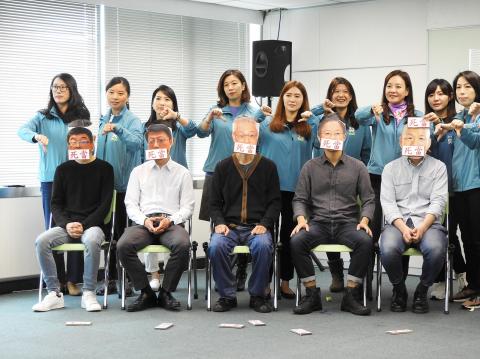
Photo: Chen Yu-fu, Taipei Times
“KMT Chairman Wu Den-yih (吳敦義) disparaged President Tsai Ing-wen (蔡英文) as an ‘ill-starred woman’ (衰尾查某) who has brought Taiwan misfortune, displaying his chauvinist attitude in maligning the nation’s leader,” Chien said.
“If we continue to tolerate such talk by Wu and the KMT, then we are condoning men discriminating against women in the future. Therefore, we ask all women and victims of discrimination to reject the KMT in the upcoming elections,” she said.
DPP Women Affairs Department director Tsai Wan-fen (蔡宛芬) said that people should take a harder line on the matter, because KMT politicians have not apologized, but rather have hidden behind excuses for their derogatory comments.
“People should not cast ballots for the KMT, a party of male chauvinist pigs,” she said.
DPP spokeswoman Tai Wei-shan (戴瑋姍) said that many KMT politicians have been using sexist and insulting comments against women, adding: “We have had enough of it and our society should not ignore it.”
“Taiwan has made much progress, but the poison of male chauvinism remains. We must sweep it away into the dustbin of history and restore a clean campaign environment for future generations,” Tai said.
After decades of struggle, Taiwan has made good progress on women participating in politics, yet KMT politicians still comment about female politicians in disrespectful ways, DPP Legislator Karen Yu (余宛如) said, describing such abuse as akin to “nuclear waste.”
Separately yesterday, former United Communications Group chairwoman Sandra Yu (余湘), the People First Party’s (PFP) vice presidential candidate, and PFP legislator-at-large nominees Amanda Liu (劉宥彤) and Evelyn Tsai (蔡沁瑜) also condemned verbal abuse against women.
PFP spokeswoman Belle Yu (于美人) said in a Facebook livestream that gender equality should not lead to gender-based conflict.
Verbal abuse is a common cause of psychological damage and politicians must stop all and any kind of verbal abuse, including discriminatory language, she said.
“Women should stand up for themselves and utterly reject such language and its implications,” Belle Yu said.
“We must stop discriminatory language against women to create a truly gender-equal society,” Liu said.
It is common to have a slip of the tongue, but someone must stand up and tell those who habitually disparage and deride women that “they are wrong,” Liu said, adding that she hoped everyone would cherish Taiwan’s efforts to establish a gender-equal society.
“These types of remarks are common during elections. Politicians need to realize that their comments are not only hurting women, but also setting the worst sort of example for Taiwan,” Evelyn Tsai said.

CROSS-STRAIT COLLABORATION: The new KMT chairwoman expressed interest in meeting the Chinese president from the start, but she’ll have to pay to get in Beijing allegedly agreed to let Chinese Nationalist Party (KMT) Chairwoman Cheng Li-wun (鄭麗文) meet with Chinese President Xi Jinping (習近平) around the Lunar New Year holiday next year on three conditions, including that the KMT block Taiwan’s arms purchases, a source said yesterday. Cheng has expressed interest in meeting Xi since she won the KMT’s chairmanship election in October. A source, speaking on condition of anonymity, said a consensus on a meeting was allegedly reached after two KMT vice chairmen visited China’s Taiwan Affairs Office Director Song Tao (宋濤) in China last month. Beijing allegedly gave the KMT three conditions it had to

STAYING ALERT: China this week deployed its largest maritime show of force to date in the region, prompting concern in Taipei and Tokyo, which Beijing has brushed off Deterring conflict over Taiwan is a priority, the White House said in its National Security Strategy published yesterday, which also called on Japan and South Korea to increase their defense spending to help protect the first island chain. Taiwan is strategically positioned between Northeast and Southeast Asia, and provides direct access to the second island chain, with one-third of global shipping passing through the South China Sea, the report said. Given the implications for the US economy, along with Taiwan’s dominance in semiconductors, “deterring a conflict over Taiwan, ideally by preserving military overmatch, is a priority,” it said. However, the strategy also reiterated

‘BALANCE OF POWER’: Hegseth said that the US did not want to ‘strangle’ China, but to ensure that none of Washington’s allies would be vulnerable to military aggression Washington has no intention of changing the “status quo” in the Taiwan Strait, US Secretary of Defense Pete Hegseth said on Saturday, adding that one of the US military’s main priorities is to deter China “through strength, not through confrontation.” Speaking at the annual Reagan National Defense Forum in Simi Valley, California, Hegseth outlined the US Department of Defense’s priorities under US President Donald Trump. “First, defending the US homeland and our hemisphere. Second, deterring China through strength, not confrontation. Third, increased burden sharing for us, allies and partners. And fourth, supercharging the US defense industrial base,” he said. US-China relations under
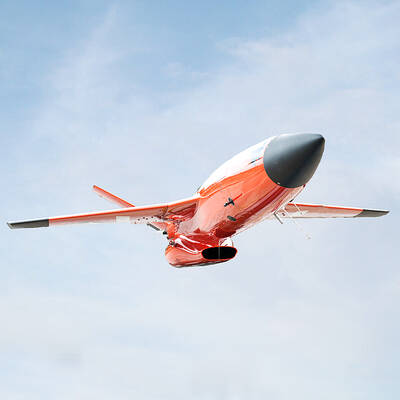
The Chien Feng IV (勁蜂, Mighty Hornet) loitering munition is on track to enter flight tests next month in connection with potential adoption by Taiwanese and US armed forces, a government source said yesterday. The kamikaze drone, which boasts a range of 1,000km, debuted at the Taipei Aerospace and Defense Technology Exhibition in September, the official said on condition of anonymity. The Chungshan Institute of Science and Technology and US-based Kratos Defense jointly developed the platform by leveraging the engine and airframe of the latter’s MQM-178 Firejet target drone, they said. The uncrewed aerial vehicle is designed to utilize an artificial intelligence computer


 RSS
RSS