


A petition to hold a referendum on activating the nation’s mothballed Fourth Nuclear Power Plant has reached the legal threshold for the referendum to be held, the Central Election Commission said on Tuesday.
The commission said that it would tomorrow submit the petition to a review before making a formal announcement with details of the referendum.
The plant, which was close to completion in New Taipei City’s Gongliao District (貢寮) before being shelved in 2014, has become a focal point in the debate over nuclear power.
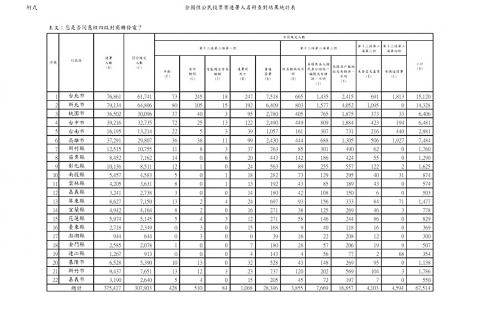
Graphic from the Central Election Commission Web site
Supporters have lauded it as a remedy to issues such as poor air quality and rising electricity costs, while critics have warned of potential danger, citing the 2011 Fukushima Dai-ichi nuclear power plant disaster in Japan as an example.
In a referendum held in November last year, 59 percent of voters elected to keep nuclear power in Taiwan’s energy mix and repeal a law that would have phased out nuclear power by 2025.
In May, the Democratic Progressive Party (DPP) complied with the referendum results by amending the law, but reaffirmed its opposition to activating the Fourth Nuclear Power Plant and its support for phasing out nuclear power.
In contrast, the Chinese Nationalist Party (KMT) has proposed using nuclear power as a supplement to renewable energy sources.
The petition by nuclear power advocate Huang Shih-hsiu (黃士修) to activate the facility and begin commercial operations has reached 307,903 valid signatures, putting it above the legal threshold, the commission said.
The Referendum Act (公民投票法) stipulates that a number equal to 1.5 percent of the voters in the most recent presidential election — approximately 282,000 people based on the turnout in 2016 — must sign a petition for a national referendum to be held.
Under amendments to the act, the next referendum could be held on Aug. 28, 2021 — a date the commission is expected to formally announce following its review.
The changes have been a subject of political controversy.
In late 2017, the Legislative Yuan, in which the DPP has the majority, pushed through legislation to relax the requirements for holding referendums, only for the party to suffer major defeats when 10 referendum questions were included alongside the nine-in-one elections on Nov. 24 last year.
In June, the government passed legislation mandating that referendum questions must be held in August, effectively separating them from national and local elections, and making it less likely that they would pass the eligibility threshold.
While the DPP has said that the changes were necessary to avoid a repeat of long lines at polling stations last year, the KMT has said that the government was creating obstacles following the string of defeats its policies suffered in the last referendums.
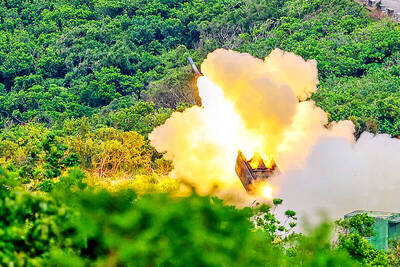
PRECISION STRIKES: The most significant reason to deploy HIMARS to outlying islands is to establish a ‘dead zone’ that the PLA would not dare enter, a source said A High Mobility Artillery Rocket System (HIMARS) would be deployed to Penghu County and Dongyin Island (東引) in Lienchiang County (Matsu) to force the Chinese military to retreat at least 100km from the coastline, a military source said yesterday. Taiwan has been procuring HIMARS and Army Tactical Missile Systems (ATACMS) from the US in batches. Once all batches have been delivered, Taiwan would possess 111 HIMARS units and 504 ATACMS, which have a range of 300km. Considering that “offense is the best defense,” the military plans to forward-deploy the systems to outlying islands such as Penghu and Dongyin so that
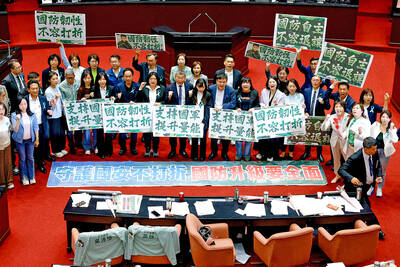
WHAT WAS ALL THAT FOR? Jaw Shaw-kong said that Cheng Li-wen had pushed for more drastic cuts and attacked him, just for the outcome to be nearly identical to his bill The legislature yesterday passed a supplementary budget bill to fund the purchase of separate packages of US military equipment, with the combined amount of spending capped at NT$780 billion (US$24.8 billion). The Chinese Nationalist Party (KMT) and Taiwan People’s Party (TPP) used their legislative majority to pass the bill, which runs until 2033 and has two main funding provisions. One was for NT$300 billion of arms sales already approved by the US for Taiwan on Dec. 17 last year, the other was for NT$480 billion for another arms package expected to be announced by Washington. The bill, which fell short of the NT$1.25

‘CLEAR MESSAGE’: The bill would set up an interagency ‘tiger team’ to review sanctions tools and other economic options to help deter any Chinese aggression toward Taiwan US Representative Young Kim has introduced a bill to deter Chinese aggression against Taiwan, calling for an interagency “tiger team” to preplan coordinated sanctions and economic measures in response to possible Chinese military or political action against Taiwan. “[Chinese President] Xi Jinping [習近平] has directed the People’s Liberation Army to be ready to invade Taiwan by 2027. China has a plan. America should have one too,” Kim said in a news release on Thursday last week. She introduced the “Deter PRC [People’s Republic of China] aggression against Taiwan act” to “ensure the US has a coordinated sanctions strategy ready should

A former television news host and six military personnel — active and retired — have been indicted on espionage charges, Kaohsiung prosecutors said yesterday. Lin Chen-you (林宸佑), a former CTi News host and YouTuber, last year allegedly made videos at the direction of a Chinese agent criticizing the Democratic Progressive Party’s recall campaign, the Ciaotou District Prosecutors’ Office told a news conference in Kaohsiung. He allegedly received 4,325 tether coins for the videos from an unidentified person surnamed Huang (黃), believed to be an agent of a hostile foreign power, they said. Lin, also known as Ma Te (馬德), has a show named


 RSS
RSS