


President Tsai Ing-wen (蔡英文) yesterday urged voters to demonstrate to the world their resolve to keep Taiwan a nation that values equality and justice.
In her speech at a National Christian Prayer Society event in Taichung, Tsai, who is seeking re-election as the Democratic Progressive Party’s (DPP) candidate, said she could feel that Christian sisters and brothers have a strong passion for the nation, as well as their insistence on equality and justice.
Taiwan has earned respect in the international community for standing tall in the face of China’s verbal and military threats, and in turn has become stronger, she said.
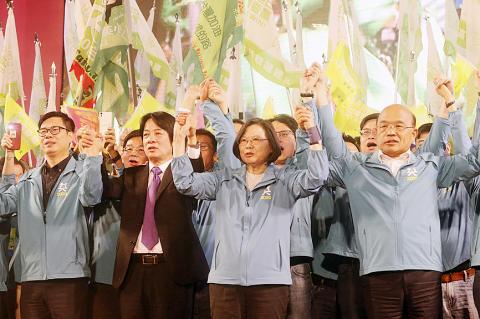
Photo: CNA
She vowed to make the nation more secure, introduce more economic policies on the back of a rebounding economy and provide more comprehensive social welfare.
Following the event, Tsai traveled to Kaohsiung, where former premier William Lai (賴清德), Premier Su Tseng-chang (蘇貞昌) and Presidential Office Secretary-General Chen Chu (陳菊) joined her to inaugurate her campaign headquarters in the city.
She urged people to defend Taiwan by supporting the DPP to win back Kaohsiung in January’s elections.
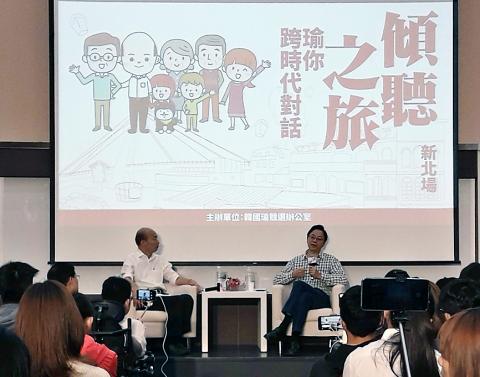
Photo: CNA
Separately, a DPP source said that Tsai is to announce Lai as her running mate today at a ceremony to open her national campaign headquarters in Taipei.
Earlier in the day, at the launch of DPP Legislator Wu Chi-ming’s (吳琪銘) campaign office in New Taipei City, Tsai said that a secure society is one that is free and democratic, and one that people gravitate toward — unlike Hong Kong, whose fate is not in the hands of its people.
Taiwanese must show their resolve to safeguard democracy and freedom with their votes on Jan. 11, she said.
Elsewhere in New Taipei City, Kaohsiung Mayor Han Kuo-yu (韓國瑜), the Chinese Nationalist Party’s (KMT) presidential candidate, and his running mate, former premier Simon Chang (張善政), attended a meet-and-greet with predominantly young people at the New Taipei Convention Center in Sindian District (新店).
One participant asked Han for his views on a survey that showed that most Taiwanese would put national interests ahead of economic benefits.
From ancient times, people prayed for their nation to have prosperity, social security and good weather, so they could live safely and have a rewarding career, Han said.
However, people cannot have a rewarding career if their safety is threatened, so his campaign slogan puts “safety for Taiwan” before “wealth for the people,” he said.
The security of the Republic of China should come first, he said.
If elected, he would shoulder the responsibility of protecting people and appoint a capable premier to enrich people, he said.
Upholding national security is not lip service, Han said, adding that he would not sacrifice economic benefit or national security for the other.
He and Chang are the pair who care most about the future of the younger generation, Han said, adding that if elected, he would formulate policies to invest in young people, for example granting them subsidies for trips abroad to broaden their worldviews.
Earlier, at an event at Juan Jing Vocational High School in New Taipei City, Han praised its e-sports program.
As Taiwanese teenagers are smart and creative, the government should pay more attention to the rising e-sports industry so that the nation can one day supplant South Korea as No. 1 in the world in terms of e-sports and development of the gaming industry, he said.
Additional reporting by Chiu Shu-yu and CNA
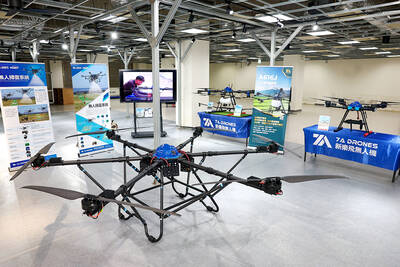
DRONE CENTRAL: Taiwan aims to become Asia’s democratic hub for drones, with most exports focused on high-quality military-grade models, an official said Taiwan’s drone industry is expected to expand significantly by 2030, producing 100,000 units per month and exporting half of them, the Ministry of Economic Affairs said yesterday. Current drone production capacity is about 15,000 units per month, but the industry can quickly scale up as demand increases, Industrial Development Administration Director-General Chiou Chyou-huey (邱求慧) told a news conference in Taipei. Taiwan’s drone output grew 2.5-fold last year to NT$12.9 billion (US$408.3 million) under a government program to develop the uncrewed vehicle sector, he said. The Executive Yuan in October last year approved plans to invest NT$44.2 billion into domestic production of uncrewed aerial
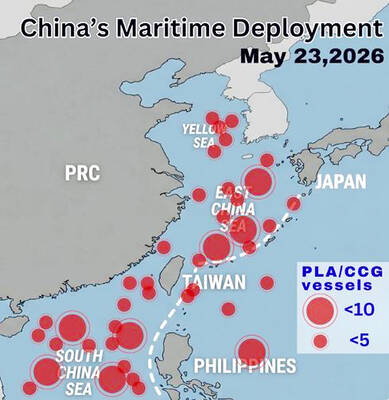
WARNING: China should stop engaging in actions that undermine regional peace and stability, as it would only build resentment among people across the Strait, the CGA said China has deployed more than 100 navy, coast guard and other vessels in waters from the Yellow Sea to the South China Sea and the western Pacific since US President Donald Trump and Chinese President Xi Jinping (習近平) met in Beijing, National Security Council Secretary-General Joseph Wu (吳釗燮) said yesterday. “In this part of the world, #China is the one & only PROBLEM wrecking the #StatusQuo & threatening regional peace & stability,” Wu wrote on X. In a separate post, he said Beijing was coercing Taiwan’s maritime domain, calling it illegal and provocative, after the Coast Guard Administration (CGA) expelled a

VERBOSE VESSELS: A CGA cutter and a China Coast Guard exchanged verbal barbs for more than a day in Taiwanese-controlled waters before the Chinese vessel left The Taiwanese and Chinese coast guards had a standoff near the strategically located Pratas Islands (Dongsha Islands, 東沙群島) in the north of the South China Sea, the Coast Guard Administration (CGA) said yesterday. The two sides engaged in intense radio exchanges over sovereignty claims during the 33-hour standoff. China Coast Guard vessel 3501 eventually left the restricted waters, 26.6 nautical miles (49.2km) west of the Pratas Islands, at 5pm yesterday, the CGA said. Lying approximately between southern Taiwan and Hong Kong, the Taiwan-controlled Pratas are seen by some security experts as vulnerable to Chinese attack due to their distance — more than
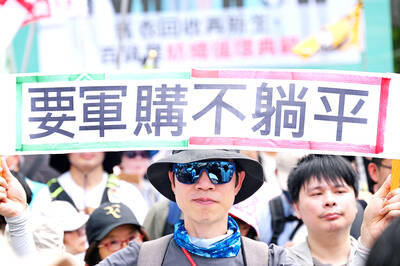
More than 8,000 people took part in a rally in Taipei yesterday to express support for more defense spending, after the opposition slashed the Cabinet’s proposed NT$1.25 trillion (US$39.6 billion) special defense budget and capped it at NT$780 billion. The demonstrators urged the Cabinet to propose another bill. Taiwan Economic Democracy Union convener Lai Chung-chiang (賴中強) said the main problem of the passed budget plan is the removal of funding for critical items, not just that the total amount is smaller. Critical budget items included purchasing or developing uncrewed vehicles, Strong Bow (強弓) missile systems, additional ammunition, artificial intelligence-powered combat systems and Taiwan-US


 RSS
RSS