


Hong Kong officials yesterday apologized to Muslim leaders after riot police on Sunday sprayed a mosque and bystanders with a water cannon loaded with a blue liquid while trying to contain pro-democracy demonstrations.
Hong Kong Chief Executive Carrie Lam (林鄭月娥) and the police chief visited the Kowloon Masjid and Islamic Centre to apologize to the chief imam and Muslim community leaders.
Officials were scrambling to minimize the fallout from the incident at one of the territory’s most well-known religious sites.

Photo: AFP
The government said in a statement that Lam “extended an apology for the inadvertent spraying.”
Authorities called it an accident, but a bystander’s account disputed that.
Muslim leaders told reporters they accepted the apology.
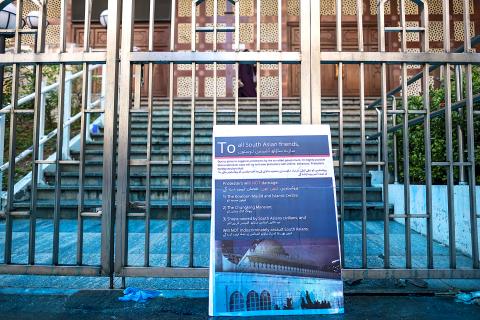
Photo: Bloomberg
“Our mosque is not damaged, nothing is done wrong. Only thing is that they should have not done it. For that they apologized so we accept it,” said Saeed Uddin, honorary secretary of the Islamic Community Fund of Hong Kong.
Police also apologized later at a daily news briefing and said they had been contacting Muslim community leaders.
“To any people or any groups that were affected, we offer our genuine apologies,” Kowloon West regional commander Cheuk Hau-yip (卓孝業) said. “We certainly do not have any malicious intent.”
It was a rare case of authorities apologizing for how they have handled the protest movement, which erupted in early June and expanded to include demands for police accountability and political reforms.
Protesters seized on it as the latest example of what they call unnecessarily harsh police tactics.
During Sunday’s protest, a police water cannon truck that was passing by the mosque sprayed a stinging blue-dyed liquid at a handful of people standing in front of the mosque’s gate, according to video of the incident by pro-democracy Hong Kong Legislator Jeremy Tam (譚文豪).
The mosque’s front steps, metal gate and the sidewalk outside were stained with the blue liquid while people caught in the plume were left gagging, coughing and trying to rinse the solution from their eyes, the video shows.
Volunteers later arrived to help clean up the mosque, and by yesterday morning the blue coating was largely gone.
Mohan Chugani, a businessman and former president of Hong Kong’s Indian Association, said he was passing by the mosque and stopped to chat with someone when he was hit by the cannon.
Chugani, who is not Muslim, said there were no protesters around when the water cannon and an armored car rolled up, so he thought nothing of it.
Then he noticed a periscope on the cannon focusing on him and before he knew it, the cannon fired.
“I was shocked,” Chugani, 73, said. “The second round became much more powerful. I couldn’t open my eyes, and it was like my whole body was on fire.”
Chugani, whose left eye remained swollen shut, said officials reached out to apologize.

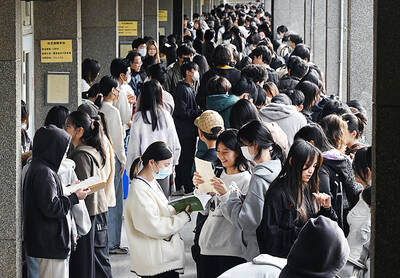
A global survey showed that 60 percent of Taiwanese had attained higher education, second only to Canada, the Ministry of the Interior said. Taiwan easily surpassed the global average of 43 percent and ranked ahead of major economies, including Japan, South Korea and the US, data from the Organisation for Economic Co-operation and Development (OECD) for 2024 showed. Taiwan has a high literacy rate, data released by the ministry showed. As of the end of last year, Taiwan had 20.617 million people aged 15 or older, accounting for 88.5 percent of the total population, with a literacy rate of 99.4 percent, the data

NEW LOW: The council in 2024 based predictions on a pessimistic estimate for the nation’s total fertility rate of 0.84, but last year that rate was 0.69, 17 percent lower An expected National Development Council (NDC) report expects the nation’s population to drop below 12 million by 2065, with the old-age dependency ratio to top 100 percent sooner than 2070, sources said yesterday. The council is slated to release its latest population projections in August, using an ultra-low fertility model, the sources said. The previous report projected that Taiwan’s population would fall to 14.37 million by 2070, but based on a new estimate of the total fertility rate (TFR) — the average number of children born to a woman over her lifetime — the population is expected to reach 12 million by
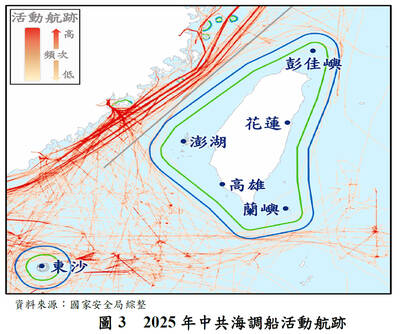
INTENSIFYING THREATS: Beijing’s tactics include massive attacks on the government service network, aircraft and naval vessel incursions and damaging undersea cables China is prepared to interfere in November’s nine-in-one local elections by launching massive attacks on the Taiwanese government’s service network (GSN), a report published by the National Security Bureau showed. The report was submitted to the Legislative Yuan ahead of the bureau’s scheduled briefing at the Foreign Affairs and National Defense Committee tomorrow. The national security team has identified about 13,000 suspicious Internet accounts and 860,000 disputed messages, the bureau said of China’s cognitive warfare against Taiwan. The disputed messages focus on major foreign affairs, national defense and economic issues, which were produced using generative artificial intelligence (AI) and distributed through Chinese

COUNTERING HOSTILITY: The draft bill would require the US to increase diplomatic pressure on China and would impose sanctions on those who sabotage undersea cable networks US lawmakers on Thursday introduced a bipartisan bill to bolster the resilience of Taiwan’s submarine cables to counter China’s hostile activities. The proposal, titled the critical undersea infrastructure resilience initiative act, was cosponsored by Republican representatives Mike Lawler and Greg Stanton, and Democratic Representative Dave Min. US Senators John Curtis and Jacky Rosen also introduced a companion bill in the US Senate, which has passed markup at the chamber’s Committee on Foreign Relations. The House’s version of the bill would prioritize the deployment of sensors to detect disruptions or potential sabotage in real-time and enhance early warning capabilities through global intelligence sharing frameworks,


 RSS
RSS