


South Korea yesterday warned Japan that it would be forced to review security cooperation between the two key US allies if Tokyo pushes ahead with plans to remove Seoul from its “white list” of trusted trade partners.
The squabble between the neighbors follows a decades-long quarrel over Japanese forced labor during World War II.
Japan last month unveiled tough restrictions on exports of chemicals vital to Seoul’s world-leading chip and smartphone industries.
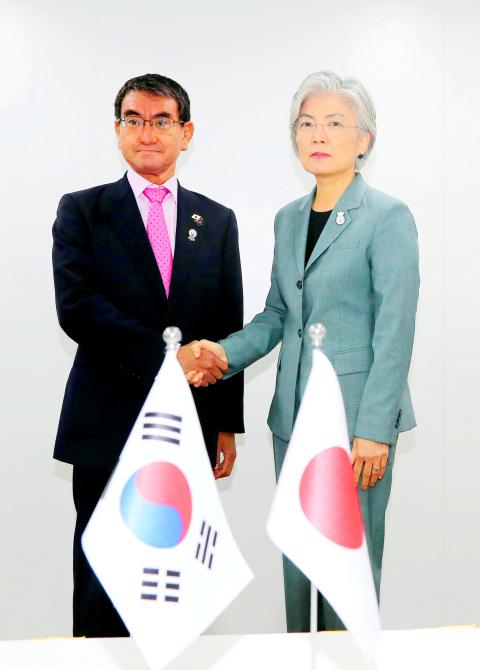
Photo: EPA-EFE / Yonhap
Tokyo has also said that it would remove South Korea from its preferential trade status list as early as yesterday, a move that could affect hundreds of key items imported to the South and punch a hole in its economy.
South Korean Minister of Foreign Affairs Kang Kyung-wha yesterday met Japanese Minister of Foreign Affairs Taro Kono on the sidelines of an ASEAN foreign ministers’ meeting in Bangkok and urged Tokyo to walk back the move.
“I made clear the grave consequences it would have on our bilateral relations if the measure was imposed,” she told reporters.
Kang warned that the renewal of a military intelligence-sharing agreement between the countries could be jeopardized by any “white list” removal.
“I said that the security cooperation framework between South Korea and Japan may be affected,” she added.
Japanese Chief Cabinet Secretary Yoshihide Suga on Wednesday said that his side intended to press ahead with the move.
“This policy remains unchanged and we will calmly proceed with the formalities,” he told reporters.
Seoul and Tokyo are Washington’s key security allies in the region and critical in any future deal on the denuclearization of the Korean Peninsula.
US Secretary of State Mike Pompeo, who is also in Bangkok attending the summit, has pledged to mediate between the two countries when he meets their diplomats today.
“We will encourage them to find a path forward,” he said ahead of his trip.
Pompeo is trialing Washington’s rebooted Asia security strategy in Bangkok.
He yesterday insisted that Washington was not asking Southeast Asian nations to “choose” between his country and rival power China.
The denuclearization of the Korean Peninsula, a bitter trade war between the superpowers and open access to contested seas dominated talks between Pompeo and Chinese State Councilor Wang Yi (王毅).
Both later played down the rifts between their nations, with Wang describing the meeting as a “deep communication” that “has helped to increase our mutual understanding.”
Pompeo said on Twitter that he had “an in-depth exchange of views” with Wang, including on North Korea, adding that “when it advances U.S. interests, we are ready to cooperate with China.”
Pompeo also insisted that the US was not prodding Southeast Asian nations to “choose between countries.”
“Our engagement in this region has not been and will not be a zero-sum exercise,” he said in short remarks at the opening of the ASEAN meeting. “Our interests simply naturally converge with yours to our mutual benefit.”
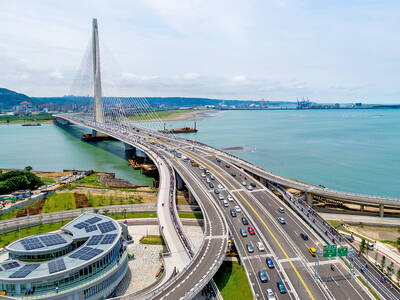
The Ministry of Transportation and Communications yesterday inaugurated the Danjiang Bridge across the Tamsui River in New Taipei City, saying that the structure would be an architectural icon and traffic artery for Taiwan. Feted as a major engineering achievement, the Danjiang Bridge is 920m long, 211m tall at the top of its pylon, and is the longest single-pylon asymmetric cable-stayed bridge in the world, the government’s Web site for the structure said. It was designed by late Iraqi-British architect Zaha Hadid. The structure, with a maximum deck of 70m, accommodates road and light rail traffic, and affords a 200m navigation channel for boats,
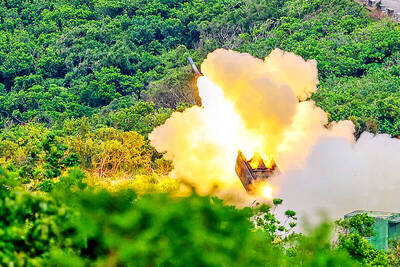
PRECISION STRIKES: The most significant reason to deploy HIMARS to outlying islands is to establish a ‘dead zone’ that the PLA would not dare enter, a source said A High Mobility Artillery Rocket System (HIMARS) would be deployed to Penghu County and Dongyin Island (東引) in Lienchiang County (Matsu) to force the Chinese military to retreat at least 100km from the coastline, a military source said yesterday. Taiwan has been procuring HIMARS and Army Tactical Missile Systems (ATACMS) from the US in batches. Once all batches have been delivered, Taiwan would possess 111 HIMARS units and 504 ATACMS, which have a range of 300km. Considering that “offense is the best defense,” the military plans to forward-deploy the systems to outlying islands such as Penghu and Dongyin so that
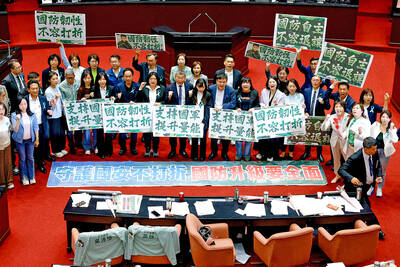
WHAT WAS ALL THAT FOR? Jaw Shaw-kong said that Cheng Li-wen had pushed for more drastic cuts and attacked him, just for the outcome to be nearly identical to his bill The legislature yesterday passed a supplementary budget bill to fund the purchase of separate packages of US military equipment, with the combined amount of spending capped at NT$780 billion (US$24.8 billion). The Chinese Nationalist Party (KMT) and Taiwan People’s Party (TPP) used their legislative majority to pass the bill, which runs until 2033 and has two main funding provisions. One was for NT$300 billion of arms sales already approved by the US for Taiwan on Dec. 17 last year, the other was for NT$480 billion for another arms package expected to be announced by Washington. The bill, which fell short of the NT$1.25
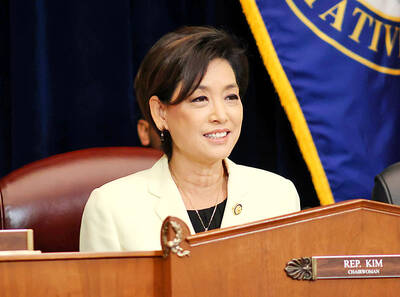
‘CLEAR MESSAGE’: The bill would set up an interagency ‘tiger team’ to review sanctions tools and other economic options to help deter any Chinese aggression toward Taiwan US Representative Young Kim has introduced a bill to deter Chinese aggression against Taiwan, calling for an interagency “tiger team” to preplan coordinated sanctions and economic measures in response to possible Chinese military or political action against Taiwan. “[Chinese President] Xi Jinping [習近平] has directed the People’s Liberation Army to be ready to invade Taiwan by 2027. China has a plan. America should have one too,” Kim said in a news release on Thursday last week. She introduced the “Deter PRC [People’s Republic of China] aggression against Taiwan act” to “ensure the US has a coordinated sanctions strategy ready should


 RSS
RSS