


Former president Ma Ying-jeou (馬英九) and former vice president Wu Den-yih (吳敦義) plan to appeal the Presidential Office’s decision to extend restrictions on their visits to China for two more years, they said yesterday.
The decision was “completely unjustified and designed to humiliate” given that neither he nor Wu had contravened the National Security Information Protection Act (國家機密保護法) or leaked confidential information, Ma said at a news conference at the Chinese Nationalist Party’s (KMT) headquarters in Taipei.
The Presidential Office informed the men on Friday — two days before their existing three-year travel restrictions were due to expire — that the restrictions had been extended to May 19, 2021.
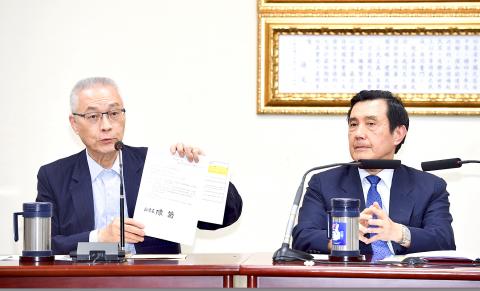
Photo: Peter Lo, Taipei Times
Under amendments to the National Security Information Protection Act passed on Friday, agencies that handle confidential information can add up to three years to an existing three-year travel restriction on former officials who had been entrusted with state secrets.
During that period, the former officials must seek approval from the pertinent agencies before traveling to China.
Article 26 of the act stipulates that responsible agencies can extend the restrictions “depending on the situation,” but the notice from the Presidential Office did not explain what situation led to its decision, Ma said.
“Have I broken any law or leaked any confidential information? Is it necessary to leave the country if I wanted to leak information? What time do you come from if you think that way? Why is it two years, not one year, or three years?” he said.
The decision was “arbitrary” and targeted certain individuals, he said.
He would obey, but to protect their rights, he and Wu would appeal the decision, Ma said.
President Tsai Ing-wen (蔡英文) should explain the rationale for the extension, and they are willing to meet with her at the Presidential Office if she has any doubts about them, he said.
Wu said that the KMT had always prioritized the rights and interests of the Republic of China (ROC) when it was the ruling party.
“Now that we have stepped down, why would we want to leak state secrets? That is just impossible. We love our country,” he said.
The act has been inappropriately and unfairly applied to them and the Presidential Office should immediately correct the mistake, he said.
Asked if the KMT-Chinese Communist Party forum planned for next month would be canceled, Wu said the party had applied for approval for him to visit China before the act was amended.
Tsai yesterday told reporters during a visit to Kaohsiung that the act applied to the former Ma administration and would apply to her own after she leaves office.
The decision “was not targeted at specific individuals,” she said, adding the higher a former official’s rank, the longer the restrictions.
Additional reporting by CNA
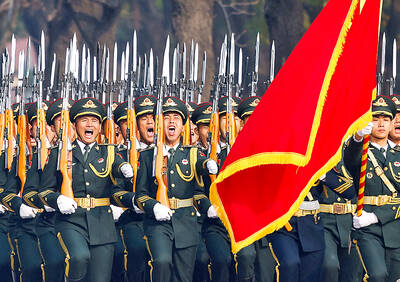
Conflict with Taiwan could leave China with “massive economic disruption, catastrophic military losses, significant social unrest, and devastating sanctions,” a US think tank said in a report released on Monday. The German Marshall Fund released a report titled If China Attacks Taiwan: The Consequences for China of “Minor Conflict” and “Major War” Scenarios. The report details the “massive” economic, military, social and international costs to China in the event of a minor conflict or major war with Taiwan, estimating that the Chinese People’s Liberation Army (PLA) could sustain losses of more than half of its active-duty ground forces, including 100,000 troops. Understanding Chinese
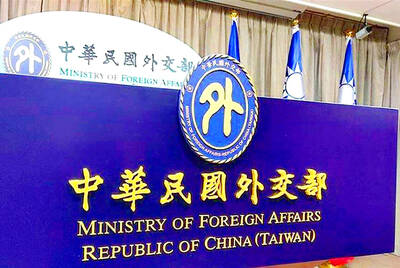
The Ministry of Foreign Affairs (MOFA) yesterday said it is closely monitoring developments in Venezuela, and would continue to cooperate with democratic allies and work together for regional and global security, stability, and prosperity. The remarks came after the US on Saturday launched a series of airstrikes in Venezuela and kidnapped Venezuelan President Nicolas Maduro, who was later flown to New York along with his wife. The pair face US charges related to drug trafficking and alleged cooperation with gangs designated as terrorist organizations. Maduro has denied the allegations. The ministry said that it is closely monitoring the political and economic situation

UNRELENTING: China attempted cyberattacks on Taiwan’s critical infrastructure 2.63 million times per day last year, up from 1.23 million in 2023, the NSB said China’s cyberarmy has long engaged in cyberattacks against Taiwan’s critical infrastructure, employing diverse and evolving tactics, the National Security Bureau (NSB) said yesterday, adding that cyberattacks on critical energy infrastructure last year increased 10-fold compared with the previous year. The NSB yesterday released a report titled Analysis on China’s Cyber Threats to Taiwan’s Critical Infrastructure in 2025, outlining the number of cyberattacks, major tactics and hacker groups. Taiwan’s national intelligence community identified a large number of cybersecurity incidents last year, the bureau said in a statement. China’s cyberarmy last year launched an average of 2.63 million intrusion attempts per day targeting Taiwan’s critical
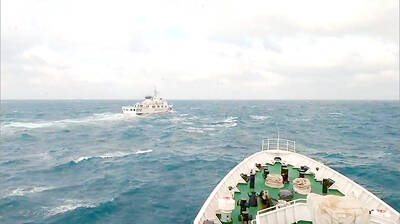
‘SLICING METHOD’: In the event of a blockade, the China Coast Guard would intercept Taiwanese ships while its navy would seek to deter foreign intervention China’s military drills around Taiwan this week signaled potential strategies to cut the nation off from energy supplies and foreign military assistance, a US think tank report said. The Chinese People’s Liberation Army (PLA) conducted what it called “Justice Mission 2025” exercises from Monday to Tuesday in five maritime zones and airspace around Taiwan, calling them a warning to “Taiwanese independence” forces. In a report released on Wednesday, the Institute for the Study of War said the exercises effectively simulated blocking shipping routes to major port cities, including Kaohsiung, Keelung and Hualien. Taiwan would be highly vulnerable under such a blockade, because it


 RSS
RSS