


China yesterday announced a 7.5 percent increase in military spending for this year, lower than last year as the nation faces an economic slowdown, but still likely to make Asian neighbors nervous.
It is working to provide the 2 million-strong Chinese People’s Liberation Army (PLA) with state-of-the-art hardware, spending heavily on stealth warplanes, aircraft carriers and other weaponry.
Beijing has also stepped up its rhetoric against any independence movements in Taiwan and continues to assert its vast territorial claims in the disputed South China Sea and East China Sea.
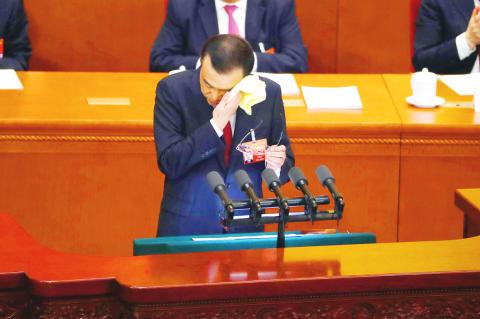
Photo: EPA-EFE
The government is to spend 1.19 trillion yuan (US$177.6 billion) on defense this year, after it increased its outlay by 8.1 percent to 1.11 trillion yuan last year, according to a government report presented at the start of the annual meeting of the National People’s Congress.
Boasting the world’s largest army, China’s military spending is second only to the US, which budgeted US$716 billion for defense this year.
China has not posted double-digit spending increases since 2015.
The Chinese government would make “further efforts to ensure the political loyalty of the armed forces,” Chinese Premier Li Keqiang (李克強) said in a speech to the nearly 3,000 members of the legislature, stressing the “absolute party leadership” over the military.
Li said the government would “strengthen military training under combat conditions and firmly protect China’s sovereignty, security and development interests.”
The lower spending increase comes as the nation’s economy is slowing, with the government setting a lower economic growth target of 6 to 6.5 percent.
“China’s military expenditure is coordinated with annual Chinese GDP growth,” said James Char, a military expert at Singapore’s Nanyang Technological University.
“China has other national priorities and an over-militarized national economy can deprive the government of much-needed resources, as what had happened to the former USSR,” Char said.
Chinese President Xi Jinping (習近平), who has vowed to turn the PLA into a “world class” military by mid-century, has repeatedly called on the army to be combat-ready.
“In Taiwan, you can legitimately worry about the Chinese budget increases, because they coincide with a more aggressive posture towards Taipei,” said Barthelemy Courmont, Asia researcher at the Institute for Strategic and Foreign Relations in Paris.
A photograph released on Twitter on Monday by ImageSat International showed that four Xian H-6 bombers from the People’s Liberation Army Air Force had been forward-deployed to the Xingning Air Base in Guangdong Province, only 450km from Taiwan.
Ministry of National Defense spokesman Major General Chen Chung-chi (陳中吉) yesterday reassured the public that the ministry has round-the-clock surveillance on military deployments or movements by China.
China also faces competing claims in the South China Sea from Taiwan, Vietnam, the Philippines, Brunei and Malaysia. It also has a territorial dispute with historic rival Japan in the East China Sea.
Additional reporting by staff writer
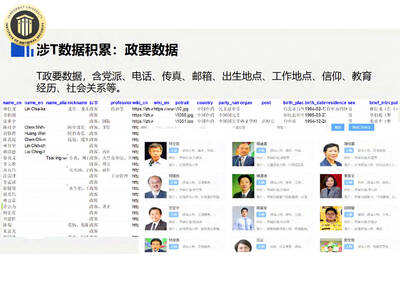
NETWORK-MAPPING PROJECT: The database contains 170 detailed files of Taiwanese politicians and about 23 million records of household registration data in Taiwan China has developed a network-mapping project targeting political figures and parties in Taiwan to monitor public opinion during elections and to craft tailored influence campaigns aimed at dividing Taiwanese society, according to documents leaked by Chinese technology firm GoLaxy (中科天璣). The documents, collected by Taipei-based Doublethink Lab, showed a database was specifically created to gather detailed information on Taiwanese political figures, including their political affiliations, job histories, birthplaces, residences, education, religion and a brief biography about them. Several notable Taiwanese politicians are in the database, including President William Lai (賴清德), former president Tsai Ing-wen (蔡英文), Minister of Foreign Affairs Lin Chia-lung (林佳龍),
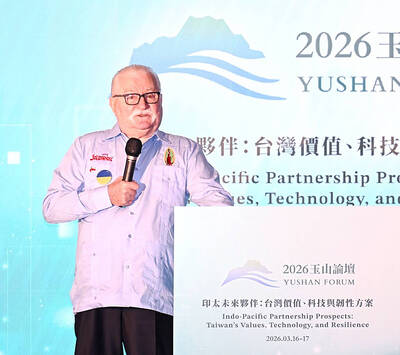
RECOGNITION: Former Fijian prime minister Mahendra Chaudhry said that Taiwan’s New Southbound Policy serves as a stabilizing force in the Indo-Pacific region Taiwan can lead the unification of the Chinese people, Nobel Peace Prize laureate and former Polish president Lech Walesa said in Taipei yesterday, adding that as the world order is changing, peaceful discussion would find good solutions, and that the use of force and coercion would always fail. Walesa made the remarks during his keynote address at a luncheon of the Yushan Forum in Taipei, titled “Indo-Pacific Partnership Prospects: Taiwan’s Values, Technology and Resilience,” organized by the Taiwan-Asia Exchange Foundation with the Ministry of Foreign Affairs. Walesa said that he had been at the forefront of a big peaceful revolution and “if
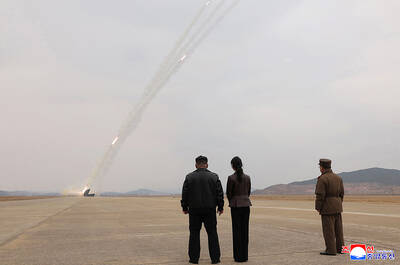
North Korea tested nuclear-capable rocket launchers, state media reported yesterday, a day after Seoul detected the launch of about 10 ballistic missiles. The test comes after South Korean and US forces launched their springtime military drills, due to run until Thursday. North Korean leader Kim Jong-un on Saturday oversaw the testing of the multiple rocket launcher system (MRLS), the Korean Central News Agency (KCNA) said. The test involved 12 600mm-caliber ultra-precision multiple rocket launchers and two artillery companies, it said. Kim said the drill gave Pyongyang’s enemies, within the 420km striking range, a sense of “uneasiness” and “a deep understanding
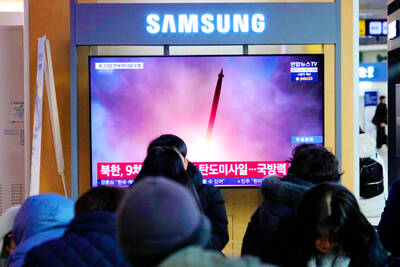
North Korea yesterday fired about 10 ballistic missiles to the sea toward Japan, the South Korean Joint Chiefs of Staff (JCS) said, days after Pyongyang warned of “terrible consequences” over ongoing South Korea-US military drills. Pyongyang recently dashed hopes of a diplomatic thaw with Seoul, Washington’s security ally, describing its latest peace efforts as a “clumsy, deceptive farce.” Seoul’s military detected “around 10 ballistic missiles launched from the Sunan area in North Korea toward the East Sea [Sea of Japan] at around 1:20pm,” JCS said in a statement, referring to South Korea’s name for the body of water. The missiles


 RSS
RSS