

The government is to revisit the “Kuan Hung Pilot Project” after 152 of 153 Vietnamese visitors in tour groups went missing last week, the largest group of runaway tourists since the project began in 2015, the Tourism Bureau said yesterday.
The project to issue electronic visas is designed to increase the number of quality tour groups visiting from India, Indonesia, Vietnam, Myanmar, Cambodia and Laos — nations targeted by the New Southbound Policy.
The tourists were able to travel to Taiwan because of the project, bureau Director-General Chou Yung-hui (周永暉) said, adding that the agency would strengthen visa reviews.
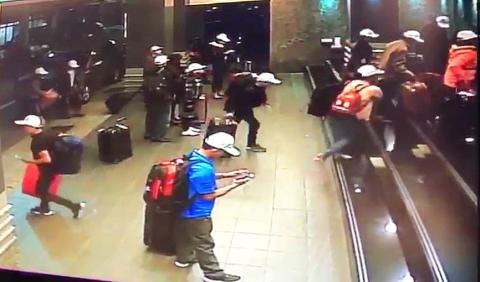
Photo copied by Huang Liang-chieh, Taipei Times
It would also work with the National Immigration Agency (NIA) and the Ministry of Foreign Affairs’ (MOFA) Bureau of Consular Affairs to randomly select applications for additional inspection, Chou added.
Asked if the government would consider revising the project, Chou said that the Tourism Bureau has been notified that it should soon attend a meeting of the Executive Yuan’s Tourism Development and Promotion Committee to discuss problems facing the project.
“What happened last week was an isolated case. There are still quality tour groups and we should not view the project with so much negativity,” the Tourism Bureau said. “The NIA still needs to investigate details involving this incident and we will propose complementary measures accordingly to handle similar situations.”
The tour groups were formed by Vietnamese travel agency International Holidays Trading Travel, then were taken over by ETHoliday (東森國際旅行社) upon arrival.
After the incident, the Bureau of Consular Affairs canceled the visas granted to 182 tourists who had booked trips with International Holidays Trading Travel, but have not yet entered the country, the Tourism Bureau said, adding that it has also stopped reviewing visa applications filed by the agency.
Travel agents said that the incident is an example of how human traffickers are able to exploit loopholes in the project.
ETHoliday last week handled five tour groups from Vietnam, Taiwan International Tourist Aid Rescue Association chairman Roget Hsu (許高慶) said.
The first group of 23 people arrived in Kaohsiung on Friday for a five-day tour, while the four other groups with a total of 130 tourists entered through Tainan Airport on Sunday for a four-day tour, he said, adding that all five groups spent the night at two hotels in Kaohsiung.
Human traffickers reportedly arranged cars to pick the visitors up at the airports, Hsu said.
The first group’s Taiwanese tour guide resisted and called the police, who said they could not make any arrests, as the tourists had valid tourist visas, he said.
Seven visitors in the first group had left by Monday morning, while the remaining 16 went missing by Tuesday morning, he said.
Of the 130 tourists who arrived on Sunday, 128 went missing by Monday morning, while one other had left by Tuesday, Hsu said.
Tourists from the countries included in the program are not required to present a financial statement when applying for a visa, so Vietnamese travel agencies should help by running preliminary checks, he said, adding that it is unreasonable that Taiwanese travel agencies should have to pay for the deportation cost of every runaway tourist.
The one remaining visitor was the only real tourist, meaning that even the tour guides were disingenuous, the Tourism Bureau said.
All of the visitors had purchased round-trip tickets, it added.
The NIA has obtained the list of tourists from ETHoliday and are searching for the missing people.
MOFA said it has revoked the visas of the missing travelers and has asked the NIA to locate and deport them.
It also urged the Executive Yuan to call a meeting to discuss ways to tighten visa application reviews.
Since 2015, 414 tourists arriving through the project have been reported missing, 409 of whom were Vietnamese, while five were Cambodian, Tourism Bureau data showed.
Additional reporting by Lu Yi-hsuan
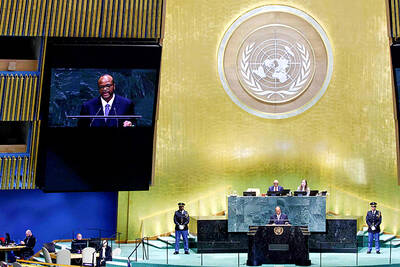
UNITY: Lai thanked the nations who spoke up for Taiwan, saying that democracies must stand together to face global authoritarian expansion Taiwan yesterday thanked eight European and Indo-Pacific countries for opposing unilateral changes to the “status quo” in the Taiwan Strait in a joint statement earlier this week, as well as three of Taiwan’s allies for speaking up for the nation’s participation in the UN at the body’s General Assembly in New York. Minister of Foreign Affairs Lin Chia-lung (林佳龍) welcomed the support and expressed his appreciation for the countries’ stance, the Ministry of Foreign Affairs said in a statement. Foreign ministers and senior representatives of Australia, France, Germany, Japan, New Zealand, Poland, South Korea and the UK issued a statement on Tuesday
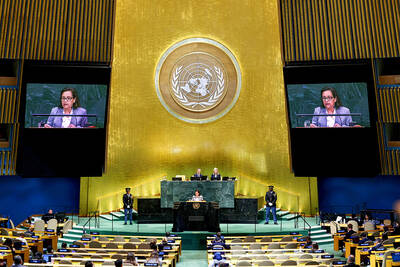
PLEA: How the UN addresses Taiwan’s security issue would be a test of its strength and relevance, Marshall Islands President Hilda Heine told the UN General Assembly Only Taiwan’s elected government can represent the people of Taiwan, Marshall Islands President Hilda Heine said on Friday at the UN General Assembly, calling for the nation’s inclusion in the UN. Taiwan and its 23 million people are a reality, and only its democratically elected government can represent it, Heine said when addressing the 81st session of the UN General Assembly General Debate. Appropriate ways must be found for Taiwan’s substantive participation in UN meetings if the UN is to be truly inclusive and effective in years to come, she said. UN member states would experience pressure to accept a

FACTS DISTORTION: The MAC rejected Xi’s remarks that the US and ‘China’ fought side-by-side during WWII, saying the ROC was Washington’s true ally during the war Taiwan yesterday denounced Chinese President Xi Jinping’s (習近平) comments to US President Donald Trump on the nation’s future, after Xi appeared to push Trump for a subtle change in stance that could erode US support for Taiwan. Xi told Trump in Washington on Thursday that he hoped the US would adhere to the “correct position” of opposing Taiwanese independence, according to a Chinese readout of the talks. That would be a tougher version of Washington’s long-standing formulation that it does not “support” independence. There was no immediate White House readout of the exchange. Xi’s remarks represent “the consistent Chinese approach of distorting facts
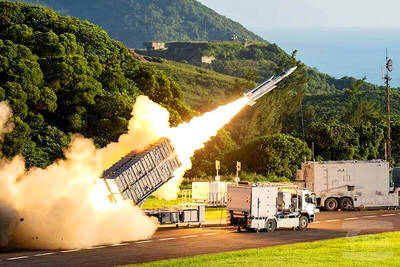
RESILIENCE: Keeping the defense industry’s assembly lines open would prove essential should the nation be involved in a prolonged conflict, a source said The Ministry of National Defense has prepared a NT$22 billion (US$692.3 million) program to acquire about 200 improved Hsiung Feng anti-ship missiles from next year to 2035, a source said. Commenting on condition of anonymity, a high-ranking defense official said the ministry’s plan for enhanced-capability Hsiung Feng II and Hsiung Feng III missiles would be funded as part of the regular defense budget. The 200 missiles would be added on top of the 1,400 missiles being funded via the Sea-Air Combat Power Improvement Plan, they said. The program is not about padding missile numbers, but expanding the capability to defeat


 RSS
RSS