


A controversy that erupted at Saturday night’s Golden Horse Awards ceremony shows no signs of ending as the Chinese-language Apple Daily’s Hong Kong edition yesterday reported that Chinese companies have been banned from entering films coproduced with Taiwanese firms in Golden Horse events.
The paper said the directive came from the Chinese Communist Party’s publicity department in the wake of Taiwanese director Fu Yue (傅榆) saying during her acceptance speech for best documentary for Our Youth in Taiwan (我們的青春,在台灣) that her greatest wish was that one day Taiwan “can be treated as a truly independent entity.”
Asked to confirm the report, the Golden Horse Awards executive committee said: “We have not heard about this. Applications for next year’s Golden Horse Awards begin in June.”
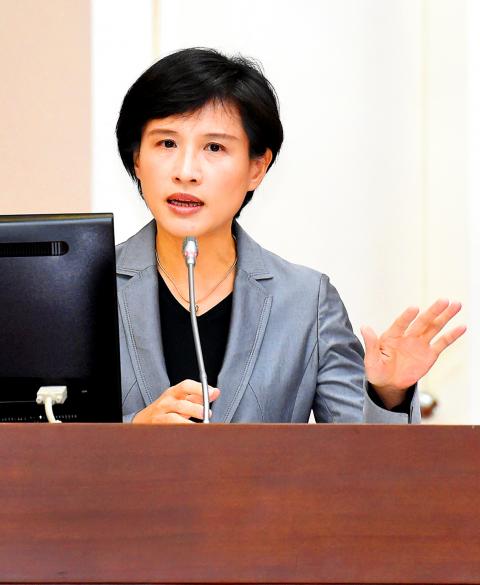
Photo: Chu Pei-hsiung, Taipei Times
The Cross-Strait Films Exchange Committee said it had not “heard of or received any information” about a Chinese movie boycott.
An unnamed leading figure in the movie industry, who claimed to have telephoned a senior official at China’s State Administration of Press, Publication, Radio, Film and Television, said the matter was “absolutely non-existent” and asked: “Why does Taiwan have so much fake news?”
Chinese actor Tu Men (涂們), one of the presenters, later said he was honored to present an award in “China, Taiwan” and that “both sides are like family.”
Chinese director Zhang Yimou (張藝謀), who won the Best Director Award for Shadow (影), said the movies nominated for the Golden Horse were “Chinese movies” and represented the hopes of the Chinese film industry.
However, Minister of Culture Cheng Li-chiun (鄭麗君) yesterday told reporters that while Taiwan welcomed the inclusion of Chinese-language films from outside the nation at the awards, it expected participants to show respect for the people of Taiwan.
“This is Taiwan, not ‘Taiwan, China,’” she said, reiterating her Facebook post on Sunday.
Talking to reporters on the sidelines of a meeting of the legislature’s Education and Culture Committee, Cheng said Taiwan is a democracy and embraces cultural diversification.
That means all Chinese-language movies, including those in China, are welcome to enter the Golden Horse Awards, she said.
Some Chinese celebrities had disrespected and hurt the feelings of Taiwanese with their comments at Saturday’s ceremony, Cheng said.
Perhaps the Chinese celebrities were forced to take a stance or had made the comments for some other reason, but they need to show respect for the Golden Horse Awards, which honors creative freedom, she added.
Democratic Progressive Party Legislator Huang Kuo-shu (黃國書) expressed concern at the legislative meeting that China might not participate in the awards again because of the controversy.
Cheng told Huang that she could not comment on China’s policy, but from Taiwan’s perspective, Chinese films were welcome.
“We sincerely welcome all Chinese-language movies, as we have been doing,” Cheng said. “We hope the Chinese government will relax its grip on its film industry and respect its celebrities.”
Additional reporting by Wu Wan-ting

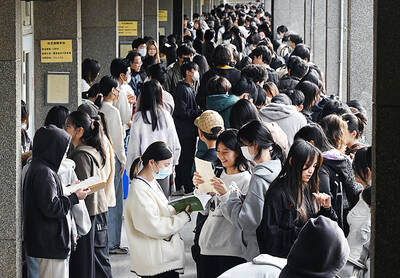
A global survey showed that 60 percent of Taiwanese had attained higher education, second only to Canada, the Ministry of the Interior said. Taiwan easily surpassed the global average of 43 percent and ranked ahead of major economies, including Japan, South Korea and the US, data from the Organisation for Economic Co-operation and Development (OECD) for 2024 showed. Taiwan has a high literacy rate, data released by the ministry showed. As of the end of last year, Taiwan had 20.617 million people aged 15 or older, accounting for 88.5 percent of the total population, with a literacy rate of 99.4 percent, the data

NEW LOW: The council in 2024 based predictions on a pessimistic estimate for the nation’s total fertility rate of 0.84, but last year that rate was 0.69, 17 percent lower An expected National Development Council (NDC) report expects the nation’s population to drop below 12 million by 2065, with the old-age dependency ratio to top 100 percent sooner than 2070, sources said yesterday. The council is slated to release its latest population projections in August, using an ultra-low fertility model, the sources said. The previous report projected that Taiwan’s population would fall to 14.37 million by 2070, but based on a new estimate of the total fertility rate (TFR) — the average number of children born to a woman over her lifetime — the population is expected to reach 12 million by

CCP ‘PAWN’? Beijing could use the KMT chairwoman’s visit to signal to the world that many people in Taiwan support the ‘one China’ principle, an academic said Chinese Nationalist Party (KMT) Chairwoman Cheng Li-wun (鄭麗文) yesterday arrived in China for a “peace” mission and potential meeting with Chinese President Xi Jinping (習近平), while a Taiwanese minister detailed the number of Chinese warships currently deployed around the nation. Cheng is visiting at a time of increased Chinese military pressure on Taiwan, as the opposition-dominated Legislative Yuan stalls a government plan for US$40 billion in extra defense spending. Speaking to reporters before going to the airport, Cheng said she was going on a “historic journey for peace,” but added that some people felt uneasy about her trip. “If you truly love Taiwan,
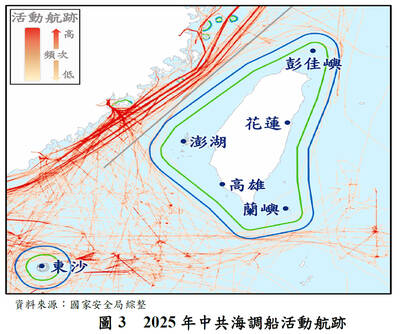
INTENSIFYING THREATS: Beijing’s tactics include massive attacks on the government service network, aircraft and naval vessel incursions and damaging undersea cables China is prepared to interfere in November’s nine-in-one local elections by launching massive attacks on the Taiwanese government’s service network (GSN), a report published by the National Security Bureau showed. The report was submitted to the Legislative Yuan ahead of the bureau’s scheduled briefing at the Foreign Affairs and National Defense Committee tomorrow. The national security team has identified about 13,000 suspicious Internet accounts and 860,000 disputed messages, the bureau said of China’s cognitive warfare against Taiwan. The disputed messages focus on major foreign affairs, national defense and economic issues, which were produced using generative artificial intelligence (AI) and distributed through Chinese


 RSS
RSS