


Chinese President Xi Jinping (習近平) yesterday greeted Salvadorean President Salvador Sanchez Ceren, pledging aid to the Central American country months after it switched allegiance from Taiwan to Beijing.
Xi is hosting Sanchez Ceren and the leader of another country that recently ditched Taiwan — Dominican President Danilo Medina — this week.
The Chinese leader welcomed Sanchez Ceren with a ceremony at the Great Hall of the People, where a military band serenaded the two presidents with their respective national anthems.
The two countries then inked deals pledging to cooperate on development, including on Xi’s pet Belt and Road Initiative.
Beijing also promised aid for education, health and drought relief.
China “welcomes” more exports from El Salvador and would encourage more qualified Chinese companies to invest in Salvadorean industries, Xi said in a China Central Television report.
China is also willing to offer scholarships to Salvadorean students visiting China, and would encourage more Chinese tourists to travel to the Central American country, he added.
Sanchez Ceren told Xi he was “representing the Salvadorean people to show you how grateful we are and our satisfaction now that we have restored our diplomatic relations.”
El Salvador recognized Beijing in August, becoming the third country to abandon Taiwan this year, following the Dominican Republic and Burkina Faso.
Medina will be hosted at the Great Hall of the People today.
He will also inaugurate the Dominican Republic’s embassy in Beijing during his visit.
Only 17 countries remain in Taiwan’s diplomatic circle as the nation struggles to fend off Beijing’s growing influence around the globe.
Taiwan and China have been engaged for years in a diplomatic tug-of-war in developing countries, with economic support and other aid often used as bargaining chips for diplomatic recognition.
Central America has been a key bastion for Taiwan, with Guatemala, Honduras, Nicaragua and Belize still recognizing Taipei rather than Beijing, which has used its economic muscle and promises of investment to entice governments.
Panama broke diplomatic ties with Taiwan last year.
The recent defections have irked the US, which recalled its envoys from El Salvador, the Dominican Republic and Panama in September.
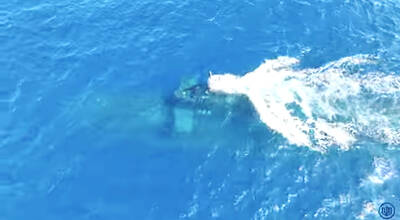
CSBC Corp, Taiwan (台灣國際造船) yesterday released the first video documenting the submerged sea trials of Taiwan’s indigenous defense submarine prototype, the Hai Kun (海鯤), or Narwhal, showing underwater navigation and the launch of countermeasures. The footage shows the vessel’s first dive, steering and control system tests, and the raising and lowering of the periscope and antenna masts. It offered a rare look at the progress in the submarine’s sea acceptance tests. The Hai Kun carried out its first shallow-water diving trial late last month and has since completed four submerged tests, CSBC said. The newly released video compiles images recorded from Jan. 29 to
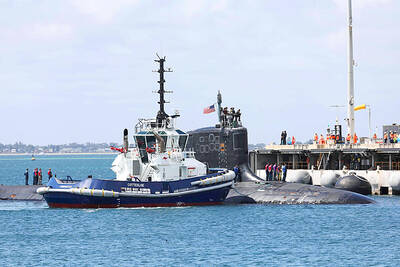
DETERRENCE EFFORTS: Washington and partners hope demonstrations of force would convince Beijing that military action against Taiwan would carry high costs The US is considering using HMAS Stirling in Western Australia as a forward base to strengthen its naval posture in a potential conflict with China, particularly over Taiwan, the Wall Street Journal reported on Saturday. As part of its Indo-Pacific strategy, Washington plans to deploy up to four nuclear-powered submarines at Stirling starting in 2027, providing a base near potential hot spots such as Taiwan and the South China Sea. The move also aims to enhance military integration with Pacific allies under the Australia-UK-US trilateral security partnership, the report said. Currently, US submarines operate from Guam, but the island could
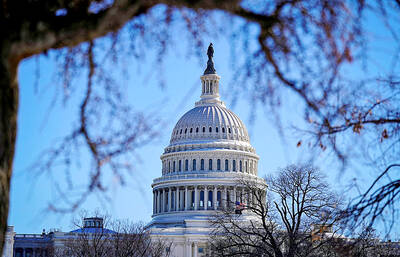
RESTRAINTS: Should China’s actions pose any threat to Taiwan’s security, economic or social systems, China would be excluded from major financial institutions, the bill says The US House of Representatives on Monday passed the PROTECT Taiwan Act, which states that Washington would exclude China from participating in major global financial organizations if its actions directly threaten Taiwan’s security. The bill, proposed by Republican Representative Frank Lucas, passed with 395 votes in favor and two against. It stipulates that if China’s actions pose any threat to Taiwan’s security, economic or social systems, the US would, “to the maximum extent practicable,” exclude Beijing from international financial institutions, including the G20, the Bank for International Settlements and the Financial Stability Board. The bill makes it clear that China must be prepared

Taiwanese trade negotiators told Washington that Taipei would not relocate 40 percent of its semiconductor production to the US, and that its most advanced technologies would remain in the nation, Vice Premier Cheng Li-chiun (鄭麗君) said on Sunday. “I told the US side very clearly — that’s impossible,” Cheng, who led the negotiation team, said in an interview that aired on Sunday night on Chinese Television System. Cheng was referring to remarks last month by US Secretary of Commerce Howard Lutnick, in which he said his goal was to bring 40 percent of Taiwan’s chip supply chain to the US Taiwan’s almost


 RSS
RSS