


Transitional Justice Commission Deputy Chairman Chang Tien-chin (張天欽) has resigned over his alleged plan to manipulate public opinion so that Chinese Nationalist Party (KMT) New Taipei City mayoral candidate Hou You-yi (侯友宜) would be held accountable for his actions during the White Terror era.
Chang’s resignation came in the aftermath of a leaked audio recording of an informal meeting on Aug. 24, which was allegedly attended by Chang, commission Secretary-General Hsu Chun-ju (許君如), as well as two commission researchers and two associate researchers.
According to a partial transcript published yesterday by the Chinese-language Mirror Media magazine, Chang asked the participants to brainstorm on how to enforce a lustration law that the commission had planned to draw up and, specifically, how to use it against Hou, whom Chang called the “most despicable case [of concern] in transitional justice.”
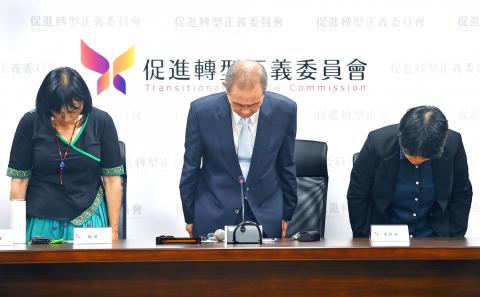
Photo: Liao Chen-huei, Taipei Times
Adopted by several nations that have undergone transitional justice, a lustration law is a mechanism to examine whether a person holding public office occupied any “suspicious positions” in the previous authoritarian regime.
“It will be a pity if we do not manipulate [public opinion] against Hou,” Chang allegedly said in the meeting, adding that the commission should find cases from other countries that are similar to Hou’s and use them to convince the public of the need to hold Hou accountable for his actions.
Hou headed the Taipei Police Department’s Criminal Investigation Division in its failed attempt to arrest — at the behest of the KMT regime — democracy activist Deng Nan-jung (鄭南榕) at the office of his Freedom Era Weekly magazine in 1989. Deng refused to be taken alive, immolating himself after locking himself in the office.
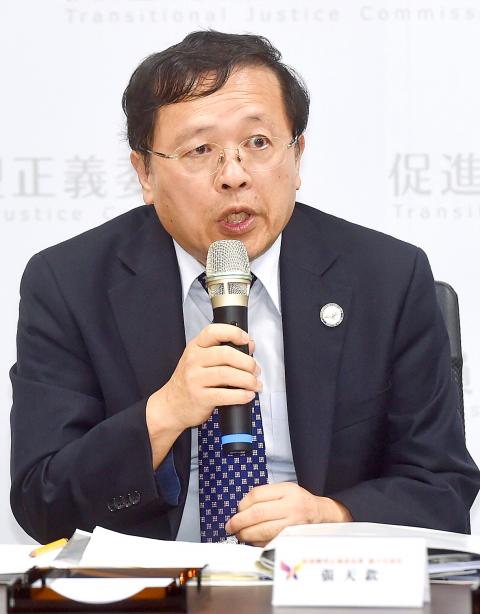
Photo: Chien Jung-fong, Taipei Times
Chang issued a statement announcing his resignation shortly after the story broke, apologizing for damage to the commission’s image and credibility.
“It is not easy for the nation to begin its transitional justice efforts, which is why many political victims and their families have high hopes for the commission,” Chang said.
“Most commission staff members have been racing against time and hoping to complete its final report within two years. Their endeavor should not be affected by the leaked recording,” he added.
The commission would never become a campaign tool, Commission Chairman Huang Huang-hsiung (黃煌雄) told a news conference yesterday afternoon, adding that he had approved Chang’s resignation.
Huang and the commission’s three full-time members bowed in apology to the public over the scandal.
“I want to reiterate that the commission is an independent body established in accordance with the law, which transcends partisan politics. None of its employees are allowed to participate in political activities, nor would we ever entangle our transitional justice efforts with elections,” Huang said.
Huang said staff members at the meeting convened by Chang were merely discussing issues among themselves, and did not represent the commission’s stance, but added that an investigation would be launched into the matter.
Apologizing to the public on behalf of the Executive Yuan,Premier William Lai (賴清德) yesterday said the Executive Yuan found Chang’s remarks “utterly unacceptable.”
“Chang’s comments have not only undermined the commission’s credibility, but have also fueled social divisions,” Lai said.
Presidential Office spokesman Sidney Lin (林鶴明) said the tasks that the commission has been entrusted with do not target any individual, nor are they designed to improve a party’s competitiveness.
“The key to the smooth fulfillment of these tasks is ensuring an independent and objective stance in the process... Chang’s remarks, whether made publicly or in private, were inappropriate,” he said.
Additional reporting by CNA

A signaling system malfunction disrupted high-speed rail (HSR) services beginning at 8am today, with trains temporarily reduced to three northbound and three southbound trains per hour as authorities conduct inspections. The malfunction occurred on a section of track in Miaoli County during pre-operation checks early this morning, forcing northbound and southbound trains to use a single track, the HSR operator said. The regular schedule has been replaced with three hourly trains offering only nonreserved seating in each direction, stopping at every station, it said, adding that business class cars would still have reserved seating. Departures from terminal stations are scheduled at the top

DRONE CENTRAL: Taiwan aims to become Asia’s democratic hub for drones, with most exports focused on high-quality military-grade models, an official said Taiwan’s drone industry is expected to expand significantly by 2030, producing 100,000 units per month and exporting half of them, the Ministry of Economic Affairs said yesterday. Current drone production capacity is about 15,000 units per month, but the industry can quickly scale up as demand increases, Industrial Development Administration Director-General Chiou Chyou-huey (邱求慧) told a news conference in Taipei. Taiwan’s drone output grew 2.5-fold last year to NT$12.9 billion (US$408.3 million) under a government program to develop the uncrewed vehicle sector, he said. The Executive Yuan in October last year approved plans to invest NT$44.2 billion into domestic production of uncrewed aerial

VERBOSE VESSELS: A CGA cutter and a China Coast Guard exchanged verbal barbs for more than a day in Taiwanese-controlled waters before the Chinese vessel left The Taiwanese and Chinese coast guards had a standoff near the strategically located Pratas Islands (Dongsha Islands, 東沙群島) in the north of the South China Sea, the Coast Guard Administration (CGA) said yesterday. The two sides engaged in intense radio exchanges over sovereignty claims during the 33-hour standoff. China Coast Guard vessel 3501 eventually left the restricted waters, 26.6 nautical miles (49.2km) west of the Pratas Islands, at 5pm yesterday, the CGA said. Lying approximately between southern Taiwan and Hong Kong, the Taiwan-controlled Pratas are seen by some security experts as vulnerable to Chinese attack due to their distance — more than
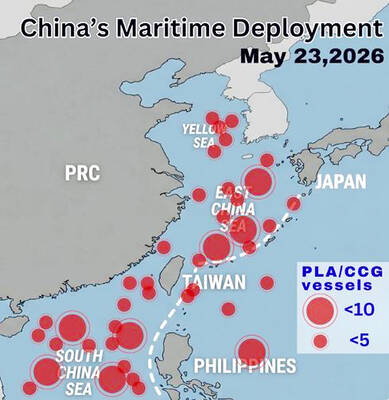
WARNING: China should stop engaging in actions that undermine regional peace and stability, as it would only build resentment among people across the Strait, the CGA said China has deployed more than 100 navy, coast guard and other vessels in waters from the Yellow Sea to the South China Sea and the western Pacific since US President Donald Trump and Chinese President Xi Jinping (習近平) met in Beijing, National Security Council Secretary-General Joseph Wu (吳釗燮) said yesterday. “In this part of the world, #China is the one & only PROBLEM wrecking the #StatusQuo & threatening regional peace & stability,” Wu wrote on X. In a separate post, he said Beijing was coercing Taiwan’s maritime domain, calling it illegal and provocative, after the Coast Guard Administration (CGA) expelled a


 RSS
RSS