


The Executive Yuan plans to spend more than NT$1.6 billion (US$51.1 million) next year to protect the most frequently attacked government Web sites and databases from Chinese hacking, multiple sources said yesterday.
Last year’s most frequently hacked targets were the Web sites of the Presidential Office, the Ministry of the Interior, the Ministry of Foreign Affairs and the National Security Bureau, the sources said.
To shore up its defenses, the bureau, which last year averted more than 23 million assaults, plans to build by 2025 a fibet-optic communication network at an estimated cost of NT$210 million, they said.
The digital economy budget of the Ministry of the Interior is to allocate NT$910 million toward enhancing local government cybersecurity and regional joint defenses.
The Ministry of Economic Affairs is to implement a cybersecurity flagship program for the defense industry at a cost of NT$370 million, while the National Communications Commission is to establish a data stream security office, as well as cybersecurity services and research, at a cost of NT$130 million, the budget plan shows.
“China has, out of its deep hostility for our nation, initiated an aggressive campaign to obtain information on the nation’s 23 million citizens through their household registration, military service or personal data,” a government official said yesterday on condition of anonymity.
The nation must continually improve its cybersecurity without letting up, the official added.
The special budget for the first phase of the Forward-looking Infrastructure Development Program allocates NT$840 million to replace aging and vulnerable equipment used by the household registration services, the Department of Household Registration Affairs and the Ministry of the Interior said separately.
The phase-out program is proceeding smoothly, the department said, adding that it would continue to enhance its cybersecurity by taking advantage next year of the cybersecurity of local governments and the regional joint-defense program.
The Executive Yuan plans to spend NT$8 million on operations to safeguard homeland information and communications, the sources said.
While NT$4.7 million of the budget is allocated for international cooperation and dialogue on homeland security and anti-terrorism measures, NT$33 million is slated for dialogue and activities related to cybersecurity policies, they said.
The dialogue would include Taiwan-US talks on cybersecurity, conferences on protecting crucial digital infrastructure and participation in Black Hat panels, the world’s leading information security event, they said.
The Presidential Office proposed NT$600,000 to establish a cybersecurity research fund that would apply the latest research to protect its information practices and communications, they said.
The Ministry of Foreign Affairs — reportedly targeted by 20,000 cyberattacks per year — has proposed allocating NT$1.6 million toward information security at embassies and representative offices, they said.
The budget would enable purchase of encryption equipment and additional secured telephone lines, as well as funding supervision for the use of codes and the transportation of classified mail, they said.
Another NT$1.9 million is allocated for the foreign affairs ministry to conduct cybersecurity inspections, particularly at embassies and representative offices, they added.
The Central Election Committee is to allocate NT$1.5 million in next year’s budget toward protecting elections from interference and data theft, they said, adding that the proposed funds would be used for cybersecurity inspections, Web site stress testing, system infiltration simulations and similar activities.

LEVERAGE: China did not ‘need to fire a shot’ to deny Taiwan airspace over Africa when it owns ‘half the continent’s debt,’ a US official said, calling it economic warfare The EU has raised concerns about overflight rights following the delay of President William Lai’s (賴清德) planned state visit to the Kingdom of Eswatini after three African nations denied overflight clearance for his charter at the last minute. Taiwanese allies Paraguay and Saint Kitts and Nevis, as well as several US lawmakers and the Inter-Parliamentary Alliance on China (IPAC) condemned China for allegedly pressuring the countries. Lai was scheduled to fly directly to Taiwan’s only African ally from yesterday to Sunday to celebrate the 40th anniversary of King Mswati III’s accession and his 58th birthday, but Seychelles, Mauritius and Madagascar suddenly revoked
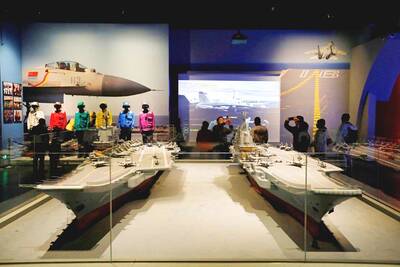
China on Wednesday teased in a video an aircraft carrier that could be its fourth, and the first using nuclear power, while making an allusion to Taiwan and vowing to further build up its islands, as it looks to boost maritime power, secure resources and bolster territorial claims. The video, issued on the eve of the 77th founding anniversary of the Chinese People’s Liberation Army Navy, featured fictional officers with names that are homophones of three commissioned aircraft carriers, the Liaoning (遼寧), Shandong (山東) and Fujian (福建). Titled Into the Deep, it showed a 19-year-old named “Hejian” (何劍) joining the group, sparking

BIG YEAR: The company said it would also release its A12 chip the same year to keep a ‘reliable stream of new silicon technologies’ flowing to its customers Taiwan Semiconductor Manufacturing Co (TSMC, 台積電) yesterday said its newest A13 chip is to enter volume production in 2029 as the chipmaker seeks to hold onto its tech leadership and demand for next-generation chips used in artificial intelligence (AI), high-performance-computing (HPC) and mobile applications. TSMC, the world’s biggest contract chipmaker, also unveiled its A12 chip at its annual technology symposium in Santa Clara, California. The A12 chip, which features TSMC’s super-power-rail technology to provide backside power delivery for AI and HPC applications, is also to enter volume production in 2029, a year after the scheduled release of the A14 chip. The technology moves

ESWATINI TRIP: The ‘irresponsible actions’ of three African nations set a dangerous precedent and they should be held accountable, a US representative said The US Senate Foreign Relations Committee on Thursday urged Washington not to normalize Chinese pressure, while a US lawmaker called on the US government to hold countries accountable for yielding to Beijing’s pressure to block President William Lai’s (賴清德) planned trip to Eswatini. Lai had been scheduled to visit Eswatini to attend birthday events for King Mswati III of Eswatini this week, but on Tuesday, the eve of his planned departure on Wednesday, the Presidential Office said the trip was “suspended” after the Seychelles, Mauritius and Madagascar unexpectedly withdrew overflight permission. “China reportedly pressured Mauritius, Seychelles, and Madagascar to deny airspace access


 RSS
RSS