


Taipei Mayor Ko Wen-je (柯文哲) yesterday urged the Democratic Progressive Party (DPP) to refrain from using ideology to censor its members, after DPP Deputy Secretary-General Hsu Chia-ching (徐佳青) on Wednesday said that the party would expel any member stumping for Ko after Aug. 31, the candidate registration deadline for the November elections.
“Those who stump for Ko will have to make the choice between voluntarily withdrawing from the party and exclusion,” Hsu told SET-TV host Cheng Hung-yi (鄭弘儀).
The decision followed reports that several DPP Taipei city councilors and borough wardens have broken ranks with DPP Legislator Pasuya Yao (姚文智), the party’s Taipei mayoral candidate.
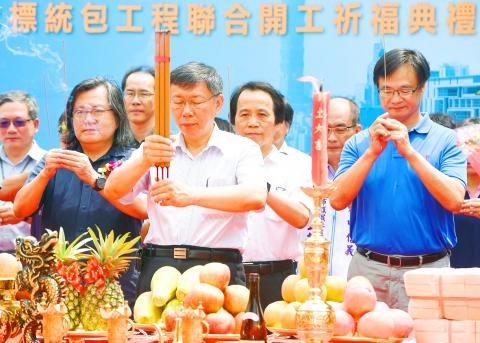
Photo: Liao Chen-huei, Taipei Times
The DPP’s Taipei chapter on Monday voted against nominating Nangang District (南港) Xixin Borough (西新) Warden Chiu Pi-chu (邱碧珠) for re-election, after Chiu endorsed Ko on multiple occasions.
Ko at a ribbon-cutting event said that he thinks the nation should have “soft” political parties that do not compel members to follow an ideological line or pursue collective self-interests.
“Hopefully, the election will change the character of Taiwanese politics,” he added.
Taipei Department of Civil Affairs Commissioner Lan Shih-tsung (藍世聰), a DPP member who has come under fire from party colleagues, said it would be strange for a political appointee to not defend the mayor and his policies.
“Would the Executive Yuan tolerate ministers who do not support the president?” he asked. “I really do not want to be expelled from the party, but what can I do?”
Asked what he would do if the party demands that he stump for Yao, Lan vowed to support Ko regardless of the party’s sanctions, saying that he would not be able to endorse another candidate after declaring his support for Ko at the city council.
“I can vouch that Ko is a hard worker who is deserving of my support,” Lan said.
The DPP should think carefully when wielding party discipline, because it has no power over the will of the people, he said, adding that using disciple to force the party against the people would only harm the party.
Asked to comment on the DPP’s mounting criticism of Lan, Ko said that Lan’s visits to borough wardens and civil groups were strictly related to his work as civil affairs commissioner.
“You cannot forbid the man from leaving his office six months before an election. It is not as if he is a named member of my campaign,” Ko said.
Yao yesterday spoke to reporters after accepting a Broadcasting Corp of China (中廣) interview, during which he rejected the suggestion that the DPP had made the decision to discipline members in response to his flagging approval rating.
“The order to endorse party nominees applies equally to every DPP politician in the nation, and everyone engaged in politics should know that as party members, their speech and actions are subject to discipline,” he said.
Additional reporting by Chou Yan-yu
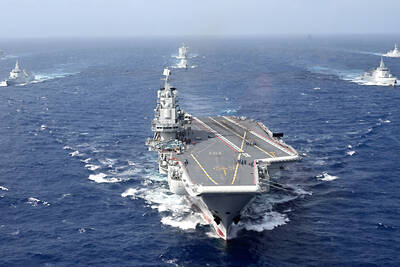
PROVOCATIVE: Chinese Deputy Ambassador to the UN Sun Lei accused Japan of sending military vessels to deliberately provoke tensions in the Taiwan Strait China denounced remarks by Japan and the EU about the South China Sea at a UN Security Council meeting on Monday, and accused Tokyo of provocative behavior in the Taiwan Strait and planning military expansion. Ayano Kunimitsu, a Japanese vice foreign minister, told the Council meeting on maritime security that Tokyo was seriously concerned about the situation in the East China and South China seas, and reiterated Japan’s opposition to any attempt to change the “status quo” by force, and obstruction of freedom of navigation and overflight. Stavros Lambrinidis, head of the EU delegation to the UN, also highlighted South China Sea
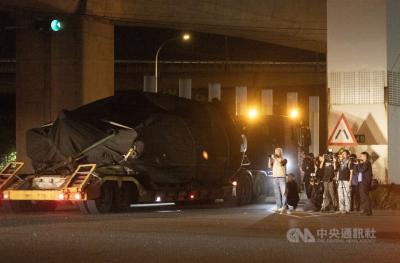
The final batch of 28 M1A2T Abrams tanks purchased from the US arrived at Taipei Port last night and were transported to the Armor Training Command in Hsinchu County’s Hukou Township (湖口), completing the military’s multi-year procurement of 108 of the tanks. Starting at 12:10am today, reporters observed more than a dozen civilian flatbed trailers departing from Taipei Port, each carrying an M1A2T tank covered with black waterproof tarps. Escorted by military vehicles, the convoy traveled via the West Coast Expressway to the Armor Training Command, with police implementing traffic control. The army operates about 1,000 tanks, including CM-11 Brave Tiger
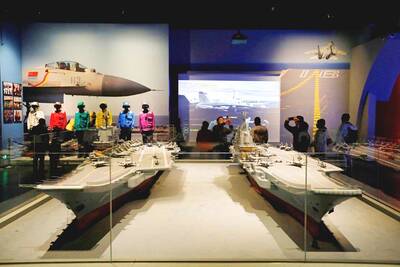
China on Wednesday teased in a video an aircraft carrier that could be its fourth, and the first using nuclear power, while making an allusion to Taiwan and vowing to further build up its islands, as it looks to boost maritime power, secure resources and bolster territorial claims. The video, issued on the eve of the 77th founding anniversary of the Chinese People’s Liberation Army Navy, featured fictional officers with names that are homophones of three commissioned aircraft carriers, the Liaoning (遼寧), Shandong (山東) and Fujian (福建). Titled Into the Deep, it showed a 19-year-old named “Hejian” (何劍) joining the group, sparking
BIG YEAR: The company said it would also release its A12 chip the same year to keep a ‘reliable stream of new silicon technologies’ flowing to its customers Taiwan Semiconductor Manufacturing Co (TSMC, 台積電) yesterday said its newest A13 chip is to enter volume production in 2029 as the chipmaker seeks to hold onto its tech leadership and demand for next-generation chips used in artificial intelligence (AI), high-performance-computing (HPC) and mobile applications. TSMC, the world’s biggest contract chipmaker, also unveiled its A12 chip at its annual technology symposium in Santa Clara, California. The A12 chip, which features TSMC’s super-power-rail technology to provide backside power delivery for AI and HPC applications, is also to enter volume production in 2029, a year after the scheduled release of the A14 chip. The technology moves


 RSS
RSS