


Chinese and Southeast Asian naval forces have staged their first computer-simulated drills so they can jointly respond to emergencies and build trust amid long-seething disputes in the South China Sea.
The two-day exercises that ended yesterday involved more than 40 sailors from China and ASEAN. They worked on search-and-rescue scenarios following a mock ship collision.
The Singaporean Navy hosted the drills at a training center at Changi Naval Base, where officers coordinated their force deployments and helicopter landings on navy ships.
They monitored developments on three giant screens, including one showing the location of a collision between an oil tanker, which supposedly caught fire, and a passenger ship that sank and scattered people in the high seas.
It was a successful prelude to actual maneuvers at sea that are planned for October in China, Singaporean Navy Colonel Lim Yu Chuan said.
“The exercise is beneficial to promote military exchanges and cooperation between China and ASEAN member states, [and] to advance our mutual trust,” Chinese People’s Liberation Army Navy Captain Liang Zhijia told reporters.
Organizers did not directly link the exercises to the territorial disputes, which escalated after China turned seven disputed reefs into artificial islands.
Some now resemble bases with buildings and weapons, including surface-to-air missiles, and have sparked protests, including from rival claimants.
Taiwan, Brunei, Malaysia, Vietnam and the Philippines also have claims to all or parts of the South China Sea.
During an annual meeting of their foreign ministers in Singapore on Thursday, an agreement was announced on an initial draft of a “code of conduct”: a set of rules to discourage aggression and reduce chances of accidental clashes and miscalculations.
Chinese Minister of Foreign Affairs Wang Yi (王毅) called the draft the “biggest highlight” of the meeting.
“We believe that without any disturbances from the outside, COC [code of conduct] consultations will accelerate,” Wang said.
China has accused the US of meddling in an Asian dispute. The US military has deployed its massive aircraft carriers, other warships and fighter jets to patrol the disputed waters, including areas close to China’s artificial islands, in maneuvers Washington has said aim to promote freedom of navigation and overflight in the strategic waterway.
Other Asian and Western nations have weighed in on the territorial conflicts, calling for the rule of law to be upheld and the disputes to be resolved peacefully, and not by force or intimidation.
EU High Representative for Foreign Affairs and Security Policy Federica Mogherini expressed hopes that negotiations would lead to a legally binding code of conduct that would uphold international laws and principles like freedom of navigation.
“We have, I would say, political interest in the international principles, norms and laws to be respected,” Mogherini said in a lecture on the sidelines of ASEAN meetings in Singapore. “Secondly, we have an economic interest, because as you know, European goods travel the seas, including around Asia.”
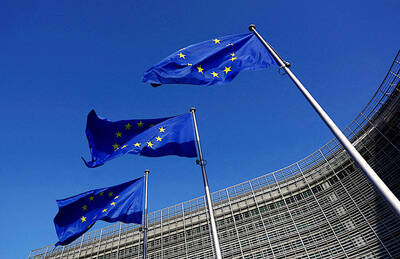
LEVERAGE: China did not ‘need to fire a shot’ to deny Taiwan airspace over Africa when it owns ‘half the continent’s debt,’ a US official said, calling it economic warfare The EU has raised concerns about overflight rights following the delay of President William Lai’s (賴清德) planned state visit to the Kingdom of Eswatini after three African nations denied overflight clearance for his charter at the last minute. Taiwanese allies Paraguay and Saint Kitts and Nevis, as well as several US lawmakers and the Inter-Parliamentary Alliance on China (IPAC) condemned China for allegedly pressuring the countries. Lai was scheduled to fly directly to Taiwan’s only African ally from yesterday to Sunday to celebrate the 40th anniversary of King Mswati III’s accession and his 58th birthday, but Seychelles, Mauritius and Madagascar suddenly revoked
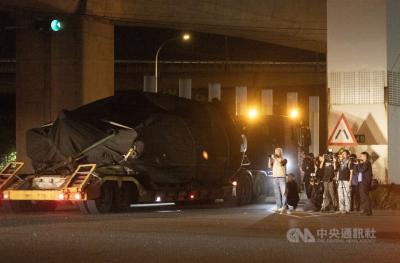
The final batch of 28 M1A2T Abrams tanks purchased from the US arrived at Taipei Port last night and were transported to the Armor Training Command in Hsinchu County’s Hukou Township (湖口), completing the military’s multi-year procurement of 108 of the tanks. Starting at 12:10am today, reporters observed more than a dozen civilian flatbed trailers departing from Taipei Port, each carrying an M1A2T tank covered with black waterproof tarps. Escorted by military vehicles, the convoy traveled via the West Coast Expressway to the Armor Training Command, with police implementing traffic control. The army operates about 1,000 tanks, including CM-11 Brave Tiger
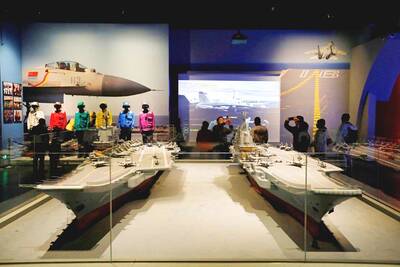
China on Wednesday teased in a video an aircraft carrier that could be its fourth, and the first using nuclear power, while making an allusion to Taiwan and vowing to further build up its islands, as it looks to boost maritime power, secure resources and bolster territorial claims. The video, issued on the eve of the 77th founding anniversary of the Chinese People’s Liberation Army Navy, featured fictional officers with names that are homophones of three commissioned aircraft carriers, the Liaoning (遼寧), Shandong (山東) and Fujian (福建). Titled Into the Deep, it showed a 19-year-old named “Hejian” (何劍) joining the group, sparking
BIG YEAR: The company said it would also release its A12 chip the same year to keep a ‘reliable stream of new silicon technologies’ flowing to its customers Taiwan Semiconductor Manufacturing Co (TSMC, 台積電) yesterday said its newest A13 chip is to enter volume production in 2029 as the chipmaker seeks to hold onto its tech leadership and demand for next-generation chips used in artificial intelligence (AI), high-performance-computing (HPC) and mobile applications. TSMC, the world’s biggest contract chipmaker, also unveiled its A12 chip at its annual technology symposium in Santa Clara, California. The A12 chip, which features TSMC’s super-power-rail technology to provide backside power delivery for AI and HPC applications, is also to enter volume production in 2029, a year after the scheduled release of the A14 chip. The technology moves


 RSS
RSS