


A pro-independence group yesterday called for the complete removal of authoritarian symbols and the closure of mausoleums after they hurled red paint at the 6.3m-tall bronze statue of Chiang Kai-shek (蔣介石) at the Chiang Kai-shek Memorial Hall in Taipei.
The defacement was carried out by several members of the pro-independence group From Ethnos to Nation at about 9:30am in front of visitors at the memorial hall.
The hall is the largest in the nation commemorating Chiang, despite his regime being blamed for the deaths of millions of people.
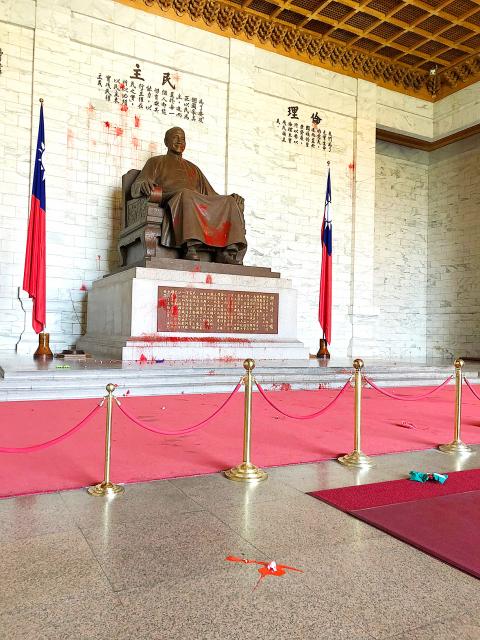
Photo: AFP / Chiang Kai-shek Memorial Hall
The group also held up a banner that read: “Eliminate Chinese Tyranny, Build Taiwan’s Own Republic,” referring to the Chinese Nationalist Party (KMT) regime that retreated from China to Taiwan in 1949 under Chiang’s leadership.
Police later arrested two protesters, who were to be turned over to prosecutors for further investigation, the Taipei Police Department’s Zhongzheng First Precinct said.
The incident came just hours before the Taoyuan District Court was scheduled to hold its first session on the group’s hurling of red paint at Chiang’s sarcophagus in Taoyuan’s Dasi District (大溪) on Feb. 28, the 71st anniversary of the 228 Incident, a bloody state-led crackdown against civilian demonstrations.
“We are perfectly aware that our actions today are not conducive to our court trial, but Taiwanese’s pursuit of independence, freedom, democracy and human rights has never been evaluated by the law,” the group said in a statement.
The essence of reconciliation is not making compromises to conservative forces opposed to change, nor is it maintaining the “status quo” out of a need for expediency or worries about causing social divisions, it said.
“True reconciliation lies in a promise to future generations that there will no longer be any worship of dictators and that there will be a new, independent nation ruled by freedom and democracy,” the group said.
The group made several demands, including the complete removal of authoritarian symbols; the closure of the mausoleums of Chiang and his son former president Chiang Ching-kuo (蔣經國); an end to the “worship of dictators” using government resources; and ending the practice of using authoritarian legacies for tourism.
It also called for the termination of the “Republic of China [ROC] regime” and for the establishment of a new nation.
KMT Culture and Communications Committee deputy director-general Hung Meng-kai (洪孟楷) said that the administration of President Tsai Ing-wen (蔡英文) and the Ministry of Culture — which is in charge of the hall — should take full responsibility for the failure to protect monuments and for “evoking criminal tendencies in people.”
“Over the past two years, the Tsai administration has sought to erase symbols of Chiang Kai-shek in disregard of his dedication to Taiwan, twisting and ignoring facts to help achieve that goal under the banner of transitional justice,” Hung said.
The ministry said that periodic paint-hurling incidents underscore the public’s urgency to see transitional justice realized.
“However, the hall’s operation is governed by the Organization Act of National Chiang Kai-shek Memorial Management Office (國立中正紀念堂管理處組織法), the existence of which is like an intangible statue,” the ministry said.
The ministry said it plans to submit a bill to the Executive Yuan by the end of this year for the hall’s transformation, adding that public hearings would be held to expand public participation.
The Transitional Justice Commission, which was inaugurated in May, said that incidents like yesterday’s were the result of the nation’s long-delayed realization of transitional justice.
The incident “shows that Taiwanese society is now at a critical moment,” the commission said.
“We must seriously reflect on the existence of authoritarian symbols and jointly explore ways to remove them so that we can bring about true freedom and democracy in the nation,” it said.
The commission said it would soon submit proposals to Premier William Lai (賴清德) and the public regarding how the memorial hall could be transformed.
Additional reporting by Ling Mei-hsueh

‘NO SECURITY RISK’: The Railway Bureau reassured the public that the technicians’ activities were limited to technical guidance and did not involve sensitive systems The Railway Bureau yesterday said it had invited eight Chinese technicians to assist with an airport MRT construction project. The bureau issued the confirmation after an Internet user said Chinese nationals had entered the construction zone of Taiwan Taoyuan International Airport’s Terminal 3 project. They asked why “individuals from an enemy state” were allowed access to such a major national infrastructure project, which raised serious concerns over Taiwan’s industrial safety, sensitive systems and information security. The bureau’s Northern Region Engineering Branch Office said subcontractor Taiwan Handle Industrial Co (台灣手把工業) of the Taoyuan airport MRT’s “Contract No. CU05 Project A14 Station Civil, MEP &

A US uncrewed surface vessel (USV) encountered multiple Chinese warships during an autonomous transit of the Taiwan Strait, US defense company Seasats said in a statement on Wednesday. Seasats announced that a Lightfish USV had completed the first autonomous transit of the Taiwan Strait. Over five days, the USV traversed the entire length of the Strait while constantly monitoring surface vessel traffic, the company said. The Lightfish encountered multiple Chinese warships, one of which was a Chinese People’s Liberation Army Navy (PLAN) Type 056 corvette, it said. The Chinese vessels were operating “well within Taiwan’s exclusive economic zone without transmitting their identity via the

Taiwan is still in the process of assessing the possibility of recruiting workers from Eswatini, the Ministry of Foreign Affairs said yesterday, adding that its goal is to help Eswatini upgrade its vocational training centers. If there are plans to recruit workers from Eswatini, safeguarding national security, protecting public health and ensuring the employment rights of Taiwanese would be prerequisites, Department of West Asian and African Affairs Director-General Yen Chia-liang (顏嘉良) told a news conference. Key considerations would also include filling labor shortages in specific industries, and fostering bilateral professional and technical exchanges, he said. Yen was asked about the progress of labor
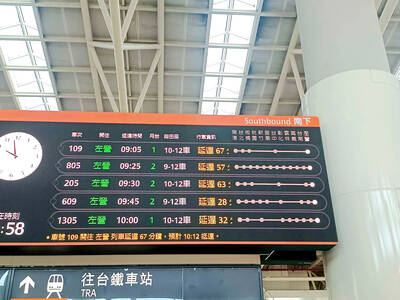
The nation’s usually punctual high-speed rail system yesterday was hit by major disruptions after all scheduled services were canceled and replaced with three hourly trains offering only non-reserved seating, affecting more than 200,000 passengers. Preliminary findings indicate the disruption was caused by a faulty power module in a track switch control cabinet, Taiwan High-Speed Rail Corp (THSRC) said, adding that as a full system inspection could only be conducted after operations end for the day, a decision on whether normal service would resume today would be announced before the first train departs. During a routine inspection early yesterday, a switch signal abnormality


 RSS
RSS