


The US is mulling the possibility of sending an aircraft carrier through the Taiwan Strait as a show of support to Taiwan, a report by Reuters said yesterday, citing US officials speaking on condition of anonymity.
According to the report, the US had explored plans for an aircraft carrier passage earlier this year, but did not pursue them, perhaps due to concerns about upsetting China.
The last time a US aircraft carrier transited the Taiwan Strait was in 2007, when George W. Bush was president.
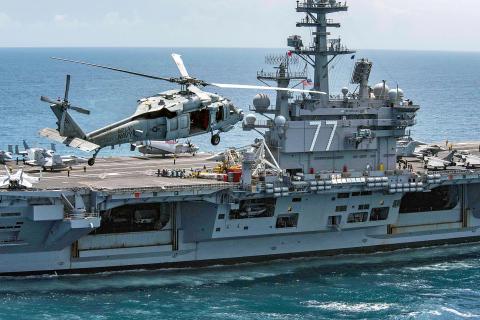
Photo: Reuters
According to Reuters, the Pentagon has declined to comment on any potential future operations, so it was not clear how soon such a passage might take place.
However, yesterday’s story follows a Reuters’ report on Sunday from the sidelines of the Shangri-La Dialogue security forum in Singapore that said the US Department of Defense was weighing a more assertive program of freedom-of-navigation operations close to Chinese installations on reefs in the Paracel Islands (Xisha Islands, 西沙群島) and Spratly Islands (Nansha Islands, 南沙群島), citing two unnamed US officials, and Western and Asian diplomats close to the discussions.
Two US Navy warships, the USS Higgins, a destroyer, and the USS Antietam, a cruiser — last month passed within 12 nautical miles (22.2km) of the Paracels.
While yesterday’s Reuters report said that some US military officials think a carrier transit is overdue, it said another option would be resuming the periodic passages by other US Navy ships.
The last time US Navy ships sailed through the Strait was in July last year, according to Reuters.
“They’re turning up the heat,” Reuters yesterday cited one US official as saying about the US view of Chinese military activities around Taiwan this year.
In Taipei, Ministry of Foreign Affairs spokesman Andrew Lee (李憲章) declined to comment on the possibility of a US warship passage through the Strait, saying the news had yet to be verified.
According to the Reuters report yesterday, one US official said that Washington is also aiming to change the way it approaches arms sales requests from Taiwan to address them on a case-by-case basis instead of bundling them together.
It also quoted US-Taiwan Business Council president Rupert Hammond-Chambers as saying that moving away from bundling would be better for Taipei’s defense needs, as it would treat Taiwan more like a regular security partner.
“We get into difficulty when we treat Taiwan differently, which opens the door for the politicization of the [arms sales] process,” it cited Hammond-Chambers as saying.
Asked by Reuters about US obligations to Taiwan, Pentagon spokesman Lieutenant Colonel Christopher Logan said Washington has sold Taiwan more than US$15 billion of weaponry since 2010.
“We have a vital interest in upholding the current rules-based international order, which features a strong, prosperous and democratic Taiwan,” it quoted Logan as saying.
Meanwhile, Chinese Ministry of Foreign Affairs spokeswoman Hua Chunying (華春瑩) yesterday urged the US to prudently handle the Taiwan issue to avoid harming bilateral ties and peace and stability in the region.
“We have repeatedly emphasized that the Taiwan issue is the most important and sensitive core issue in the China-US relationship,” she told a daily news briefing.
In related news, it now appears unlikely that Washington is to send top officials to next week’s dedication ceremony for the new American Institute in Taiwan’s office building in Taipei, according to a Reuters report.
US officials cited by Reuters said that the ceremony would clash with the summit in Singapore on Tuesday next week between US President Donald Trump and North Korean leader Kim Jong-un, but that there would be another opportunity to commemorate the unveiling when the complex opens in September.

SILENCING CRITICS: In addition to blocking Taiwan, China aimed to prevent rights activists from speaking out against authoritarian states, a Cabinet department said The Ministry of Foreign Affairs (MOFA) yesterday condemned transnational repression by Beijing after RightsCon, a major digital human rights conference scheduled to be held in Zambia this week, was abruptly canceled due to Chinese pressure over Taiwanese participation. This year’s RightsCon, the world’s largest conference discussing issues “at the intersection of human rights and technology,” was scheduled to take place from tomorrow to Friday in Lusaka, and expected to draw 2,600 in-person attendees from 150 countries, along with 1,100 online participants. However, organizers were forced to cancel the event due to behind-the-scenes pressure from China, the ministry said, expressing its “strongest condemnation”
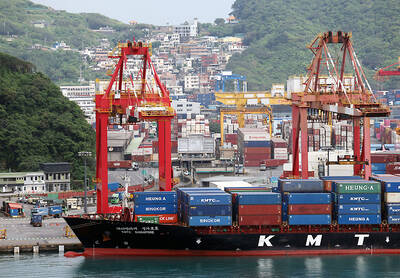
Taiwan’s economy grew far faster than expected in the first quarter, as booming demand for artificial intelligence (AI) applications drove a surge in exports, spilling over into investment and consumption, the Directorate-General of Budget, Accounting and Statistics (DGBAS) said yesterday. GDP growth was 13.69 percent year-on-year during the January-to-March period, beating the DGBAS’ February forecast by 2.23 percentage points and marking the most robust growth in nearly four decades, DGBAS senior official Chiang Hsin-yi (江心怡) told a news conference in Taipei. The result was powered by exports, which remain the backbone of Taiwan’s economy, Chiang said. Outbound shipments jumped 51.12 percent year-on-year to
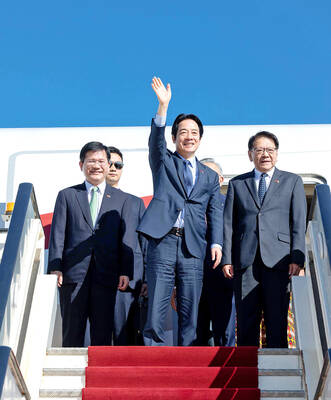
DELAYED BUT DETERMINED: The president’s visit highlights Taiwan’s right to international engagement amid regional pressure from China President Willaim Lai (賴清德) yesterday arrived in Eswatini, more than a week after his planned visit to Taiwan’s sole African ally was suspended because of revoked overflight permits. “The visit, originally scheduled for April 22, was postponed due to unforeseen external factors,” Lai wrote on social media. “After several days of careful arrangements by our diplomatic and national security teams, we successfully arrived today.” Lai said he looked forward to further deepening Taiwan-Eswatini relations through closer cooperation in the economy, agriculture, culture and education, as well as advancing the nation’s international partnerships. The president was initially scheduled to arrive in time to celebrate
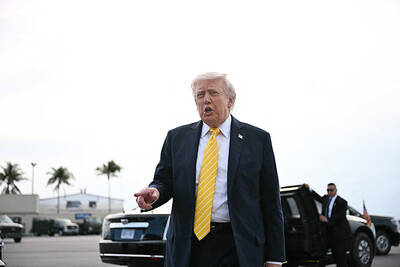
Iran’s Islamic Revolutionary Guard Corp (IRGC) yesterday said the US faced a choice between an “impossible” military operation or a “bad deal” with Tehran, after US President Donald Trump disparaged Iran’s latest peace proposal. Negotiations between the two countries have been deadlocked since a ceasefire came into effect on April 8, with only one round of direct peace talks held so far. Iran’s Tasnim and Fars news agencies reported that Tehran had submitted a 14-point proposal to mediator Pakistan, but Trump was quick to cast doubt on it. “I will soon be reviewing the plan that Iran has just sent to us, but


 RSS
RSS