


European powers and China yesterday rushed to defend a landmark deal curbing Iran’s nuclear program after US President Donald Trump pulled Washington out of the agreement and reimposed sanctions on Tehran.
Trump’s move risks overturning years of diplomacy, worsening instability in the Middle East and threatens foreign companies’ business in Iran worth billions of US dollars.
“The risks of confrontation are real,” French Minister of Foreign Affairs Jean-Yves Le Drian said, adding that Europe would act to “avoid the explosion [of conflict] that risks happening if ... no measures are taken.”
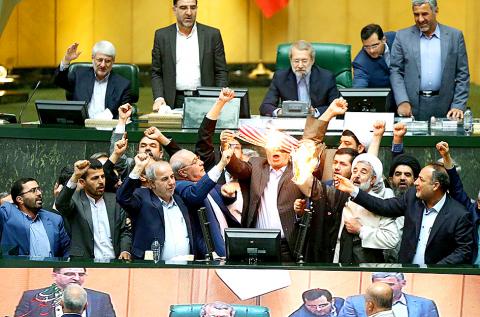
Photo: EPA
Iran reacted furiously to Trump’s decision, with lawmakers burning a US flag and chanting “Death to America” in the Iranian parliament.
However, its regional rivals Saudi Arabia and Israel applauded the US move.
European powers and key trading power China vowed to save the accord and protect companies operating in Iran.
US national security adviser John Bolton said that European firms doing business in Iran have a six-month deadline to wind up investments or risk US sanctions.
European governments are going “to do everything to protect the interests” of their companies, said an official in the French presidency, who asked not to be named.
However, Iranian Supreme Leader Ayatollah Ali Khamenei said Tehran would also quit the nuclear deal unless Europeans offered solid guarantees that trade relations would continue.
“If you don’t succeed in obtaining a definitive guarantee — and I really doubt that you can — at that moment, we cannot continue like this,” Khameini told the Iranian government in a televised speech.
Chinese Ministry of Foreign Affairs spokesman Geng Shuang (耿爽) said that China would maintain “normal economic and trade exchanges” with Iran.
Beijing will “remain in dialogue with all parties and continue to devote itself to safeguard and implement the deal,” he said.
Slapping aside more than a decade and a half of diplomacy by Britain, China, France, Germany, Iran, Russia and past US administrations, Trump called for a “new and lasting deal.”
Trump described the 2015 pact as an “embarrassment” to the US that did nothing to contain Iran’s nuclear ambitions.
He said that a deal with Iran would have to include not just deeper restrictions on its nuclear program, but on its ballistic missiles and support for militant groups across the Middle East.
“We will not allow American cities to be threatened with destruction,” he said.
Iranian President Hassan Rouhani said Tehran could resume uranium enrichment “without limit” in response to Trump’s announcement, but added that Iran would discuss its response with other parties to the deal before announcing a decision.
In a joint statement, German Chancellor Angela Merkel, British Prime Minister Theresa May and French President Emmanuel Macron voiced their “regret and concern” at Trump’s decision.
Bolton said that cooperation with Europe on Iran was not over.
The US will “work with the Europeans and others not only on the nuclear issue, but on Iran’s ballistic missile development, its continuing support for terrorism and its military activities that jeopardize our friends,” he told Fox News.
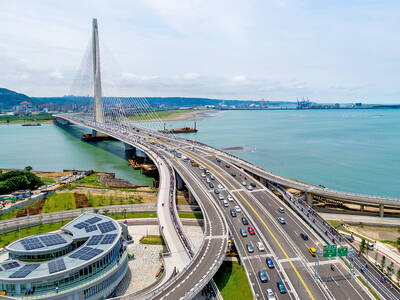
The Ministry of Transportation and Communications yesterday inaugurated the Danjiang Bridge across the Tamsui River in New Taipei City, saying that the structure would be an architectural icon and traffic artery for Taiwan. Feted as a major engineering achievement, the Danjiang Bridge is 920m long, 211m tall at the top of its pylon, and is the longest single-pylon asymmetric cable-stayed bridge in the world, the government’s Web site for the structure said. It was designed by late Iraqi-British architect Zaha Hadid. The structure, with a maximum deck of 70m, accommodates road and light rail traffic, and affords a 200m navigation channel for boats,
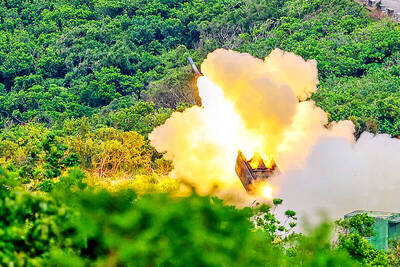
PRECISION STRIKES: The most significant reason to deploy HIMARS to outlying islands is to establish a ‘dead zone’ that the PLA would not dare enter, a source said A High Mobility Artillery Rocket System (HIMARS) would be deployed to Penghu County and Dongyin Island (東引) in Lienchiang County (Matsu) to force the Chinese military to retreat at least 100km from the coastline, a military source said yesterday. Taiwan has been procuring HIMARS and Army Tactical Missile Systems (ATACMS) from the US in batches. Once all batches have been delivered, Taiwan would possess 111 HIMARS units and 504 ATACMS, which have a range of 300km. Considering that “offense is the best defense,” the military plans to forward-deploy the systems to outlying islands such as Penghu and Dongyin so that

Taiwan Semiconductor Manufacturing Co (TSMC, 台積電), the world’s largest foundry service provider, yesterday said that global semiconductor revenue is projected to hit US$1.5 trillion in 2030, after the figure exceeds US$1 trillion this year, as artificial intelligence (AI) demand boosts consumption of token and compute power. “We are still at the beginning of the AI revolution, but we already see a significant impact across the whole semiconductor ecosystem,” TSMC deputy cochief operating officer Kevin Zhang (張曉強) said at the company’s annual technology symposium in Hsinchu City. “It is fair to say that in the past decade, smartphones and other mobile devices were
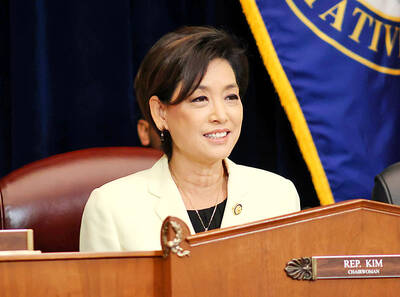
‘CLEAR MESSAGE’: The bill would set up an interagency ‘tiger team’ to review sanctions tools and other economic options to help deter any Chinese aggression toward Taiwan US Representative Young Kim has introduced a bill to deter Chinese aggression against Taiwan, calling for an interagency “tiger team” to preplan coordinated sanctions and economic measures in response to possible Chinese military or political action against Taiwan. “[Chinese President] Xi Jinping [習近平] has directed the People’s Liberation Army to be ready to invade Taiwan by 2027. China has a plan. America should have one too,” Kim said in a news release on Thursday last week. She introduced the “Deter PRC [People’s Republic of China] aggression against Taiwan act” to “ensure the US has a coordinated sanctions strategy ready should


 RSS
RSS