


An inferno ripped through a printed circuit board factory in Taoyuan on Saturday night, killing five firefighters and two Thai workers, and injuring seven firefighters, the Taoyuan Fire Department said yesterday.
Fire Department Chief Hu Ying-ta (胡英達) said the department received a call at 9:26pm about a fire at the Chin-Poon Industrial Co (敬鵬工業) factory.
The department sent 189 firefighters, including 55 volunteers, and 67 fire trucks, as well as ambulances, Hu said.
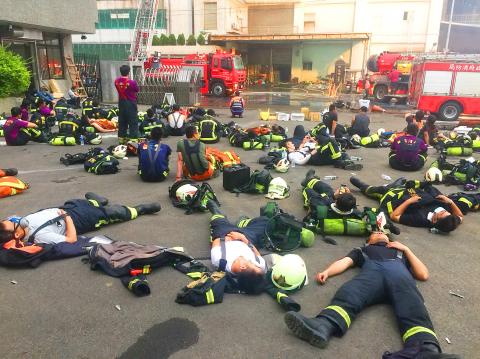
Photo: Hsu Chuo-hsun, Taipei Times
An initial investigation showed that the fire started on the fifth floor of the third factory building, he said.
Firefighters arriving at the scene at 9:30pm learned that some workers were trapped inside, but their exact location was unknown, the department said, adding that the fire quickly spread on the factory’s first and second floors.
Firefighters led by captains Yu Yao-yang (游曜陽) and Lee Han-lin (李翰霖) entered the factory at 9:35pm, it said.
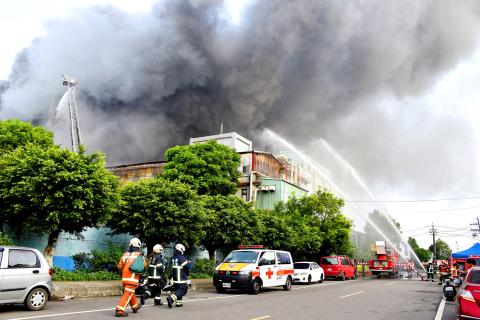
Photo: Lee Jung-ping, Taipei Times
Su Wen-yuan (蘇文遠), auxiliary captain at Taoyuan’s Shanfeng (山峰) fire department, said department group leader Chen Hung-chuan (陳宏銓) discovered at about 9:55pm that a furnace had split at the back of the factory, burning down the entire back wall, and that the building was about to collapse.
Chen ordered firefighters to exit the factory immediately, Su said, adding that firefighter Yu Yao-yang (游曜陽) had twice responded over the radio that he received the order, but was later trapped and could not escape the blaze.
Taoyuan Mayor Cheng Wen-tsan (鄭文燦), who was at the scene to coordinate firefighting and relief efforts, said the firefighters died after becoming trapped under heavy machinery.
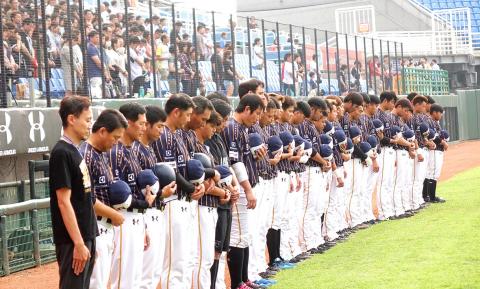
Photo: Chang Chia-ming, Taipei Times
Some firefighters were also injured by acids or other chemicals stored at the factory, and have been hospitalized.
Lu Tsung-yu (呂宗郁), the first fireman to be rescued yesterday, was found at 00:50am and firefighter Lin Wei-hsi (林尉熙) was found at about 4am, the fire department said, adding that both were hospitalized in serious condition.
The fallen firefighters are: Yu, Lee, Lin Po-ting (林伯庭), Yu Po-yu (游博瑜) and Yu Chia-sheng (余佳昇), the department said.
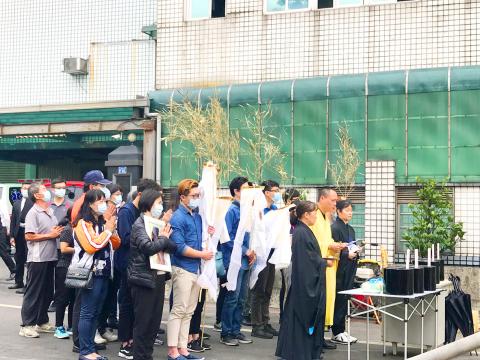
Photo: Lee Jung-ping, Taipei Times
Information about the identities of the two migrant workers who died had yet to be disclosed, it said.
While the fire had been brought under control, the factory was still smoldering and plumes of smoke were still rising from the building at about 4:30pm, the Taoyuan Department of Environmental Protection’s Environmental Inspection section chief Chang Shu-hao (張書豪) said.
The factory passed a fire safety inspection on Dec. 21 last year, Hu said.
The cause of the blaze is under investigation, and the department said large amounts of various types of chemicals, including highly flammable and explosive materials, were stored at the factory.
Family members of the deceased firefighters visited the factory at 4pm, offering prayers and calling for the departed to “return home.”
The mother of firefighter Lee, who was 44, said he had prepared dinner for her before heading to work on Saturday.
She never thought that “Do not forget to heat up the food” would be his last words to her, she added.
Meanwhile, the environmental protection department yesterday said the inferno did not cause serious air pollution, but the company could face a fine of up to NT$3 million (US$101,228) for causing river pollution.
The chemical materials stored at the factory have leaked into sewage ducts, and water samples taken from under the Jhennan Bridge (鎮南橋) were found to have highly acidic pH yesterday morning, Chang said.
The Laojie Creek (老街溪) flowing through Pingjhen District (平鎮) and Jhongli District(中壢) was already polluted, he said, urging local residents not to use the river’s water.
Additional reporting by Lin Chia-nan and Lee Jung-ping

‘NO SECURITY RISK’: The Railway Bureau reassured the public that the technicians’ activities were limited to technical guidance and did not involve sensitive systems The Railway Bureau yesterday said it had invited eight Chinese technicians to assist with an airport MRT construction project. The bureau issued the confirmation after an Internet user said Chinese nationals had entered the construction zone of Taiwan Taoyuan International Airport’s Terminal 3 project. They asked why “individuals from an enemy state” were allowed access to such a major national infrastructure project, which raised serious concerns over Taiwan’s industrial safety, sensitive systems and information security. The bureau’s Northern Region Engineering Branch Office said subcontractor Taiwan Handle Industrial Co (台灣手把工業) of the Taoyuan airport MRT’s “Contract No. CU05 Project A14 Station Civil, MEP &

A US uncrewed surface vessel (USV) encountered multiple Chinese warships during an autonomous transit of the Taiwan Strait, US defense company Seasats said in a statement on Wednesday. Seasats announced that a Lightfish USV had completed the first autonomous transit of the Taiwan Strait. Over five days, the USV traversed the entire length of the Strait while constantly monitoring surface vessel traffic, the company said. The Lightfish encountered multiple Chinese warships, one of which was a Chinese People’s Liberation Army Navy (PLAN) Type 056 corvette, it said. The Chinese vessels were operating “well within Taiwan’s exclusive economic zone without transmitting their identity via the
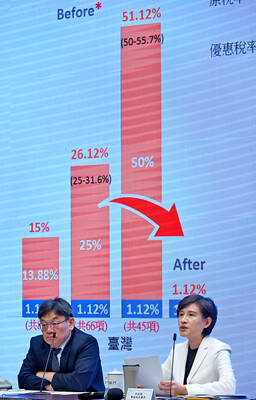
GREATER REACH? Auto parts and wood products would face tariffs of up to 15%, matching those targeting the EU, Japan and South Korea, Vice Premier said The US has announced that preferential tariff treatment for Taiwan’s non-semiconductor Section 232 goods would take effect retroactively from May 1, the Executive Yuan said yesterday. The US government yesterday posted a notice on the Federal Register’s public inspection Web site previewing tariff concessions for Taiwan under a memorandum of understanding (MOU) on Taiwan-US investment after two months of negotiations. The MOU signed on Jan. 15 stipulated three major preferential tariff arrangements: a 15 percent “reciprocal” tariff rate for Taiwan without stacking most-favored nation (MFN) rates; preferential Section 232 treatment for semiconductors and related products; and preferential Section 232 treatment for non-semiconductor
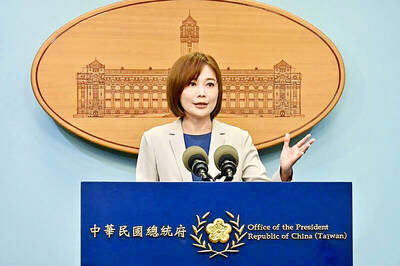
TIT-FOR-TAT: The US allegedly revoked the visa of a Chinese national working at Xinhua News Agency in the US in response to Beijing’s expulsion of Vivian Wang The Presidential Office yesterday condemned China for expelling a New York Times correspondent from Beijing following the newspaper’s interview with President William Lai (賴清德), saying the move highlighted Beijing’s suppression of press freedom and its threat to international news media. Taiwan has noted a series of recent incidents in which Beijing used similar tactics to “threaten and pressure international media outlets and journalists,” Presidential Office spokeswoman Karen Kuo (郭雅慧) said in a statement. “This concerns not only press freedom and freedom of expression, but also the safety of journalists, and Taiwan and relevant partners are paying close attention to the situation,” she


 RSS
RSS