


Low-cost carrier Tigerair Taiwan (台灣虎航) yesterday denied that it had tried to cover up that two of its flight attendants had measles.
Tigerair Taiwan said in a statement yesterday that it has never purposely put ill crew members on duty and that it immediately canceled the two staff members’ upcoming flights once they exhibited symptoms of measles.
One staff member had sought medical attention several times since the onset of the symptoms, but he was misdiagnosed with a cold, the carrier said, adding that he was immediately quarantined after being listed as a suspected measles case on Monday.

Photo: Tony Yao, Taipei Times
A passenger list of those who could have had contact with the infected crew members has been sent to the Centers for Disease Control (CDC), the airline said.
The airline made the remarks one day after the CDC announced that a female flight attendant in her 20s working for Tigerair Taiwan had been diagnosed with the virus.
The woman has been confirmed to be infected with a strain identified as associated with three cluster cases that were announced on Tuesday, the CDC said.
The first case of measles brought into Taiwan this year was confirmed on Thursday last week when a man in his 30s suffering from coughing and a high fever after returning from a trip to Thailand early last month was diagnosed with the virus, the CDC said.
The man saw a doctor on March 15 and March 16, but thought the fever was only a cold.
On March 17 he flew with Tigerair Taiwan to Okinawa, Japan, where he was diagnosed with measles on March 19.
The man returned to Taiwan on Monday last week.
Another man, who is a colleague of the man in the first case and who lives in northern Taiwan, was diagnosed with measles on Saturday last week.
On Tuesday, a male flight attendant in his 30s, who was working on the March 17 flight to Okinawa, was also diagnosed with measles.
CDC Deputy Director-General Chuang Jen-hsiang (莊人祥) said that the female flight attendant started exhibiting symptoms on Sunday and has not worked on any flights since.
However, infected people are considered contagious four days before a rash appears and she had worked on six flights during the incubation period, Chuang said.
The woman worked on flights to Japan’s Kansai International Airport and Narita International Airport, as well as Macau International Airport, the CDC said.
A total of 852 people might have had direct contact with the woman, Chuang said, adding that local health departments plan to follow up on people’s health conditions until April 24.
The 505 people who might have had direct contact with the first three cases are to be monitored until April 23, Chuang said.
Late last night, the CDC announced five new cases of measles, two of whom were on the same flight to Okinawa as the first case.
The other three cases were a woman in her 40s, a man in his 20s and a man in his 30s.
The former two departed for Macau at the Taiwan Taoyuan International Airport on March 17, the agency said.
The CDC said the man in his 30s, who departed for Thailand on March 17, is the brother of another imported measles case confirmed on Tuesday and also a Tigerair Taiwan crew member.
The crew member had taken public transportation in Taiwan and served on several flights during the incubation period to Japan’s Iwate-Hanamaki Airport, Fukuoka Airport and Kansai International Airport, the CDC said, adding that he could have had direct contact with 1,026 people.
As of yesterday, the nation had recorded 11 confirmed measles cases with the total number of people being monitored reaching 3,013.
Additional reporting by CNA

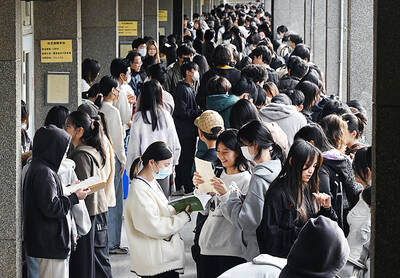
A global survey showed that 60 percent of Taiwanese had attained higher education, second only to Canada, the Ministry of the Interior said. Taiwan easily surpassed the global average of 43 percent and ranked ahead of major economies, including Japan, South Korea and the US, data from the Organisation for Economic Co-operation and Development (OECD) for 2024 showed. Taiwan has a high literacy rate, data released by the ministry showed. As of the end of last year, Taiwan had 20.617 million people aged 15 or older, accounting for 88.5 percent of the total population, with a literacy rate of 99.4 percent, the data

CCP ‘PAWN’? Beijing could use the KMT chairwoman’s visit to signal to the world that many people in Taiwan support the ‘one China’ principle, an academic said Chinese Nationalist Party (KMT) Chairwoman Cheng Li-wun (鄭麗文) yesterday arrived in China for a “peace” mission and potential meeting with Chinese President Xi Jinping (習近平), while a Taiwanese minister detailed the number of Chinese warships currently deployed around the nation. Cheng is visiting at a time of increased Chinese military pressure on Taiwan, as the opposition-dominated Legislative Yuan stalls a government plan for US$40 billion in extra defense spending. Speaking to reporters before going to the airport, Cheng said she was going on a “historic journey for peace,” but added that some people felt uneasy about her trip. “If you truly love Taiwan,

NEW LOW: The council in 2024 based predictions on a pessimistic estimate for the nation’s total fertility rate of 0.84, but last year that rate was 0.69, 17 percent lower An expected National Development Council (NDC) report expects the nation’s population to drop below 12 million by 2065, with the old-age dependency ratio to top 100 percent sooner than 2070, sources said yesterday. The council is slated to release its latest population projections in August, using an ultra-low fertility model, the sources said. The previous report projected that Taiwan’s population would fall to 14.37 million by 2070, but based on a new estimate of the total fertility rate (TFR) — the average number of children born to a woman over her lifetime — the population is expected to reach 12 million by
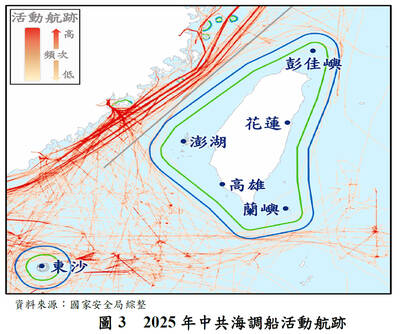
INTENSIFYING THREATS: Beijing’s tactics include massive attacks on the government service network, aircraft and naval vessel incursions and damaging undersea cables China is prepared to interfere in November’s nine-in-one local elections by launching massive attacks on the Taiwanese government’s service network (GSN), a report published by the National Security Bureau showed. The report was submitted to the Legislative Yuan ahead of the bureau’s scheduled briefing at the Foreign Affairs and National Defense Committee tomorrow. The national security team has identified about 13,000 suspicious Internet accounts and 860,000 disputed messages, the bureau said of China’s cognitive warfare against Taiwan. The disputed messages focus on major foreign affairs, national defense and economic issues, which were produced using generative artificial intelligence (AI) and distributed through Chinese


 RSS
RSS