


The No. 2 reactor at the Guosheng Nuclear Power Plant which was restarted on Tuesday, tripped yesterday during testing, state-run Taiwan Power Co (Taipower, 台電) said.
The plant in New Taipei City’s Wanli District (萬里) was expected to output at full capacity by the end of the week, but a safety mechanism governing the reactor’s steam valve that was set too sensitively triggered a shutdown yesterday afternoon, Taipower said.
The company said it would wait for approval from the Atomic Energy Council before restarting the reactor again.
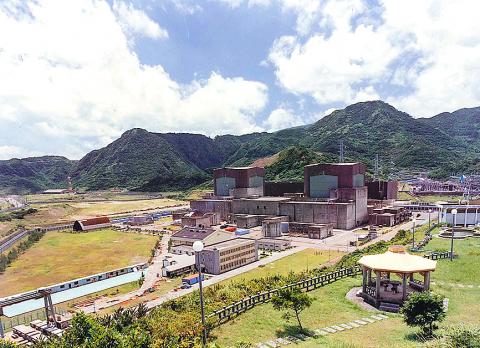
Photo courtesy of Taiwan Power Co
The reactor had been shutdown since 2016 and underwent an overhaul late last year, with the company applying to the council on Feb. 5 to restart it after repairs were complete.
The restart obtained a preliminary approval from the council on March 5 and cleared a subsequent review by the Legislative Yuan on March 15.
Taipower restarted the reactor at 11:30am on Wednesday last week, allowing it to slowly build up heat and pressure in preparation for the generation of power on Tuesday at 12:55pm.
The council said an emergency shutdown was indicated yesterday at 1:25pm after a warning signal was given by the reactor’s neutron detection system.
Taipower is investigating the incident and would issue a public report after it is able to fully confirm the cause of the shutdown, the council said.
The reactor is not to be restarted before the investigation is complete and the council inspects facilities in accordance with established laws and regulations, the company said.
Taipower said it had already run excess speed tests on the main steam generator, as well as two tests on the system’s power generating equipment before the shutdown, adding that an initial investigation indicated that the sensitivity of a sensor on a steam valve was set too high.
Environmental groups responded to the news of the shutdown by calling for the reactor to remain suspended and for those in charge of approving its operation to be held responsible.
New Taipei City Nuclear Energy Safety Supervision Committee Chairman Lee Ssu-chuan (李四川) also condemned Taipower for the shutdown by a safety mechanism so soon after the reactor’s restart.
“Although there was no radiation leak at the plant, the incident has already led to doubts about the facility among the public,” Lee said.
Wild at Heart Legal Defense Association lawyer Tsai Ya-ying (蔡雅瀅) said she hopes the incident would be properly investigated and that the results of investigation will be truthfully revealed to the public, adding that she hopes Taipower will see the restart is a mistake and abandon its plans to restart the reactor.
Green Consumers’ Foundation chairman Jay Fang (方儉) joked about the incident on Facebook, saying: “A machine that shuts down is a good thing. It is one that cannot shutdown that we need to be worried about. If we face that, we will be done for.”
Fang said he believed there was no way the reactor, which had been inoperable for 670 days, could function normally.
The use of old nuclear equipment has already been the cause of a 20 percent increase in power costs, he said, adding that the plant’s age creates a risk of nuclear disaster.
Additional reporting by Ho Yu-hua and Yang Mien-chieh

LEVERAGE: China did not ‘need to fire a shot’ to deny Taiwan airspace over Africa when it owns ‘half the continent’s debt,’ a US official said, calling it economic warfare The EU has raised concerns about overflight rights following the delay of President William Lai’s (賴清德) planned state visit to the Kingdom of Eswatini after three African nations denied overflight clearance for his charter at the last minute. Taiwanese allies Paraguay and Saint Kitts and Nevis, as well as several US lawmakers and the Inter-Parliamentary Alliance on China (IPAC) condemned China for allegedly pressuring the countries. Lai was scheduled to fly directly to Taiwan’s only African ally from yesterday to Sunday to celebrate the 40th anniversary of King Mswati III’s accession and his 58th birthday, but Seychelles, Mauritius and Madagascar suddenly revoked
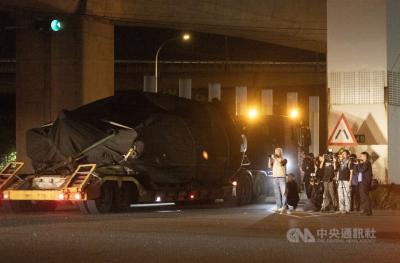
The final batch of 28 M1A2T Abrams tanks purchased from the US arrived at Taipei Port last night and were transported to the Armor Training Command in Hsinchu County’s Hukou Township (湖口), completing the military’s multi-year procurement of 108 of the tanks. Starting at 12:10am today, reporters observed more than a dozen civilian flatbed trailers departing from Taipei Port, each carrying an M1A2T tank covered with black waterproof tarps. Escorted by military vehicles, the convoy traveled via the West Coast Expressway to the Armor Training Command, with police implementing traffic control. The army operates about 1,000 tanks, including CM-11 Brave Tiger
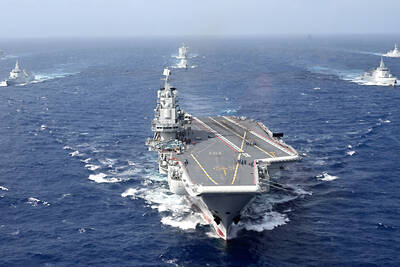
PROVOCATIVE: Chinese Deputy Ambassador to the UN Sun Lei accused Japan of sending military vessels to deliberately provoke tensions in the Taiwan Strait China denounced remarks by Japan and the EU about the South China Sea at a UN Security Council meeting on Monday, and accused Tokyo of provocative behavior in the Taiwan Strait and planning military expansion. Ayano Kunimitsu, a Japanese vice foreign minister, told the Council meeting on maritime security that Tokyo was seriously concerned about the situation in the East China and South China seas, and reiterated Japan’s opposition to any attempt to change the “status quo” by force, and obstruction of freedom of navigation and overflight. Stavros Lambrinidis, head of the EU delegation to the UN, also highlighted South China Sea
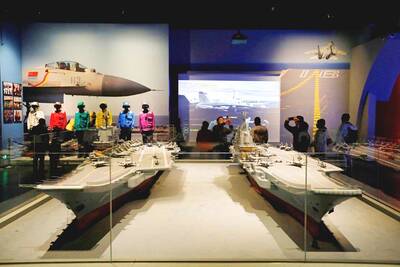
China on Wednesday teased in a video an aircraft carrier that could be its fourth, and the first using nuclear power, while making an allusion to Taiwan and vowing to further build up its islands, as it looks to boost maritime power, secure resources and bolster territorial claims. The video, issued on the eve of the 77th founding anniversary of the Chinese People’s Liberation Army Navy, featured fictional officers with names that are homophones of three commissioned aircraft carriers, the Liaoning (遼寧), Shandong (山東) and Fujian (福建). Titled Into the Deep, it showed a 19-year-old named “Hejian” (何劍) joining the group, sparking


 RSS
RSS