


About 200 people yesterday rallied outside the Taipei Guest House in Taipei demanding that the government respect National Taiwan University’s (NTU) autonomy, as controversy over the appointment of NTU president-elect Kuan Chung-ming (管中閔) shows no signs of dying down.
“We are strongly opposed to the political interference that has obstructed the legal NTU presidential election process and prevented Kuan from taking office,” NTU School of Veterinary Medicine professor Chou Chung-hsi (周崇熙) said.
Chou led NTU students, faculty and alumni in chanting slogans such as “keep your political hands off our campus” and “we want a president.”
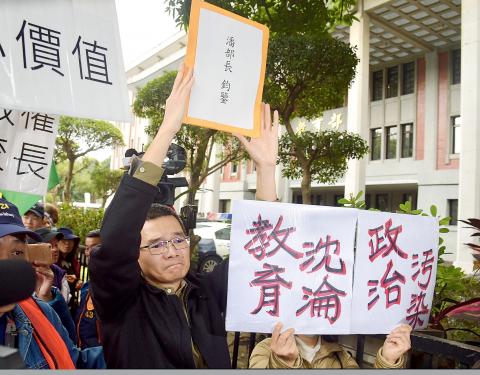
Photo: Huang Yao-cheng, Taipei Times
NTU political science professor Su Hung-dah (蘇宏達) said he joined the rally not because he is personally in favor of Kuan, but because his election was legal.
“The election was legitimate and the result ought to be respected by the government,” he said.
Kuan was elected on Jan. 5 to succeed Yang Pan-chyr (楊泮池), who chose not to serve another term when his first term expired in June last year.
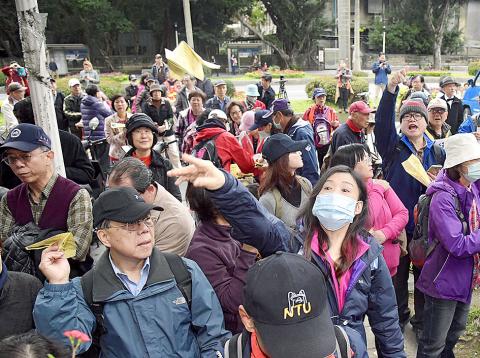
Photo: Huang Yao-cheng, Taipei Times
However, Kuan has since been accused of plagiarism and conflict of interest, which cast doubt on the legitimacy of the election process.
Members of the university’s election committee on Jan. 31 decided to uphold the election result, but the Ministry of Education was not satisfied with the selection committee’s findings and has demanded that the allegations be cleared up before it confirms Kuan’s appointment.
Ministry Department of Personnel Director Chen Kun-yuan (陳焜元) said that the election committee “has yet to answer the questions” about the conflict-of-interest allegation.
Kuan allegedly did not inform the committee that he was then an independent member of Taiwan Mobile’s board of directors.
Taiwan Mobile vice chairman Richard Tsai (蔡明興) is on the NTU election committee.
According to the committee meeting minutes from Jan. 31, members said that Kuan’s position on the board was public knowledge.
The election committee said that they were unable to determine whether the election result would have been different had they known that Kuan served in the role.
“From the meeting records, we could not determine whether the information might have influenced the election result,” Chen said. “This is a question that either the university or the election committee need to answer.”
Meanwhile, other university students, faculty and alumni have criticized the selection committee for playing down the allegations against Kuan.
A petition initiated by NTU Affairs Council representatives has reached the signature threshold to demand that the council call a special meeting to investigate the dispute, pending a response from the University’s Office of the Secretariat.
Chen said the ministry would pay close attention to how the Affairs Council handles the issue.

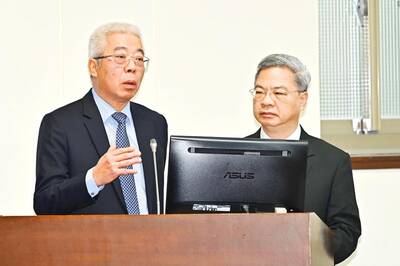
Taiwan has arranged for about 8 million barrels of crude oil, or about one-third of its monthly needs, to be shipped from the Red Sea this month to bypass the Strait of Hormuz and ease domestic supply pressures, CPC Corp, Taiwan (CPC, 台灣中油) said yesterday. The state-run oil company has worked with Middle Eastern suppliers to secure routes other than the Strait of Hormuz, through which about 20 percent of the world’s oil and liquefied natural gas typically passes, CPC chairman Fang Jeng-zen (方振仁) said at a meeting of the legislature’s Economics Committee in Taipei. Suppliers in Saudi Arabia have indicated they
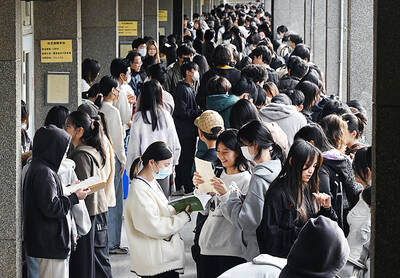
A global survey showed that 60 percent of Taiwanese had attained higher education, second only to Canada, the Ministry of the Interior said. Taiwan easily surpassed the global average of 43 percent and ranked ahead of major economies, including Japan, South Korea and the US, data from the Organisation for Economic Co-operation and Development (OECD) for 2024 showed. Taiwan has a high literacy rate, data released by the ministry showed. As of the end of last year, Taiwan had 20.617 million people aged 15 or older, accounting for 88.5 percent of the total population, with a literacy rate of 99.4 percent, the data
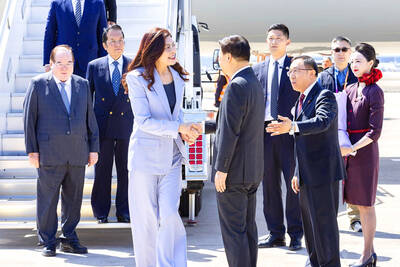
CCP ‘PAWN’? Beijing could use the KMT chairwoman’s visit to signal to the world that many people in Taiwan support the ‘one China’ principle, an academic said Chinese Nationalist Party (KMT) Chairwoman Cheng Li-wun (鄭麗文) yesterday arrived in China for a “peace” mission and potential meeting with Chinese President Xi Jinping (習近平), while a Taiwanese minister detailed the number of Chinese warships currently deployed around the nation. Cheng is visiting at a time of increased Chinese military pressure on Taiwan, as the opposition-dominated Legislative Yuan stalls a government plan for US$40 billion in extra defense spending. Speaking to reporters before going to the airport, Cheng said she was going on a “historic journey for peace,” but added that some people felt uneasy about her trip. “If you truly love Taiwan,

NEW LOW: The council in 2024 based predictions on a pessimistic estimate for the nation’s total fertility rate of 0.84, but last year that rate was 0.69, 17 percent lower An expected National Development Council (NDC) report expects the nation’s population to drop below 12 million by 2065, with the old-age dependency ratio to top 100 percent sooner than 2070, sources said yesterday. The council is slated to release its latest population projections in August, using an ultra-low fertility model, the sources said. The previous report projected that Taiwan’s population would fall to 14.37 million by 2070, but based on a new estimate of the total fertility rate (TFR) — the average number of children born to a woman over her lifetime — the population is expected to reach 12 million by


 RSS
RSS