


The National Women’s League’s months-long negotiations with the Ministry of the Interior and the Executive Yuan’s Ill-gotten Party Assets Settlement Committee finally yielded some results yesterday, with the three parties signing a memorandum of understanding laying down the foundation for a formal administrative contract.
Under the agreement, inked at a news conference at the ministry in Taipei, the league is to donate 90 percent of its total assets, or about NT$34.3 billion (US$1.15 billion), to the state coffers to pay for long-term care services, healthcare for veterans, social welfare, and efforts to prevent domestic violence and sexual assault.
The league’s remaining assets are to be donated to a subsidiary, the Social Welfare Foundation, after deducting severance payments and administrative expenditures for its pending dissolution.
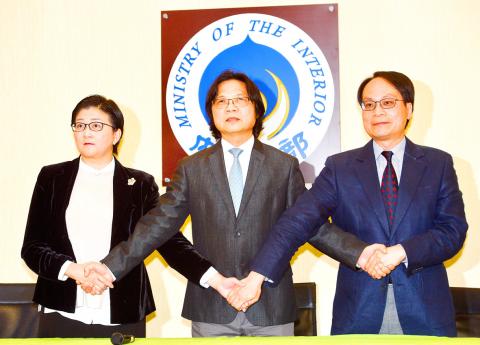
Photo: Peter Lo, Taipei Times
The agreement also requires four foundations established with the league’s funding, including the Social Welfare Foundation and the National Women’s League Foundation for the Hearing Impaired, to re-elect their boards of directors as soon as possible, with one-third of the seats to be appointed by the government.
Another important element of the document is a requirement that a draft administrative contract be tendered by the three parties, and ratified by the league’s representatives and the four foundations’ boards of directors within a month.
After the signing of the contract, the league must file for its dissolution with the ministry within four months and would no longer face investigations or punitive measures by the ministry or the committee.
“There is more than one way to deal with the Chinese Nationalist Party’s [KMT] purportedly illegal assets. We have demonstrated today that there is another way, which is not all about confrontation,” committee Chairman Lin Feng-jeng (林?正) said at the news conference.
Lin expressed hope that the agreement would lay the groundwork for the nation’s promotion of transitional justice and create room for cooperation and understanding.
Minister of the Interior Yeh Jiunn-rong (葉俊榮) said that although the negotiations might not be perfect from some perspectives, a good example has been set for achieving transitional justice, as the ministry’s proposed handling of the league was adopted in the deal and the rights of the league’s employees were safeguarded.
Yeh was referring to the three principles proposed by the ministry in dealing with the league’s transformation: the need for organizational democratization, the donation of the league’s assets to the government for charitable purposes and opening the organization up to government-led public observation.
The agreement was inked one day after the league’s standing committee, under the leadership of newly elected chairwoman Joanna Lei (雷倩), voted unanimously to sign an administrative contract based on a three-party agreement reached on July 24, in which the three principles were manifested.
Lei was elected on Sunday to succeed former league chairwoman Cecilia Koo (辜嚴倬雲), who, along with then-league deputy chairwoman Yeh Chin-fong (葉金鳳), were removed by the ministry on Friday last week over their refusal to sign the contract within a given time frame.
The league has been under investigation by the committee over its alleged links with the KMT and its use of the Military Benefit Tax, a tariff levied on the US dollar value of all imported goods from 1955 to 1989 that provided most of the funding for the league’s charity work.

South Korea has adjusted its electronic arrival card system to no longer list Taiwan as a part of China, a move that the Ministry of Foreign Affairs said would help facilitate exchanges between the two sides. South Korea previously listed “Taiwan” as “Taiwan (China)” in the drop-down menus of its online arrival card system, where people had to fill out where they came from and their next destination. The ministry had requested South Korea make a revision and said it would change South Korea’s name on Taiwan’s online immigration system from “Republic of Korea” to “Korea (South),” should the issue not be

Tainan, Taipei and New Taipei City recorded the highest fines nationwide for illegal accommodations in the first quarter of this year, with fines issued in the three cities each exceeding NT$7 million (US$220,639), Tourism Administration data showed. Among them, Taipei had the highest number of illegal short-term rental units, with 410. There were 3,280 legally registered hotels nationwide in the first quarter, down by 14 properties, or 0.43 percent, from a year earlier, likely indicating operators exiting the market, the agency said. However, the number of unregistered properties rose to 1,174, including 314 illegal hotels and 860 illegal short-term rental
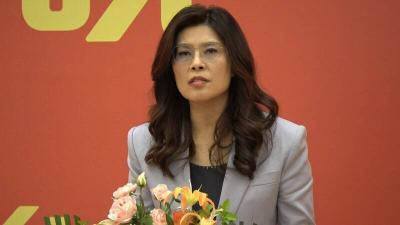
Both sides of the Taiwan Strait share a political foundation based on the “1992 consensus” and opposition to Taiwanese independence, Chinese Nationalist Party (KMT) Chairwoman Cheng Li-wun (鄭麗文) today said during her meeting with Chinese President Xi Jinping (習近平). Both sides of the Strait should plan and build institutionalized and sustainable mechanisms for dialogue and cooperation based on that foundation to make peaceful development across the Strait irreversible, she said. Peace is a shared moral value across the Strait, and both sides should move beyond political confrontation to seek institutionalized solutions to prevent war, she said. Mutually beneficial cross-strait relations are what the
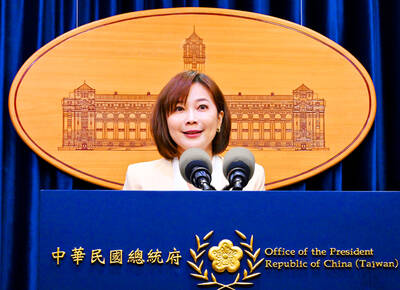
ECONOMIC COERCION: Such actions are often inconsistently applied, sometimes resumed, and sometimes just halted, the Presidential Office spokeswoman said The government backs healthy and orderly cross-strait exchanges, but such arrangements should not be made with political conditions attached and never be used as leverage for political maneuvering or partisan agendas, Presidential Office spokeswoman Karen Kuo (郭雅慧) said yesterday. Kuo made the remarks after China earlier in the day announced 10 new “incentive measures” for Taiwan, following a landmark meeting between Chinese President Xi Jinping (習近平) and Chinese Nationalist Party (KMT) Chairwoman Cheng Li-wun (鄭麗文) in Beijing on Friday. The measures, unveiled by China’s Xinhua news agency, include plans to resume individual travel by residents of Shanghai and China’s Fujian


 RSS
RSS