


Premier William Lai (賴清德) yesterday proposed redefining administrative zones to balance urban and rural development, and introducing a population policy to boost the declining birth rate as the Executive Yuan’s priorities next year.
Lai recounted the Cabinet’s achievements over the past year at an end of year news conference, saying that his policies are oriented toward developing the economy, promoting renewable energy sources and technology, as well as achieving social justice, and promoting security and cultural policies.
He said he would prioritize a fertility policy, drug and crime prevention, and balancing urban and rural development as the Cabinet’s goals next year.

Photo: Fang Pin-chao, Taipei Times
The government is to begin evaluating how administrative regions could be rezoned to alleviate the unequal distribution of resources in rural areas, he added.
Local governments are constantly underfunded and understaffed, while public officials in the six special municipalities are better paid and have more opportunities for promotion than their counterparts in rural areas, leading to a brain drain outside of the special municipalities, Lai said.
The Cabinet is to amend the Act Governing the Allocation of Government Revenues and Expenditures (財政收支劃分法) to give local governments more resources to retain talent, he added.
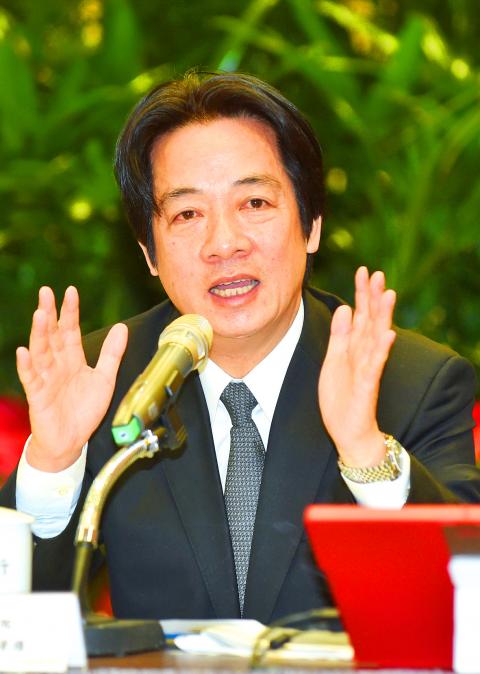
Photo: Liu Hsin-te, Taipei Times
It is also to fund city governments to develop plans to boost the local economy and culture, providing career opportunities for young people, Lai said.
A set of new population policies is to be announced soon, which would aim to boost the nation’s sub-replacement birthrate, while introducing immigrants, he added.
The policies aim to increase the average number of children born per woman from 1.17 to 1.4 by 2030, Lai said, adding that if the birthrate remains at its current level, the nation’s population would decrease to less than 20 million by 2056.
The government is to introduce subsidy packages for private kindergartens to make them as affordable as their state-run counterparts, he said.
Lai said he introduced a similar policy in Tainan during his first term as mayor, waiving public kindergarten tuition fees while offering a subsidy of between NT$70,000 and NT$75,000 per year for each child registered with a private kindergarten to reduce child-rearing costs for parents.
The Ministry of Education has been preparing budget plans for a possible nationwide implementation of the subsidy policy, and measures are to be announced after the Lunar New Year holiday, he said.
To prevent drug trafficking, the government is to redouble efforts to crackdown on criminal organizations by utilizing new legal tools provided by amendments to the Organized Crime Prevention Act (組織犯罪防制條例), which widened the criteria for recognizing a criminal organization and authorized law enforcement agencies to confiscate all such groups’ assets believed to be obtained illegally, Lai said.
To boost the economy, the Cabinet has relaxed financial and environmental laws and regulations to boost flexibility and efficiency, such as streamlining the processes for environmental impact assessments and urban renewal reviews, he said.
Vice Premier Shih Jun-ji (施俊吉) said the Directorate-General of Budget, Accounting and Statistics has raised its forecast for GDP growth next year to 2.29 percent, lower than the global average, but higher than developed countries.
GDP growth might be further increased with proper implementation of key government policies, such as the Forward-looking Infrastructure Development Program, to boost domestic demand, which is especially important as the nation has experienced a decline in foreign investment, he said.
A planned 3 percent pay hike for public employees, as well as a 4.3 percent increase to the minimum wage and a 5.3 percent increase to minimum hourly pay to be implemented on Monday next week, would give salaried workers a better share of the benefits of the GDP growth, he added.
While President Tsai Ing-wen (蔡英文) has said it would be ideal to raise the minimum monthly salary to NT$30,000, that “is not very distant from the degree of the current pay raise,” Shih said.

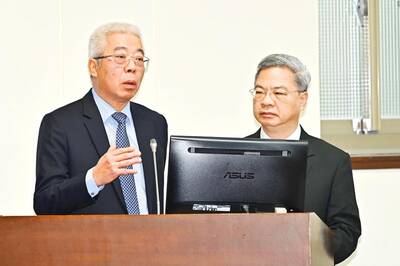
Taiwan has arranged for about 8 million barrels of crude oil, or about one-third of its monthly needs, to be shipped from the Red Sea this month to bypass the Strait of Hormuz and ease domestic supply pressures, CPC Corp, Taiwan (CPC, 台灣中油) said yesterday. The state-run oil company has worked with Middle Eastern suppliers to secure routes other than the Strait of Hormuz, through which about 20 percent of the world’s oil and liquefied natural gas typically passes, CPC chairman Fang Jeng-zen (方振仁) said at a meeting of the legislature’s Economics Committee in Taipei. Suppliers in Saudi Arabia have indicated they
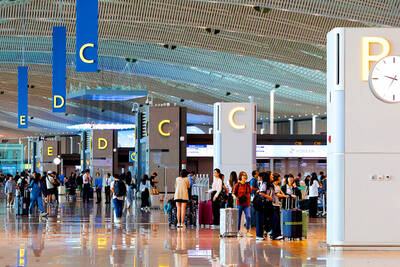
South Korea has adjusted its electronic arrival card system to no longer list Taiwan as a part of China, a move that the Ministry of Foreign Affairs said would help facilitate exchanges between the two sides. South Korea previously listed “Taiwan” as “Taiwan (China)” in the drop-down menus of its online arrival card system, where people had to fill out where they came from and their next destination. The ministry had requested South Korea make a revision and said it would change South Korea’s name on Taiwan’s online immigration system from “Republic of Korea” to “Korea (South),” should the issue not be

Tainan, Taipei and New Taipei City recorded the highest fines nationwide for illegal accommodations in the first quarter of this year, with fines issued in the three cities each exceeding NT$7 million (US$220,639), Tourism Administration data showed. Among them, Taipei had the highest number of illegal short-term rental units, with 410. There were 3,280 legally registered hotels nationwide in the first quarter, down by 14 properties, or 0.43 percent, from a year earlier, likely indicating operators exiting the market, the agency said. However, the number of unregistered properties rose to 1,174, including 314 illegal hotels and 860 illegal short-term rental
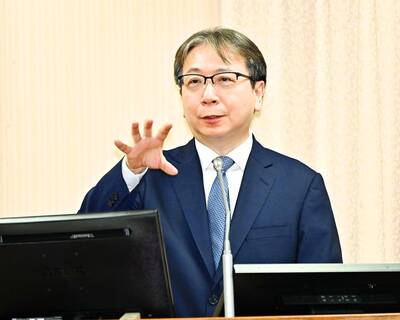
AIR ALERT: China’s reservation of airspace over the Yellow Sea and East China Sea could be an attempt to test the US’ response ahead of a Trump-Xi meeting, the NSB head said China’s attempts to infiltrate Taiwan are systematic, planned and targeted, with activity shifting from recruiting mid-level military officers to rank-and-file enlisted personnel, National Security Bureau (NSB) Director-General Tsai Ming-yen (蔡明彥) said yesterday. The Chinese Communist Party’s (CCP) integrates national security, intelligence operations and “united front” efforts into a dense network to conduct intelligence gathering and espionage in Taiwan, Tsai said at a meeting of the legislature’s Foreign Affairs and National Defense Committee. It uses specific networks to screen targets through exchange activities and recruiting local collaborators to establish intelligence-gathering organizations, he said. China is also shifting who it targets to lower-ranking military personnel,


 RSS
RSS