


Thousands of people yesterday marched in Taichung and Kaohsiung, calling on the government to stop using coal in power generation and end the phenomenon of “one sky, two Taiwans” caused by air pollution predominantly affecting the nation’s southern regions.
The demonstration in Taichung saw most participants dressed in black, which they said represented lungs darkened by air pollution caused by burning coal.
The protesters gathered at Taichung City Council Square at 1pm and outlined the words “no coal” and a map of Taiwan with their bodies for an aerial photograph.
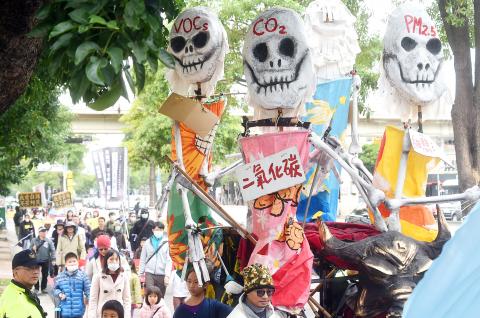
Photo: Liao Yao-tung, Taipei Times
They then marched around the Taichung City Government Building until about 5:20pm.
Hsu Hsin-hsin (許心欣), a member of the Taiwan Healthy Air Action Alliance, which organized the Taichung protest, said that air pollution is caused by the government’s past policies that wrongly put excessive emphasis on industrial development, but it is trying to fool the public by saying that local pollution is mostly caused by pollutants coming from China.
To improve the air quality in southern Taiwan, the Executive Yuan should relocate the offices of the Ministry of Economic Affairs, the Environmental Protection Administration and the Ministry of Health and Welfare to the south, she said.
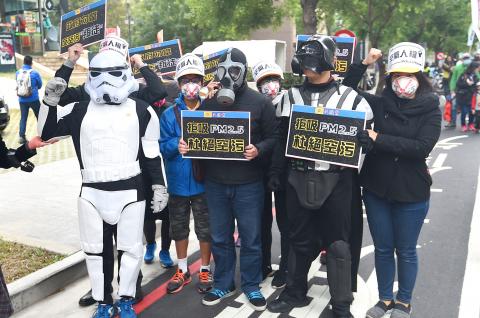
Photo: Liao Yao-tung, Taipei Times
Before the march, a member of the Central Taiwan Citizen Action Front raised placards that read “The Chinese Nationalist Party [KMT] is the biggest pollution source in Taiwan” and “Searching for blue skies, but not for the pan-blue camp,” which angered a KMT supporter who demanded that the group leave the area.
Everyone — government officials, environmentalists, academics and pollution producers — should join forces to tackle the problem of air pollution, which should be regarded as a “common enemy” of Taiwanese, alliance director Yeh Guang-perng (葉光芃) said.
While Taichung Mayor Lin Chia-lung (林佳龍) has set up guidelines for regulating the use of coal and petroleum coke in the city’s factories, he should work harder to close the Taichung Power Plant, which has 10 coal-fired power generators, Yeh said.
The alliance estimated that 5,000 people attended the parade.
The parade in Kaohsiung attracted about 3,000 participants, organizer and Southern Taiwan Anti-Air Pollution Alliance convener Chen Jiau-hua (陳椒華) said.
Also at 1pm, the protesters met at Exit 4 of the Aozihdi MRT Station (凹子底) and marched along Boai 2nd Road (博愛二路).
To improve air quality in the south, state-run utilities, such as China Steel Corp (中鋼), CPC Corp, Taiwan (中油) and Taiwan Power Co (台電), should reduce their polluting emissions by 50 percent within three years, the southern alliance said, adding that coal burning should also be banned.
The government should distribute more air pollution funds to residents living near Kaohsiung’s industrial areas to cover the cost of epidemiological studies and health risk evaluations, it said.
KMT Chairman Wu Den-yih (吳敦義) attended the protest along with other KMT members.
People took to the streets in such cold weather because they could not bear the effects of air pollution anymore, Wu said, calling on the government to launch more effective policies to deal with air pollution.
Additional reporting by Chang Jui-chen, Ou Su-mei and Hung Chen-hung
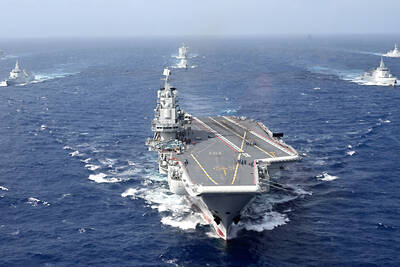
PROVOCATIVE: Chinese Deputy Ambassador to the UN Sun Lei accused Japan of sending military vessels to deliberately provoke tensions in the Taiwan Strait China denounced remarks by Japan and the EU about the South China Sea at a UN Security Council meeting on Monday, and accused Tokyo of provocative behavior in the Taiwan Strait and planning military expansion. Ayano Kunimitsu, a Japanese vice foreign minister, told the Council meeting on maritime security that Tokyo was seriously concerned about the situation in the East China and South China seas, and reiterated Japan’s opposition to any attempt to change the “status quo” by force, and obstruction of freedom of navigation and overflight. Stavros Lambrinidis, head of the EU delegation to the UN, also highlighted South China Sea
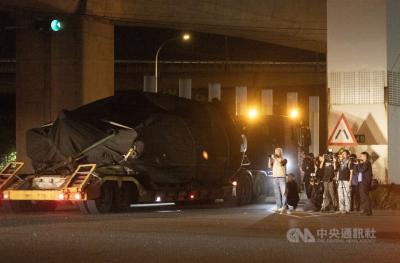
The final batch of 28 M1A2T Abrams tanks purchased from the US arrived at Taipei Port last night and were transported to the Armor Training Command in Hsinchu County’s Hukou Township (湖口), completing the military’s multi-year procurement of 108 of the tanks. Starting at 12:10am today, reporters observed more than a dozen civilian flatbed trailers departing from Taipei Port, each carrying an M1A2T tank covered with black waterproof tarps. Escorted by military vehicles, the convoy traveled via the West Coast Expressway to the Armor Training Command, with police implementing traffic control. The army operates about 1,000 tanks, including CM-11 Brave Tiger
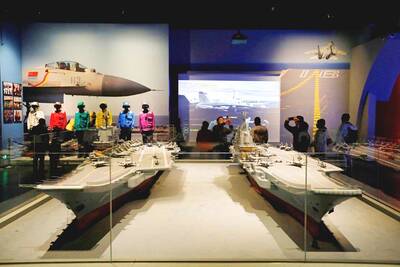
China on Wednesday teased in a video an aircraft carrier that could be its fourth, and the first using nuclear power, while making an allusion to Taiwan and vowing to further build up its islands, as it looks to boost maritime power, secure resources and bolster territorial claims. The video, issued on the eve of the 77th founding anniversary of the Chinese People’s Liberation Army Navy, featured fictional officers with names that are homophones of three commissioned aircraft carriers, the Liaoning (遼寧), Shandong (山東) and Fujian (福建). Titled Into the Deep, it showed a 19-year-old named “Hejian” (何劍) joining the group, sparking
Taiwan Semiconductor Manufacturing Co (TSMC, 台積電), the world’s largest contract chipmaker, said it expects its 2-nanometer (2nm) chip capacity to grow at a compound annual rate of 70 percent from this year to 2028. The projection comes as five fabs begin volume production of 2-nanometer chips this year — two in Hsinchu and three in Kaohsiung — TSMC senior vice president and deputy cochief operating officer Cliff Hou (侯永清) said at the company’s annual technology symposium in Silicon Valley, California, last week. Output in the first year of 2-nanometer production, which began in the fourth quarter of last year, is expected to


 RSS
RSS