


Lawmakers yesterday approved amendments to the Referendum Act (公民投票法) to lower the legal voting age and slash the thresholds for initiating, seconding and passing referendums.
The Legislative Yuan yesterday reviewed several motions concerning seven disputed draft amendments.
A proposed amendment to Article 2, which states that issues stipulated in the Constitution — such as the nation’s official title and territory — are not to be decided through referendums, was passed with the support of the Democratic Progressive Party (DPP), the Chinese Nationalist Party (KMT) and the People First Party caucuses.
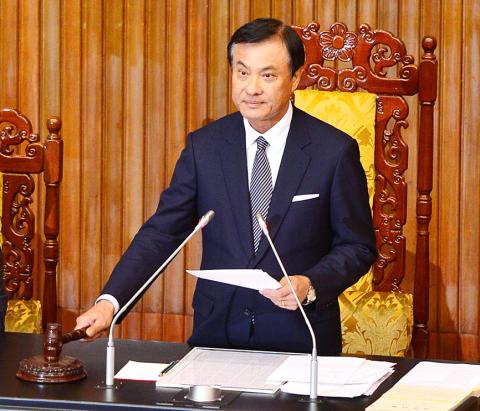
Photo: Wang Yi-sung, Taipei Times
The New Power Party’s (NPP) motion to extend the scope of the act to cover the Constitution’s contents and to allow a new Constitution to be written was struck down.
The amended Article 2 also grants people the right to propose — through a referendum — laws to be considered by city or county councils, and to amend or abolish local government-level autonomous acts.
This is a step up from the former rule, which granted people the right to amend or abolish lower-level autonomous regulations, which do not need approval from city or county councils.
All four caucuses lent their support to a draft amendment of Article 7, which lowers the legal voting age for referendums from 20 to 18, allowing it to advance to the third reading without a vote.
The threshold for initiation of national and regional referendums has been lowered from 0.005 percent of the electorate in the most recent presidential election, or about 90,000, to 0.0001 percent, or about 1,800.
The number of signatures required for a proposed referendum to pass its second stage — 5 percent of all eligible voters in the most recent president election, or about 900,000 — has been reduced to 1.5 percent, or about 280,000.
For a referendum to pass, 25 percent of the eligible voters must vote "yes."
A motion tabled by the KMT on Monday, which set the threshold at 20 percent, was vetoed.
A DPP motion to amend Article 13 to grant the Executive Yuan the right to propose referendums on major policies, proposing or vetoing a law was passed.
The amended act includes a new provision that allows signature drives, which are necessary for a referendum, to be conducted online.
According to the provision, the lead initiator of a referendum should request an authentication code when filing a request for an online signature drive with the Central Election Commission.
A KMT motion to implement absentee voting for referendums failed to obtain a majority vote.
A draft amendment by the NPP that seeks to have the president propose topics of “political negotiations” with Beijing as topics to be voted on in referendums before such negotiations are conducted was vetoed.
The DPP and the KMT said that such a regulatory measure should be stipulated in the proposed act on supervising cross-strait agreements, which the DPP has put on the back-burner to avoid worsening cross-strait ties.
NPP Executive Chairman Huang Kuo-chang (黃國昌) criticized the DPP over the outcome, saying its decision had forced President Tsai Ing-wen (蔡英文) to renege on a promise she made in 2011 during her first presidential election campaign to form a law on monitoring cross-strait political negotiations.
In response to the NPP’s proposals that the amendment should allow the public to vote on issues such as territorial changes and cross-strait negotiations, DPP spokeswoman Kolas Yotaka said those issues should be handled within the framework of the Constitution or a draft act on the cross-strait oversight mechanism.
While the KMT criticized the amendment for the exclusion of an absentee voting system, the DPP said it supports the idea of absentee voting and would legislate for its establishment with a separate law.
Additional reporting by Chen Wei-han
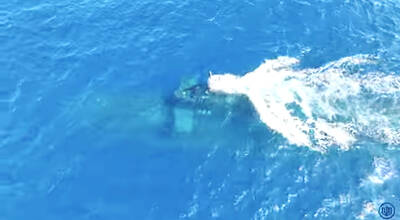
CSBC Corp, Taiwan (台灣國際造船) yesterday released the first video documenting the submerged sea trials of Taiwan’s indigenous defense submarine prototype, the Hai Kun (海鯤), or Narwhal, showing underwater navigation and the launch of countermeasures. The footage shows the vessel’s first dive, steering and control system tests, and the raising and lowering of the periscope and antenna masts. It offered a rare look at the progress in the submarine’s sea acceptance tests. The Hai Kun carried out its first shallow-water diving trial late last month and has since completed four submerged tests, CSBC said. The newly released video compiles images recorded from Jan. 29 to
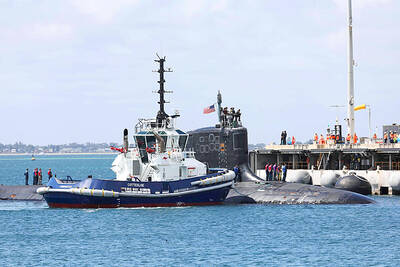
DETERRENCE EFFORTS: Washington and partners hope demonstrations of force would convince Beijing that military action against Taiwan would carry high costs The US is considering using HMAS Stirling in Western Australia as a forward base to strengthen its naval posture in a potential conflict with China, particularly over Taiwan, the Wall Street Journal reported on Saturday. As part of its Indo-Pacific strategy, Washington plans to deploy up to four nuclear-powered submarines at Stirling starting in 2027, providing a base near potential hot spots such as Taiwan and the South China Sea. The move also aims to enhance military integration with Pacific allies under the Australia-UK-US trilateral security partnership, the report said. Currently, US submarines operate from Guam, but the island could

RESTRAINTS: Should China’s actions pose any threat to Taiwan’s security, economic or social systems, China would be excluded from major financial institutions, the bill says The US House of Representatives on Monday passed the PROTECT Taiwan Act, which states that Washington would exclude China from participating in major global financial organizations if its actions directly threaten Taiwan’s security. The bill, proposed by Republican Representative Frank Lucas, passed with 395 votes in favor and two against. It stipulates that if China’s actions pose any threat to Taiwan’s security, economic or social systems, the US would, “to the maximum extent practicable,” exclude Beijing from international financial institutions, including the G20, the Bank for International Settlements and the Financial Stability Board. The bill makes it clear that China must be prepared

Taiwanese trade negotiators told Washington that Taipei would not relocate 40 percent of its semiconductor production to the US, and that its most advanced technologies would remain in the nation, Vice Premier Cheng Li-chiun (鄭麗君) said on Sunday. “I told the US side very clearly — that’s impossible,” Cheng, who led the negotiation team, said in an interview that aired on Sunday night on Chinese Television System. Cheng was referring to remarks last month by US Secretary of Commerce Howard Lutnick, in which he said his goal was to bring 40 percent of Taiwan’s chip supply chain to the US Taiwan’s almost


 RSS
RSS