


The Taipei District Prosecutors’ Office and the Agency Against Corruption have discovered that National Immigration Agency (NIA) officials bought biometric equipment from China for use in the e-Gates in the nation’s three major airports, sources said on Saturday.
The biometric equipment, which has been in use since 2012 at Taiwan Taoyuan International Airport, Kaohsiung International Airport and Taipei International Airport (Songshan airport), allows fast-track passport control for frequent travelers by using biometric verification methods such as facial recognition and fingerprint identification, and might have been compromised by China-made software and equipment, sources told the Liberty Times (the sister paper of the Taipei Times) on condition of anonymity.
The allegation has alarmed government investigators and security experts, who fear the e-Gates would be vulnerable to hacks by China or other groups seeking to obtain privileged information, or to circumvent travel restrictions on criminals or others, sources said.
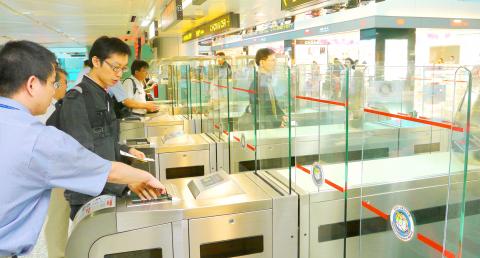
Photo: Tony Yao, Taipei Times
The Public Construction Commission’s regulations bar the purchase of equipment or technology from China that are “of a sensitive nature or might affect national security.”
Investigators reportedly suspect the bid for e-Gate computers and software was rigged by Transtep Technology Group (跨越科技) owner Lee Chi-shen (李奇申) and then-immigration agency information section chief Shih Ming-te (施明德), sources said.
They said investigators suspect Lee conspired to fix the bid for e-Gate computers and software as early as 2009.
Lee allegedly arranged for other industry figures to submit bids on his behalf and surreptitiously dictated the technical requirements of the project by writing the code for the border control’s operating system, sources said.
While e-Gate contractor Ho Fan Co (和範) is nominally a Fuji Xerox subsidiary, Transtep Technology was in control of all business related to the e-Gate contract, sources said.
TECO Smart Technologies Co (東元捷德), which supplied the e-Gate equipment to Ho Fan, allegedly imported the machines from China and then claimed they had been manufactured in Taiwan, the sources said.
Prosecutors and anti-corruption officials are concerned that Lee appears to have held a monopoly on the government’s procurement of e-Gate systems, they said.
There are fears that Lee might have knowingly or unknowingly compromised the border control apparatus via pre-installed backdoors, which could be exploited by a third party, sources said.
Lee is suspected of having connections to “specific individuals” in China and was known to have sent personnel to Shenzhen for “training,” raising fears that Lee had “nullified” the nation’s border controls and endangered travelers’ privacy, they said.
The sources said Lee and Shih are suspected of involvement in no fewer than seven allegedly rigged tenders over the past eight years and there are concerns the two men might have been acting under the instructions of others.
Shih and former immigration information section chief Chen Ying-chieh (陳英傑) were among the 41 people questioned last month by prosecutors in connection with the suspicious contracts.
Prosecutors in Taipei yesterday would only confirm that an investigation is underway.
Additional reporting by CNA

PROVOCATIVE: Chinese Deputy Ambassador to the UN Sun Lei accused Japan of sending military vessels to deliberately provoke tensions in the Taiwan Strait China denounced remarks by Japan and the EU about the South China Sea at a UN Security Council meeting on Monday, and accused Tokyo of provocative behavior in the Taiwan Strait and planning military expansion. Ayano Kunimitsu, a Japanese vice foreign minister, told the Council meeting on maritime security that Tokyo was seriously concerned about the situation in the East China and South China seas, and reiterated Japan’s opposition to any attempt to change the “status quo” by force, and obstruction of freedom of navigation and overflight. Stavros Lambrinidis, head of the EU delegation to the UN, also highlighted South China Sea
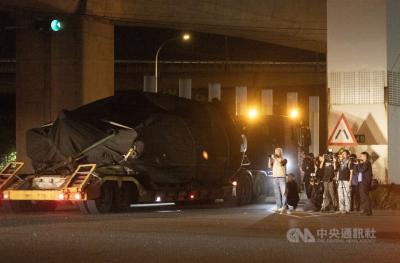
The final batch of 28 M1A2T Abrams tanks purchased from the US arrived at Taipei Port last night and were transported to the Armor Training Command in Hsinchu County’s Hukou Township (湖口), completing the military’s multi-year procurement of 108 of the tanks. Starting at 12:10am today, reporters observed more than a dozen civilian flatbed trailers departing from Taipei Port, each carrying an M1A2T tank covered with black waterproof tarps. Escorted by military vehicles, the convoy traveled via the West Coast Expressway to the Armor Training Command, with police implementing traffic control. The army operates about 1,000 tanks, including CM-11 Brave Tiger
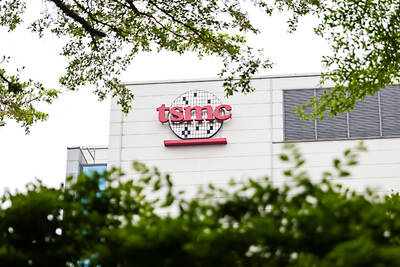
Taiwan Semiconductor Manufacturing Co (TSMC, 台積電), the world’s largest contract chipmaker, said it expects its 2-nanometer (2nm) chip capacity to grow at a compound annual rate of 70 percent from this year to 2028. The projection comes as five fabs begin volume production of 2-nanometer chips this year — two in Hsinchu and three in Kaohsiung — TSMC senior vice president and deputy cochief operating officer Cliff Hou (侯永清) said at the company’s annual technology symposium in Silicon Valley, California, last week. Output in the first year of 2-nanometer production, which began in the fourth quarter of last year, is expected to
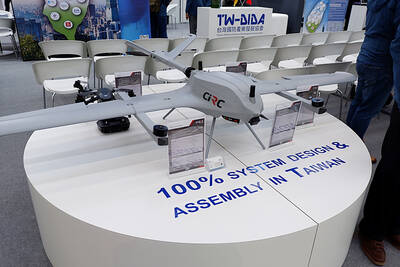
Taiwan’s drone exports surged past US$100 million in the first quarter, exceeding last year’s full-year total, with the Czech Republic emerging as the largest buyer, the Ministry of Economic Affairs said. Exports of complete drones reached US$115.85 million in the period, about 1.2 times the total recorded for all of last year, the ministry said in a report. Exports to the Czech Republic accounted for about US$100 million, far outpacing other markets. Poland, last year’s top destination, recorded about US$11.75 million in the first quarter. Taiwan’s drone exports have expanded rapidly in the past few years, with last year’s total


 RSS
RSS