


The Legislative Yuan’s Judicial Committee is tomorrow to review a draft amendment to the Criminal Code proposed by Democratic Progressive Party (DPP) Legislator Wang Ding-yu (王定宇) stipulating that Chinese spies and their collaborators should be convicted of “offenses against the external security of the state” (外患罪).
None of the punishments stipulated in the Criminal Code of the Armed Forces (陸海空軍刑法), the National Security Act (國家安全法), the Classified National Security Information Protection Act (國家機密保護法) and the National Intelligence Services Act (國家情報工作法) are strict enough to deter spies, Wang said.
While those laws have been amended over the past few years to stipulate stricter penalties, they are still too lenient and have proven ineffective in deterring spies, he said.

Photo: Liao Chen-huei, Taipei Times
Former Chinese People’s Liberation Army intelligence officer Zhen Xiaojiang (鎮小江), the mastermind behind the nation’s most serious security breach, in 2015 received a four-year prison term under the National Security Act.
Retired major general Hsu Nai-chuan (許乃權) was given a 34-month sentence for colluding with Zhen, with his pension payments to resume once he leaves jail.
Had the pair been tried under the Criminal Code, they could have received a life sentence or the death penalty.
However, as the Constitution includes China in the nation’s territory, their crimes are not legally regarded as “foreign aggression.”
The bill aims to circumvent the legal obstacle by changing the wording in the Criminal Code addressing espionage from “foreign nations” (外國) to “foreign nations or the nation’s enemies” (外國或敵人) and from “enemy nations” (敵國) to “enemies” (敵人).
The bill defines “enemies” as “countries or organizations that engage in armed conflict or a military standoff with the Republic of China” (與中華民國交戰或武力對峙之國家或團體), the wording used in the Criminal Code of the Armed Forces.
Only by associating Chinese spies with offenses against the security of the state by a foreign aggressor can they be effectively curbed, Wang said.
Wang submitted the legislation in November last year, but the Chinese Nationalist Party (KMT) caucus struck it down 10 times before the DPP caucus on Tuesday voted to send it to committee review.
The Ministry of Justice said the laws are in place to punish any action that compromises national security or is against the nation’s interests.
It advised against amending the Criminal Code, saying that the wording in one of the bill’s articles alternates between “enemies” and “enemy nations” and includes “the nation,” which it called a loophole.
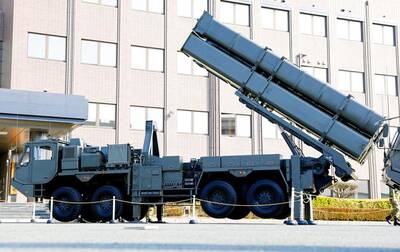
Japan has deployed long-range missiles in a southwestern region near China, the Japanese defense minister said yesterday, at a time when ties with Beijing are at their lowest in recent years. The missiles were installed in Kumamoto in the southern region of Kyushu, as Japan is attempting to shore up its military capacity as China steps up naval activity in the East China Sea. “Standoff defense capabilities enable us to counter the threat of enemy forces attempting to invade our country ... while ensuring the safety of our personnel,” Japanese Minister of Defense Shinjiro Koizumi said. “This is an extremely important initiative for

The nation’s fastest supercomputer, Nano 4 (晶創26), is scheduled to be launched in the third quarter, and would be used to train large language models in finance and national defense sectors, the National Center for High-Performance Computing (NCHC) said. The supercomputer, which would operate at about 86.05 petaflops, is being tested at a new cloud computing center in the Southern Taiwan Science Park in Tainan. The exterior of the server cabinet features chip circuitry patterns overlaid with a map of Taiwan, highlighting the nation’s central position in the semiconductor industry. The center also houses Taiwania 2, Taiwania 3, Forerunner 1 and

Chinese Nationalist Party (KMT) Chairwoman Cheng Li-wun (鄭麗文) today accepted an invitation from Chinese President Xi Jinping (習近平) to lead a delegation to China next month, saying she hopes to promote the peaceful development of cross-strait relations and bring stability to the Taiwan Strait. “I am grateful and happy to accept this invitation,” Cheng said in a statement from the KMT chairperson’s office. Cheng said she hopes both sides can work together to promote the peaceful development of cross-strait relations, enhance exchange and cooperation, bring stability to the Taiwan Strait and improve people’s livelihoods. At today's news conference, Cheng said any efforts to

MORE POPULAR: Taiwan Pass sales increased by 59 percent during the first quarter compared with the same period last year, the Tourism Administration said The Tourism Administration yesterday said that it has streamlined the Taiwan Pass, with two versions available for purchase beginning today. The tourism agency has made the pass available to international tourists since 2024, allowing them to access the high-speed rail, Taiwan Railway Corp services, four MRT systems and four Taiwan Tourist Shuttles. Previously, five types of Taiwan Pass were available, but some tourists have said that the offerings were too complicated. The agency said only two types of Taiwan Pass would be available, starting from a three-day pass with the high-speed rail and a three-day pass with Taiwan Railway Corp. The former costs NT$2,800


 RSS
RSS