


Chinese Nationalist Party (KMT) Taipei City Councilor Lee Hsin (李新) yesterday morning died after falling from a high-rise apartment in an apparent suicide, police and investigators said.
At about 5am, Lee, 64, plunged from his ex-wife’s 11th-floor residence in a residential complex on Taipei’s Anhe Road.
A resident of the unit below said he heard a noise and looked outside to see Lee standing on a ledge with his hands on the railing, eyes looking down.
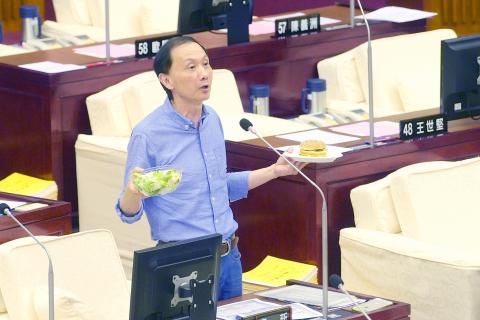
Photo: Chang Chia-ming, Taipei Times
“I asked him: ‘What are you doing out there?’ Then he just jumped,” the neighbor said.
Paramedics found Lee dead at the scene.
Police closed down the area to collect evidence and escorted Lee’s ex-wife, who was in shock, to Cathay General Hospital for treatment.
Lee might have been depressed by a chronic illness and by his girlfriend having asked to live separately from him, a source said on condition of anonymity.
KMT Taipei City Council caucus secretary-general Chen Yung-te (陳永德) said Lee had attempted suicide on Sept. 17, the night before the city council session began.
Lee took “50 or 60 sleeping pills” and was sent to a hospital, which discharged him the next day, Chen said.
The next day he went to work and attended a party caucus meeting, but appeared “sallow,” he added.
“He talked about his health repeatedly and did not seem to be his normal self,” Chen said.
KMT Taipei City Councilor Wang Hung-wei (王鴻薇) said Lee had shingles, but she did not expect him to kill himself.
She said that on Wednesday night she gave Lee a bill on preschool education to cosign, adding that he told her: “It is high time this gets done.”
Lee was a candidate in this month’s KMT Central Committee election, but had said he might have to withdraw due to stress and poor health, Wang said.
“Running for a seat on the central committee is not something you join and do not finish, but my understanding is that he was suffering physically,” she said.
KMT Legislator Lee Yen-hsiu (李彥秀) said she would remember Lee Hsin as a brave and honest man.
“Lee Hsin’s dedication to the city and the nation will not be forgotten. I hope his family will take care of themselves and I am grateful to have worked with him,” Lee Yen-hsiu said.
Lee Hsin did not leave a note behind prior to his apparent suicide, sources said.
New Party Chairman Yok Mu-ming (郁慕明) said Lee Hsin’s ailing health might have contributed to his suicide, as he had complained about it.
Yok said that Lee Hsin, who was his assistant when Yok was a lawmaker, had reached out to him in the past few days, but he was too busy to schedule an appointment.
He said he regrets not having talked to Lee Hsin before his death, as Lee Hsin had supported him 29 years ago during a difficult period of chemotherapy.
“His death causes me great sadness and regret,” Yok said. “He did not spell things out to me at the time. He only said: ‘My health has been extremely poor lately.’”
“We hope his family will get through this,” he added.
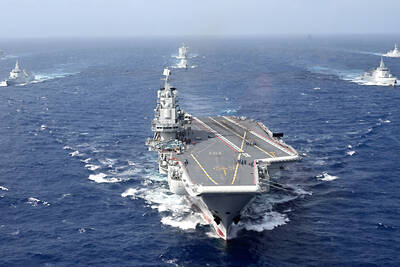
PROVOCATIVE: Chinese Deputy Ambassador to the UN Sun Lei accused Japan of sending military vessels to deliberately provoke tensions in the Taiwan Strait China denounced remarks by Japan and the EU about the South China Sea at a UN Security Council meeting on Monday, and accused Tokyo of provocative behavior in the Taiwan Strait and planning military expansion. Ayano Kunimitsu, a Japanese vice foreign minister, told the Council meeting on maritime security that Tokyo was seriously concerned about the situation in the East China and South China seas, and reiterated Japan’s opposition to any attempt to change the “status quo” by force, and obstruction of freedom of navigation and overflight. Stavros Lambrinidis, head of the EU delegation to the UN, also highlighted South China Sea
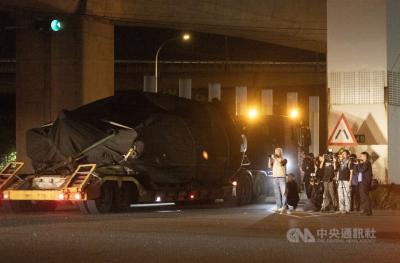
The final batch of 28 M1A2T Abrams tanks purchased from the US arrived at Taipei Port last night and were transported to the Armor Training Command in Hsinchu County’s Hukou Township (湖口), completing the military’s multi-year procurement of 108 of the tanks. Starting at 12:10am today, reporters observed more than a dozen civilian flatbed trailers departing from Taipei Port, each carrying an M1A2T tank covered with black waterproof tarps. Escorted by military vehicles, the convoy traveled via the West Coast Expressway to the Armor Training Command, with police implementing traffic control. The army operates about 1,000 tanks, including CM-11 Brave Tiger
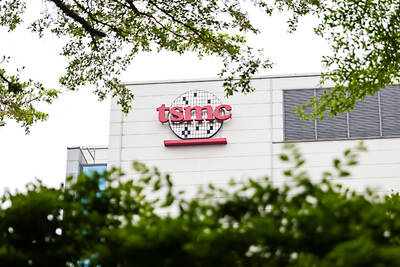
Taiwan Semiconductor Manufacturing Co (TSMC, 台積電), the world’s largest contract chipmaker, said it expects its 2-nanometer (2nm) chip capacity to grow at a compound annual rate of 70 percent from this year to 2028. The projection comes as five fabs begin volume production of 2-nanometer chips this year — two in Hsinchu and three in Kaohsiung — TSMC senior vice president and deputy cochief operating officer Cliff Hou (侯永清) said at the company’s annual technology symposium in Silicon Valley, California, last week. Output in the first year of 2-nanometer production, which began in the fourth quarter of last year, is expected to
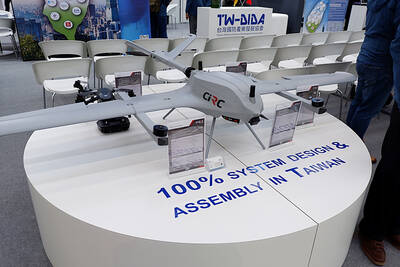
Taiwan’s drone exports surged past US$100 million in the first quarter, exceeding last year’s full-year total, with the Czech Republic emerging as the largest buyer, the Ministry of Economic Affairs said. Exports of complete drones reached US$115.85 million in the period, about 1.2 times the total recorded for all of last year, the ministry said in a report. Exports to the Czech Republic accounted for about US$100 million, far outpacing other markets. Poland, last year’s top destination, recorded about US$11.75 million in the first quarter. Taiwan’s drone exports have expanded rapidly in the past few years, with last year’s total


 RSS
RSS