


US President Donald Trump on Wednesday blocked a Chinese government-financed firm’s acquisition of an Oregon semiconductor maker on national security grounds.
A US federal panel that reviews foreign investment in the US for possible security threats ruled against the proposed US$1.3 billion purchase of Lattice Semiconductor last week.
The deal has been under scrutiny since it became clear the buyer, Canyon Bridge Capital Partners, is funded by the Chinese government.
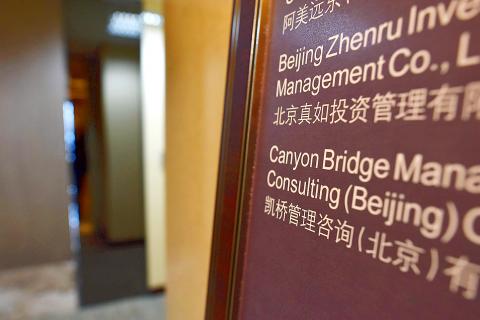
Photo: AFP
Chinese companies are on a global buying spree to acquire technology and brands. Most acquisitions in the US and Europe go through without incident, but some purchases of high-tech companies have prompted criticism they might represent security threats or the loss of important national assets.
“Credible evidence leads me to believe” the buyers of Lattice “might take action that threatens to impair the national security of the United States,” Trump said in his order.
A statement from the White House press secretary cited the importance of “semiconductor supply chain integrity” to US security, the Chinese government’s role in supporting the transaction and the potential transfer of intellectual property to a foreign buyer.
It was just the fourth time in a quarter century that a US president has ordered a foreign takeover of an American firm stopped on national security concerns.
Trump has expressed concern about the status of US manufacturing and its ability to meet national security needs.
In July, he issued an order for a review to be led by the US Department of Defense. He also has asked the US Department of Commerce to look into whether to raise tariffs on imported steel on national security grounds.
Following Trump’s announcement, Lattice said it was canceling the proposed sale.
Ministry of Commerce spokesman Gao Feng (高峰) yesterday told a media briefing in Beijing, that China is concerned over the matter and that the US should create a fair and transparent business environment.
“Conducting security checks on a sensitive investment is a nation’s legitimate right, but it shouldn’t be used as a protectionist tool,” Gao said, adding that the acquisition is a corporate decision that the US should evaluate objectively.
Lattice manufactures a relatively low-tech class of programmable computer chips that can be adapted for a variety of uses. It had 1,000 employees worldwide at the end of the last year, but that number dwindled after Lattice sold a division in India and laid off workers.
In December last year, the German government blocked the Chinese purchase of a chipmaker, Aixtron SE, after then-US president Barack Obama prohibited the buyer from taking over its California subsidiary on national security grounds.
Additional reporting by Bloomberg

SILENCING CRITICS: In addition to blocking Taiwan, China aimed to prevent rights activists from speaking out against authoritarian states, a Cabinet department said The Ministry of Foreign Affairs (MOFA) yesterday condemned transnational repression by Beijing after RightsCon, a major digital human rights conference scheduled to be held in Zambia this week, was abruptly canceled due to Chinese pressure over Taiwanese participation. This year’s RightsCon, the world’s largest conference discussing issues “at the intersection of human rights and technology,” was scheduled to take place from tomorrow to Friday in Lusaka, and expected to draw 2,600 in-person attendees from 150 countries, along with 1,100 online participants. However, organizers were forced to cancel the event due to behind-the-scenes pressure from China, the ministry said, expressing its “strongest condemnation”
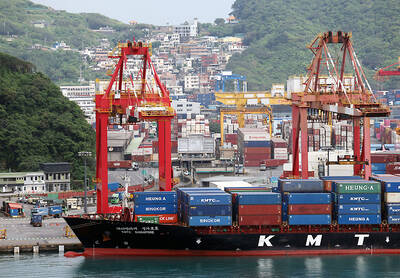
Taiwan’s economy grew far faster than expected in the first quarter, as booming demand for artificial intelligence (AI) applications drove a surge in exports, spilling over into investment and consumption, the Directorate-General of Budget, Accounting and Statistics (DGBAS) said yesterday. GDP growth was 13.69 percent year-on-year during the January-to-March period, beating the DGBAS’ February forecast by 2.23 percentage points and marking the most robust growth in nearly four decades, DGBAS senior official Chiang Hsin-yi (江心怡) told a news conference in Taipei. The result was powered by exports, which remain the backbone of Taiwan’s economy, Chiang said. Outbound shipments jumped 51.12 percent year-on-year to
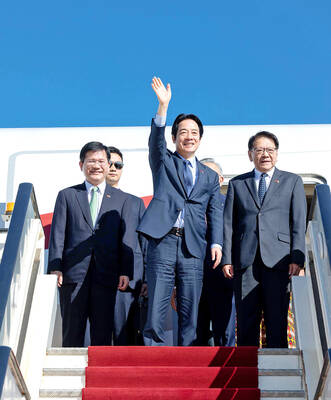
DELAYED BUT DETERMINED: The president’s visit highlights Taiwan’s right to international engagement amid regional pressure from China President Willaim Lai (賴清德) yesterday arrived in Eswatini, more than a week after his planned visit to Taiwan’s sole African ally was suspended because of revoked overflight permits. “The visit, originally scheduled for April 22, was postponed due to unforeseen external factors,” Lai wrote on social media. “After several days of careful arrangements by our diplomatic and national security teams, we successfully arrived today.” Lai said he looked forward to further deepening Taiwan-Eswatini relations through closer cooperation in the economy, agriculture, culture and education, as well as advancing the nation’s international partnerships. The president was initially scheduled to arrive in time to celebrate
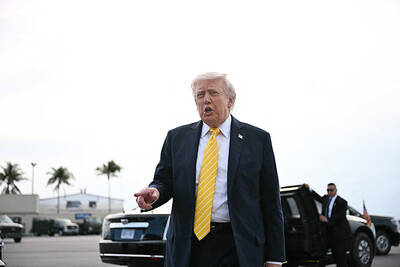
Iran’s Islamic Revolutionary Guard Corp (IRGC) yesterday said the US faced a choice between an “impossible” military operation or a “bad deal” with Tehran, after US President Donald Trump disparaged Iran’s latest peace proposal. Negotiations between the two countries have been deadlocked since a ceasefire came into effect on April 8, with only one round of direct peace talks held so far. Iran’s Tasnim and Fars news agencies reported that Tehran had submitted a 14-point proposal to mediator Pakistan, but Trump was quick to cast doubt on it. “I will soon be reviewing the plan that Iran has just sent to us, but


 RSS
RSS