


Human error and systematic flaws triggered the power outages nationwide on Aug. 15, according to a government analysis published yesterday.
The Executive Yuan released the analysis after wrapping up its investigation into the incident.
The blackouts occurred after the natural gas supply to a major power plant in Taoyuan’s Datan Township (大潭) was abruptly cut off, causing all six generators at the plant to shut down, the analysis said.
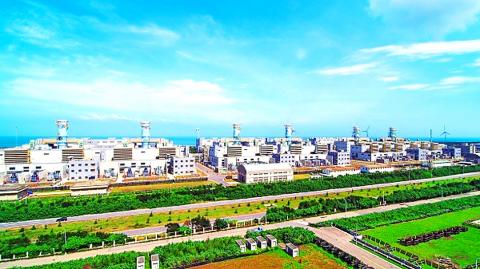
Photo: courtesy of Taiwan Power Co
The ensuing power outages affected 5.92 million households, while 423 manufacturers reported losses and about 900 elevator shutdowns were reported.
Technicians employed by a contractor for state-run oil refiner CPC Corp, Taiwan (台灣中油), which manages a natural gas metering system connected to the power plant, committed several mistakes during routine maintenance.
The technicians did not switch the control of the metering system to manual and they cut off the power to the control system for 21 seconds, causing it to automatically shut down the gas supply valve, the investigation found.
CPC Corp should be held accountable for the errors, as there was only one CPC official supervising the replacement procedure conducted by the employees of the contractor, but the official left no record, it said.
CPC Corp also did not draw up a standard replacement procedure and failed to assess the risks involved in the contractor’s replacement procedure.
It also failed to timely inform Taiwan Power Co (Taipower, 台電), which runs the Datan plant.
The design of the metering system is also flawed, as it puts too many important functions on one single control system, which, when not working properly, automatically shuts off the supply valve, the investigation found.
The gas supply is also run by a single pipeline with no backup system, the report said.
Taipower, although it handled the emergency generator shutdown and contingency power rationing efforts well, does not have a warning system in place to notify users of its rationing measures, causing inconvenience to the public, the investigation found.
Taipower then compounded the problem by shifting control of a generator at the Taichung Power Plant from manual to automatic without first confirming that the system was completely restored, causing the generator to trip.
To make improvements, both CPC Corp and Taipower should launch a comprehensive examination of their systems and management, to try to remove the possibility of human error and mismanagement, the report said.
The two companies should also establish an effective cooperation mechanism and multiple backup power generation systems, while improving their professional management and training, the report said.
The Ministry of Economic Affairs would take disciplinary measures against all those involved, including CPC Corp and Taipower technicians and supervisors, the report said.
CPC Corp and Taipower staff deemed responsible for the incident are to be punished for negligence, and former officials whose duties involved the operations of the gas supply system in question would also undergo scrutiny, the ministry said.

‘NO SECURITY RISK’: The Railway Bureau reassured the public that the technicians’ activities were limited to technical guidance and did not involve sensitive systems The Railway Bureau yesterday said it had invited eight Chinese technicians to assist with an airport MRT construction project. The bureau issued the confirmation after an Internet user said Chinese nationals had entered the construction zone of Taiwan Taoyuan International Airport’s Terminal 3 project. They asked why “individuals from an enemy state” were allowed access to such a major national infrastructure project, which raised serious concerns over Taiwan’s industrial safety, sensitive systems and information security. The bureau’s Northern Region Engineering Branch Office said subcontractor Taiwan Handle Industrial Co (台灣手把工業) of the Taoyuan airport MRT’s “Contract No. CU05 Project A14 Station Civil, MEP &
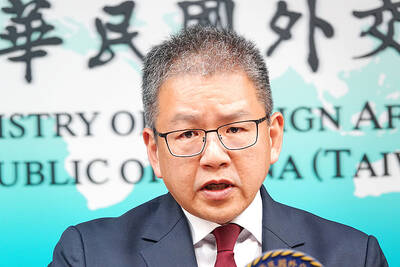
Taiwan is still in the process of assessing the possibility of recruiting workers from Eswatini, the Ministry of Foreign Affairs said yesterday, adding that its goal is to help Eswatini upgrade its vocational training centers. If there are plans to recruit workers from Eswatini, safeguarding national security, protecting public health and ensuring the employment rights of Taiwanese would be prerequisites, Department of West Asian and African Affairs Director-General Yen Chia-liang (顏嘉良) told a news conference. Key considerations would also include filling labor shortages in specific industries, and fostering bilateral professional and technical exchanges, he said. Yen was asked about the progress of labor

A US uncrewed surface vessel (USV) encountered multiple Chinese warships during an autonomous transit of the Taiwan Strait, US defense company Seasats said in a statement on Wednesday. Seasats announced that a Lightfish USV had completed the first autonomous transit of the Taiwan Strait. Over five days, the USV traversed the entire length of the Strait while constantly monitoring surface vessel traffic, the company said. The Lightfish encountered multiple Chinese warships, one of which was a Chinese People’s Liberation Army Navy (PLAN) Type 056 corvette, it said. The Chinese vessels were operating “well within Taiwan’s exclusive economic zone without transmitting their identity via the
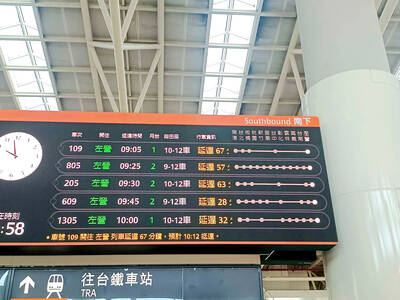
The nation’s usually punctual high-speed rail system yesterday was hit by major disruptions after all scheduled services were canceled and replaced with three hourly trains offering only non-reserved seating, affecting more than 200,000 passengers. Preliminary findings indicate the disruption was caused by a faulty power module in a track switch control cabinet, Taiwan High-Speed Rail Corp (THSRC) said, adding that as a full system inspection could only be conducted after operations end for the day, a decision on whether normal service would resume today would be announced before the first train departs. During a routine inspection early yesterday, a switch signal abnormality


 RSS
RSS