


Taiwanese human rights advocate Lee Ming-che (李明哲), who has been detained in China since March, is to stand trial soon, his wife, Lee Ching-yu (李凈瑜), said yesterday, adding that she is traveling to China to see him.
“I must see my husband, and I cannot wait to see him,” Lee Ching-yu said.
She said she would apply for a new Taiwanese compatriot permit today after receiving a call yesterday from a man named Zhang Zhongwei (張忠偉), who said he was the court-appointed lawyer for her husband.
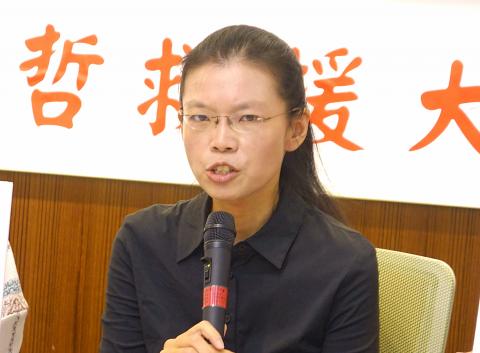
Photo: Wang Yi-sung, Taipei Times
Lee Ming-che has been held incommunicado since entering China from Macau on March 19 on what his wife says was a mission to share Taiwan’s experience with democratization.
Beijing arbitrarily canceled Lee Ching-yu’s Taiwanese compatriot permit in April, forcing her to cancel a trip to China with Straits Exchange Foundation (SEF) officials, to try to see her husband.
Lee Ching-yu said that Zhang had told her to begin applying for travel documents because her husband is to stand trial in the Intermediate People’s Court in Yueyang City, Hunan Province.
Zhang did not say when the trial would start, but promised to notify her when a date has been set.
She said she has not decided whether to ask SEF officials to accompany her again, but called on Taiwanese lawyers to join her.
Taiwan Association for Human Rights secretary-general Chiu Ee-ling (邱伊翎) said that the Mainland Affairs Council yesterday called to offer its assistance.
Beijing’s refusal to abide by the terms of the Cross-Strait Joint Crime-Fighting and Judicial Mutual Assistance Agreement (海峽兩岸共同打擊犯罪及司法互助協議) and directly contact Taipei over the case has been a major point of contention.
Lee Ching-yu said that she did not ask Zhang for proof of identity, but added that he appeared to be a Chinese Communist Party branch secretary and had represented Yueyang at the 7th National People’s Congress.
It is important that Lee Ching-yu be accompanied by Taiwanese lawyers, because there is a danger that Chinese authorities could use her to pressure her husband to confess, Judicial Reform Foundation executive secretary Hsiao Yi-ming (蕭逸民) said.
“If he had confessed, there should be a public video at this point,” Hsiao said.
“Lee Ming-che has already disappeared — we do not want Lee Ching-yu to be next,” he said.
Chinese human rights lawyer Jiang Xianyong (江天勇), whose sentencing was broadcast last month over social media, appears to have confessed after his father disappeared, he said.
The Judicial Reform Foundation will send representatives to accompany Lee Ching-yu, he said, calling on the Chinese government to allow them to be present for the trial, that all evidence against Lee Ming-che be presented openly and for him to have the opportunity to rebut accusations.
Lee Ming-che may be the first Taiwanese to stand trial on charges of attempting to overthrow the Chinese government, which carries a potential life sentence, Hsiao said, adding that the Chinese government’s failure to contact his immediate family members after his arrest violated China’s own laws.
“China’s intention is clearly aimed at disrupting our plans to take the case to the UN,” Chiu said, referring to Lee Ching-yu’s scheduled appearance next week before the UN Human Rights Council’s Working Group on Enforced or Involuntary Disappearances.
Lee Ching-yu said that she was unsure if she would be able to attend the UN hearing.
Chiu said her group and Covent Watch would send representatives to the hearing to assist in presenting evidence if they are barred from using their Republic of China (ROC) passports.
The Presidential Office said it was the government’s duty to protect Lee Ming-che’s safety and ensure his return under the condition that national dignity is maintained.
Lee Ming-che is an ROC citizen and it is the government’s duty to protect him, Presidential Office spokesman Sidney Lin (林鶴明) said.
The Mainland Affairs Council will provide necessary assistance, Lin said.

PROVOCATIVE: Chinese Deputy Ambassador to the UN Sun Lei accused Japan of sending military vessels to deliberately provoke tensions in the Taiwan Strait China denounced remarks by Japan and the EU about the South China Sea at a UN Security Council meeting on Monday, and accused Tokyo of provocative behavior in the Taiwan Strait and planning military expansion. Ayano Kunimitsu, a Japanese vice foreign minister, told the Council meeting on maritime security that Tokyo was seriously concerned about the situation in the East China and South China seas, and reiterated Japan’s opposition to any attempt to change the “status quo” by force, and obstruction of freedom of navigation and overflight. Stavros Lambrinidis, head of the EU delegation to the UN, also highlighted South China Sea
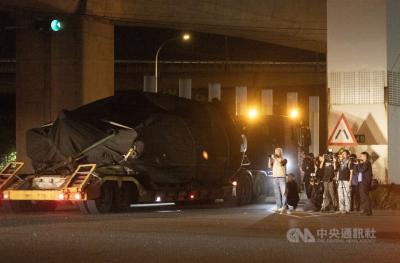
The final batch of 28 M1A2T Abrams tanks purchased from the US arrived at Taipei Port last night and were transported to the Armor Training Command in Hsinchu County’s Hukou Township (湖口), completing the military’s multi-year procurement of 108 of the tanks. Starting at 12:10am today, reporters observed more than a dozen civilian flatbed trailers departing from Taipei Port, each carrying an M1A2T tank covered with black waterproof tarps. Escorted by military vehicles, the convoy traveled via the West Coast Expressway to the Armor Training Command, with police implementing traffic control. The army operates about 1,000 tanks, including CM-11 Brave Tiger

Taiwan Semiconductor Manufacturing Co (TSMC, 台積電), the world’s largest contract chipmaker, said it expects its 2-nanometer (2nm) chip capacity to grow at a compound annual rate of 70 percent from this year to 2028. The projection comes as five fabs begin volume production of 2-nanometer chips this year — two in Hsinchu and three in Kaohsiung — TSMC senior vice president and deputy cochief operating officer Cliff Hou (侯永清) said at the company’s annual technology symposium in Silicon Valley, California, last week. Output in the first year of 2-nanometer production, which began in the fourth quarter of last year, is expected to

Taiwan’s drone exports surged past US$100 million in the first quarter, exceeding last year’s full-year total, with the Czech Republic emerging as the largest buyer, the Ministry of Economic Affairs said. Exports of complete drones reached US$115.85 million in the period, about 1.2 times the total recorded for all of last year, the ministry said in a report. Exports to the Czech Republic accounted for about US$100 million, far outpacing other markets. Poland, last year’s top destination, recorded about US$11.75 million in the first quarter. Taiwan’s drone exports have expanded rapidly in the past few years, with last year’s total


 RSS
RSS