


The nation should be referred to as “Taiwan,” not “Chinese Taipei,” at international sporting events, a range of Taiwanese independence groups said yesterday, unfurling huge banners outside the Democratic Progressive Party (DPP) headquarters in Taipei in a bid to raise international awareness.
Hundreds of people affiliated with the Taiwan Radical Wings party, the People Rule Foundation, the World United Formosans for Independence and other groups opened massive banners reading “Taiwan is not Chinese Taipei” and “Let Taiwan be Taiwan” in English, while shouting “Go Team Taiwan” in English, Mandarin and Hoklo (commonly known as Taiwanese).
“Last month, we realized that the Universiade was coming up, and Taiwan was going to be faced with using ‘Chinese Taipei’ again, which is extremely sad, because ‘Team Taiwan’ is what we really want to be cheering,” said Taiwan Radical Wings deputy head Joyce Lin (林春妙), who served as the spokesperson for yesterday’s Taiwan Name Rectification Action Working Group.
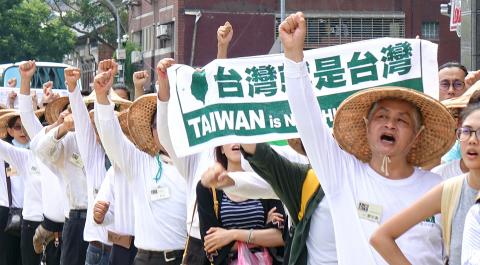
Photo: Liu Hsin-de, Taipei Times
Videos of the unfurling are to be published online in English, French, Spanish, Norwegian and other languages “to show the world that Taiwan does not want to use ‘Chinese Taipei,’” she said.
The Summer Universiade is scheduled to begin on Saturday, but has drawn controversy domestically over requirements that the nation be officially referred to as “Chinese Taipei” following a 1979 International Olympic Committee resolution allowing for the nation’s continued participation in international sporting events.
Additional controversy over the name erupted yesterday after the English version of an official Universiade brochure was found to have used the name to replace geographical references to Taiwan before being corrected by the Taipei City Government.
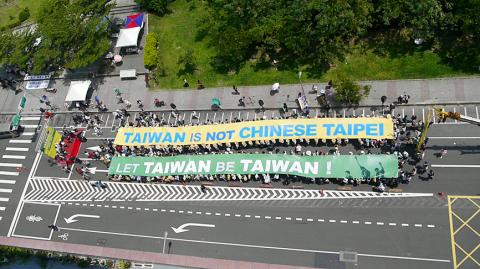
Photo courtesy of Taiwan Radical Wings
“The incident was extremely humiliating for Taiwan, because the city government should not have had to wait until being criticized to change this, but it definitely helps people see that there are forces trying to keep us from using ‘Taiwan,’ which underscores the importance of today’s action,” Lin said.
The group is to distribute a Taiwanese flag popular among independence groups outside of competition venues and collect signatures for a petition to rectify the name for the 2020 Tokyo Olympics, she said.
They had chosen not to protest outside event venues because they do not want to create a disturbance, instead organizing yesterday’s event as an alternative, said Alliance for Safeguarding Taiwan member Jimmy Chen (陳政德), a key organizer in bringing the groups together.
“Taiwanese have spent NT$20 billion [US$658.8 million] to invite the world’s premier college athletes and international media to come to Taiwan. We hope that they feel at home and leave with a great impression, but what is tragic and what we are worried about is that under the rules, they might not even know their host’s real name,” he said.
While Lin and other key volunteers were all members of Taiwan Radical Wings, which aligned with the Taiwan Solidarity Union to compete against the DPP in the last legislative election, they were careful to define the event as an “action” rather than a “protest” directed at the DPP, despite its location.
“We want to speak to all Taiwanese and the entire world, not just the DPP,” Lin said, adding that the DPP had opened the upper floors of its headquarters to allow people to take overhead pictures.
Participant Lu Mei-ju (盧美如) said she came because she hoped Taiwanese could “hold their heads high” and walk out from under Chinese restrictions while participating in international society.
However, she also expressed regret over the lack of participation by young people in yesterday’s event.
“I did not think that the majority of participants would be older,” she said. “Taiwan’s future is in the hands of young people, but it seems that old people are helping them defend and preserve their future.”
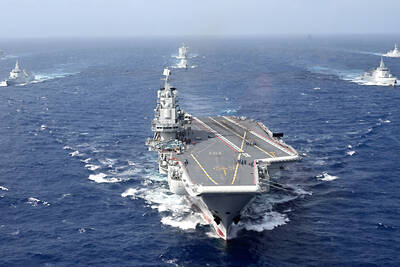
PROVOCATIVE: Chinese Deputy Ambassador to the UN Sun Lei accused Japan of sending military vessels to deliberately provoke tensions in the Taiwan Strait China denounced remarks by Japan and the EU about the South China Sea at a UN Security Council meeting on Monday, and accused Tokyo of provocative behavior in the Taiwan Strait and planning military expansion. Ayano Kunimitsu, a Japanese vice foreign minister, told the Council meeting on maritime security that Tokyo was seriously concerned about the situation in the East China and South China seas, and reiterated Japan’s opposition to any attempt to change the “status quo” by force, and obstruction of freedom of navigation and overflight. Stavros Lambrinidis, head of the EU delegation to the UN, also highlighted South China Sea
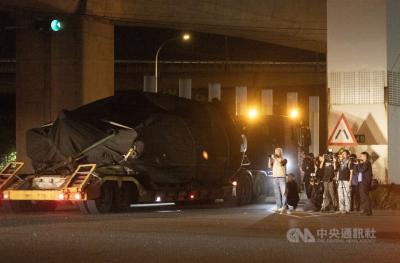
The final batch of 28 M1A2T Abrams tanks purchased from the US arrived at Taipei Port last night and were transported to the Armor Training Command in Hsinchu County’s Hukou Township (湖口), completing the military’s multi-year procurement of 108 of the tanks. Starting at 12:10am today, reporters observed more than a dozen civilian flatbed trailers departing from Taipei Port, each carrying an M1A2T tank covered with black waterproof tarps. Escorted by military vehicles, the convoy traveled via the West Coast Expressway to the Armor Training Command, with police implementing traffic control. The army operates about 1,000 tanks, including CM-11 Brave Tiger
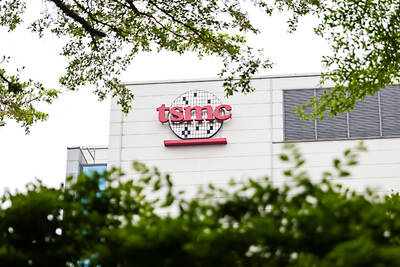
Taiwan Semiconductor Manufacturing Co (TSMC, 台積電), the world’s largest contract chipmaker, said it expects its 2-nanometer (2nm) chip capacity to grow at a compound annual rate of 70 percent from this year to 2028. The projection comes as five fabs begin volume production of 2-nanometer chips this year — two in Hsinchu and three in Kaohsiung — TSMC senior vice president and deputy cochief operating officer Cliff Hou (侯永清) said at the company’s annual technology symposium in Silicon Valley, California, last week. Output in the first year of 2-nanometer production, which began in the fourth quarter of last year, is expected to
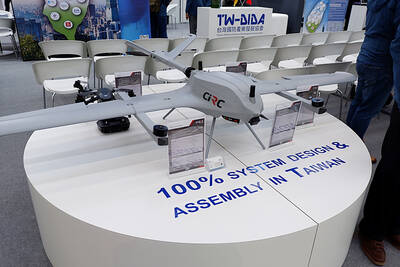
Taiwan’s drone exports surged past US$100 million in the first quarter, exceeding last year’s full-year total, with the Czech Republic emerging as the largest buyer, the Ministry of Economic Affairs said. Exports of complete drones reached US$115.85 million in the period, about 1.2 times the total recorded for all of last year, the ministry said in a report. Exports to the Czech Republic accounted for about US$100 million, far outpacing other markets. Poland, last year’s top destination, recorded about US$11.75 million in the first quarter. Taiwan’s drone exports have expanded rapidly in the past few years, with last year’s total


 RSS
RSS